


Shopping Cart
Remove All Your shopping cart is currently empty

Synonyms: ML-120B dihydrochloride, ML120B dihydrochloride
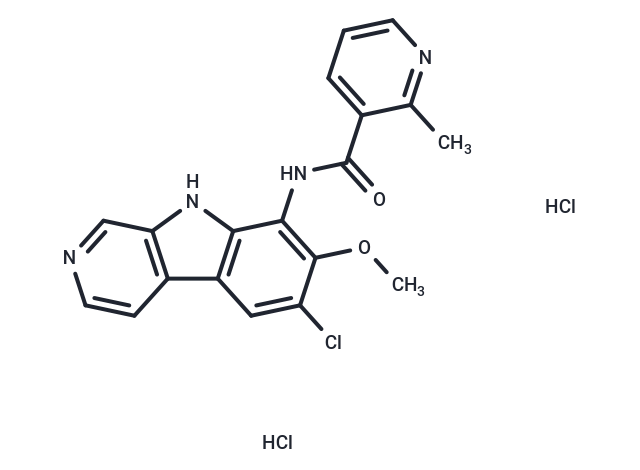
| Pack Size | Price | USA Stock | Global Stock | Quantity |
|---|---|---|---|---|
| 2 mg | $155 | 5 days | 5 days |
| Description | ML 120B dihydrochloride is an effective ATP competitive IKKβ inhibitor with oral activity, and its IC₅₀ is 60 nM. ML 120B dihydrochloride can inhibit the growth of multiple myeloma cells and can be used in the related research of rheumatoid arthritis. |
| Targets & IC50 | IKKβ:60 nM |
| In vitro | In RPMI 8226 and INA6 cells, ML 120B dihydrochloride (0–20 μM; 90 minutes) inhibits TNF-α-induced phosphorylation and degradation of IκB and blocks TNF-α-induced phosphorylation of p65 NF-κB [1]. ML 120B dihydrochloride inhibits the proliferation of various multiple myeloma cell lines (MM.1S, MM.1R, RPMI 8226, RPMI-LR5, RPMI-Dox40, U266, and INA6 cells) [1]. ML 120B dihydrochloride inhibits LPS-induced NF-κB activation in RAW267.4 cells. For cells transfected with NF-κB2-luc2, IL8-luc2, or TNF-AIP3-luc2 reporter genes, the IC50 values of ML 120B dihydrochloride were 1.4 μM, 14.8 μM, and 27.3 μM, respectively [3]. |
| In vivo | ML 120B dihydrochloride, administered orally at a dosage of 50 mg/kg twice daily for three weeks, has been shown to significantly reduce shuIL-6R, a key marker of tumor growth, in two separate studies, thereby indicating its efficacy in suppressing tumor progression. Furthermore, this treatment has demonstrated a trend towards prolonged survival in treated animals when compared to controls, suggesting its potential therapeutic benefit in oncological contexts[1][3]. Implemented in an animal model involving SCID mice implanted with human fetal bone chips and subsequently inoculated with INA6 cells, ML 120B dihydrochloride inhibited human multiple myeloma cell growth in vivo. Additionally, in a study with two-month-old female Lewis rats administered varying dosages (30 mg/kg, 10 mg/kg, 3 mg/kg, or 1 mg/kg) of ML 120B dihydrochloride orally twice daily for three weeks, it was found to protect against bone and cartilage destruction in a rat model of disease, further evidencing its potential for broader applications in disease treatment and management[2]. |
| Synonyms | ML-120B dihydrochloride, ML120B dihydrochloride |
| Molecular Weight | 439.72 |
| Formula | C19H17Cl3N4O2 |
| Cas No. | 1782573-78-7 |
| Smiles | O=C(C1=CC=CN=C1C)NC2=C(C(Cl)=CC3=C2NC4=C3C=CN=C4)OC.Cl.Cl |
| Storage | Keep away from moisture Powder: -20°C for 3 years | In solvent: -80°C for 1 year Shipping with blue ice/Shipping at ambient temperature. | |||||||||||||||||||||||||
| Solubility Information | DMSO: 16.67 mg/mL (37.91 mM), when pH is adjusted to 8 with NaOH.Sonication and heating are recommended. | |||||||||||||||||||||||||
Solution Preparation Table | ||||||||||||||||||||||||||
DMSO
Note : The dilution table applies only to solid products. For liquid products, please calculate the stock solution based on the stated concentration and/or density. | ||||||||||||||||||||||||||
 For example, if the intended dosage is 10 mg/kg for animals weighing 20 g , with a dosing volume of 100 μL per animal, and a total of 10 animals are to be administered, using a formulation of
  10% DMSO+ 40% PEG300+ 5% Tween 80+ 45% Saline/PBS/ddH2O , the resulting working solution concentration would be 2 mg/mL.
Dissolve 2 mg of the compound in 100 μL DMSO to obtain a stock solution at a concentration of 20 mg/mL . If the required concentration exceeds the compound's known solubility, please contact us for technical support before proceeding.
1) Add 100 μL of the DMSO stock solution to 400 µL PEG300 and mix thoroughly until the solution becomes clear.
2) Add 50 µL Tween 80 and mix well until fully clarified.
3) Add 450 µL Saline,PBS or ddH2O and mix thoroughly until a homogeneous solution is obtained.
| Size | Quantity | Unit Price | Amount | Operation |
|---|
 Feedback
 Hello! How can I help you today?
Copyright © 2015-2026 TargetMol Chemicals Inc. All Rights Reserved.
