


Shopping Cart
Remove All Your shopping cart is currently empty

Synonyms: Liraglutide sodium salt (204656-20-2 Free base)
| Pack Size | Price | USA Stock | Global Stock | Quantity |
|---|---|---|---|---|
| 1 mg | $120 | - | In Stock | |
| 5 mg | $332 | - | In Stock | |
| 10 mg | $481 | - | In Stock |
| Description | Liraglutide sodium salt (204656-20-2, free base) is a long-acting glucagon-like peptide-1 (GLP-1) receptor agonist that mimics the action of endogenous incretins, promoting glucose-dependent insulin secretion, inhibiting glucagon release, and delaying gastric emptying. Liraglutide sodium salt (204656-20-2, free base) is commonly used in research related to type 2 diabetes, obesity, and metabolic disorders. |
| Targets & IC50 | HEK293 cells:65.7 pM (EC50) |
| In vitro | Method: Mouse Leydig cell line (BLTK1) was treated with Liraglutide sodium salt (25, 50, 100 nM) for 48 hours. Intracellular ROS levels were detected using the CM-H2DCFDA fluorescent probe, and mitochondrial membrane potential was measured using the JC-1 fluorescent probe. Result: All concentrations of Liraglutide sodium salt (25, 50, 100 nM) significantly reduced ROS production; however, none of the concentrations had a significant effect on mitochondrial membrane potential [1]. |
| In vivo | Method: A type 2 diabetic SD rat model was induced by a high-fat and high-sugar diet combined with low-dose streptozotocin. After treatment with Liraglutide sodium salt in the treatment group, the gastrocnemius muscle wet weight, length, histological morphology (HE staining), muscle fiber type distribution (immunofluorescence staining), and the expression levels of senescence-related proteins and YAP/TAZ pathway components (Western blotting) were compared among the control group, diabetes group, and Liraglutide sodium salt treatment group. Result: Liraglutide sodium salt significantly ameliorated the reduction in muscle mass, length, and cross-sectional area, as well as myofiber structural disorganization in diabetic rats [2]. Method: C57BL/6J mice were rendered obese by a high-fat diet and then subcutaneously injected with Liraglutide sodium salt (0.1 mg/kg, twice daily) or normal saline for 8 consecutive weeks. Body weight, fasting blood glucose, and HOMA-IR index were measured. Hepatic mRNA and protein expression of AC3 and GLP-1R were detected by qPCR and Western blotting, and serum AC3 levels were measured by ELISA. Result: Liraglutide sodium salt significantly reduced body weight in both obese and normal control mice, with a more pronounced decrease in obese mice (average reduction of 21.8%). Liraglutide sodium salt significantly upregulated the mRNA and protein expression of hepatic AC3 and GLP-1R in obese mice and increased serum AC3 levels [3]. |
| Synonyms | Liraglutide sodium salt (204656-20-2 Free base) |
| Molecular Weight | 3773.18 |
| Formula | C172H264N43NaO51 |
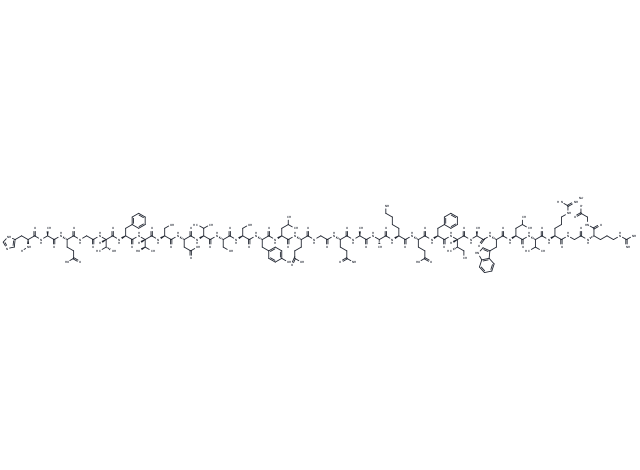
| Smiles | [H]N[C@@H](CC1=CN=CN1)C(N[C@@H](C)C(N[C@H](C(NCC(N[C@]([C@H](O)C)([H])C(N[C@@H](CC2=CC=CC=C2)C(N[C@]([C@H](O)C)([H])C(N[C@H](C(N[C@@H](CC(O)=O)C(N[C@H](C(N[C@H](C(N[C@H](C(N[C@@H](CC3=CC=C(C=C3)O)C(N[C@H](C(N[C@H](C(NCC(N[C@H](C(N[C@@H](C)C(N[C@@H](C)C(N[C@H](C(N[C@H](C(N[C@@H](CC4=CC=CC=C4)C(N[C@]([C@@H](C)CC)([H])C(N[C@@H](C)C(N[C@@H](CC5=CNC6=C5C=CC=C6)C(N[C@H](C(N[C@H](C(N[C@H](C(NCC(N[C@H](C(NCC([O-])=O)=O)CCCNC(N)=N)=O)=O)CCCNC(N)=N)=O)C(C)C)=O)CC(C)C)=O)=O)=O)=O)=O)CCC(O)=O)=O)CCCCN)=O)=O)=O)CCC(N)=O)=O)=O)CCC(O)=O)=O)CC(C)C)=O)=O)CO)=O)CO)=O)C(C)C)=O)=O)CO)=O)=O)=O)=O)=O)CCC(O)=O)=O)=O.[Na+] |
| Relative Density. | no data available |
| Sequence | His-Ala-Glu-Gly-Thr-Phe-Thr-Ser-Asp-Val-Ser-Ser-Tyr-Leu-Glu-Gly-Gln-Ala-Ala-{Lys-N6-[N-(1-oxohexadecyl)-L-g-glutamyl]}-Glu-Phe-Ile-Ala-Trp-Leu-Val-Arg-Gly-Arg-Gly |
| Sequence Short | HAEGTFTSDVSSYLEGQAAKEFIAWLVRGRG |
| Storage | Keep away from moisture, Powder: -20°C for 3 years | In solvent: -80°C for 1 year Shipping with blue ice/Shipping at ambient temperature. |
 For example, if the intended dosage is 10 mg/kg for animals weighing 20 g , with a dosing volume of 100 μL per animal, and a total of 10 animals are to be administered, using a formulation of
  10% DMSO+ 40% PEG300+ 5% Tween 80+ 45% Saline/PBS/ddH2O , the resulting working solution concentration would be 2 mg/mL.
Dissolve 2 mg of the compound in 100 μL DMSO to obtain a stock solution at a concentration of 20 mg/mL . If the required concentration exceeds the compound's known solubility, please contact us for technical support before proceeding.
1) Add 100 μL of the DMSO stock solution to 400 µL PEG300 and mix thoroughly until the solution becomes clear.
2) Add 50 µL Tween 80 and mix well until fully clarified.
3) Add 450 µL Saline,PBS or ddH2O and mix thoroughly until a homogeneous solution is obtained.
| Size | Quantity | Unit Price | Amount | Operation |
|---|
 Feedback
 Hello! How can I help you today?
Copyright © 2015-2026 TargetMol Chemicals Inc. All Rights Reserved.
