


Shopping Cart
Remove All Your shopping cart is currently empty

Synonyms:
| Pack Size | Price | USA Stock | Global Stock | Quantity |
|---|---|---|---|---|
| 10 mg | Inquiry | 10-14 weeks | 10-14 weeks | |
| 50 mg | Inquiry | 10-14 weeks | 10-14 weeks |
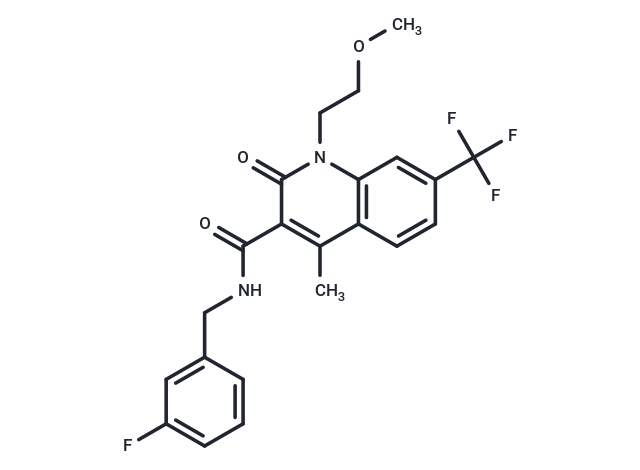
| Description | Kv7.2/Kv7.3 activator-3 (GRT-X) is an orally active activator of Kv7.2/Kv7.3 channels and the TSPO. It activates Kv7.2/Kv7.3, Kv7.4, and Kv7.5 with EC50 values of 0.37, 2.06, and 0.75 μM, respectively, and binds to TSPO with Ki values of 0.07 μM (rat membrane) and 4.60 μM (human U-118 MG cells). This compound protects motor neurons from degeneration caused by exposure to astrocyte-conditioned media from mice and humans with amyotrophic lateral sclerosis/frontotemporal dementia. Additionally, Kv7.2/Kv7.3 activator-3 stimulates axonal growth in dorsal root ganglia through TSPO and Kv7.2/3 activation and exhibits anticonvulsant effects in epilepsy models. It alleviates hyperalgesia in diabetic neuropathy patients, enhances the survival and regeneration of neurons after cervical neuropathy in rats, and accelerates the recovery of normal function in sensory and motor neurons. |
| Targets & IC50 | Kv7.2 channel:0.37 μM (EC50) |
| In vitro | Kv7.2/Kv7.3 activator-3, when used at concentrations of 6.25-25 μM over 20 days, reduces motor neuron (MN) death in spinal cord-thalamic-epithelial cells (SCOC). At 0.1-10 μM for 4 days, it maintains MN survival in primary rat spinal cultures (VSCN) up to 2.5 μM. A 6.25-25 μM concentration for 4 days sustains MN vitality in SCOCs treated with human SOD1 G93A-ACM/SOD1 D90A-ACM/TDP43 A90V-ACM. Additionally, at 1-2.5 μM for 4 days, it rescues MN death and decreases DCF counts in VSCNs treated with the same agents. When applied at 10 μM for 4 days, it enhances neurite network length and density and significantly increases AUC in embryonic C57BL6/J DRG cultures. Over 8 days, it maintains positive impacts on axonal growth and increases the AUC of E13.5 DRG explants. It also induces gene expression increases related to myelination, Schwann cells, neuron development, differentiation, and axonal structure. In embryonic TSPO-KO DRG explants, the compound increases gene expression related to myelination and neuron development without affecting neurite outgrowth. In CHO-K1 cells, it activates neuronal hKv7.2/3, hKv7.4, and hKv7.5 channels more efficiently than retigabine. At 10 μM, it induces strong hyperpolarization of resting membrane potentials in cultured rat DRG neurons (EC50 = 0.201 μM, maximum hyperpolarization: 13.2 mV). In TSPO binding assays, it binds with high affinity to rat heart membranes and moderate affinity to human U-118 MG glioblastoma cells, while increasing pregnenolone synthesis in cultured rat C6 glioma cells. |
| In vivo | Kv7.2/Kv7.3 activator-3, administered orally as a single dose, demonstrates various effects across multiple rodent models. At a dosage of 10 mg/kg, it enhances neurosteroid and steroid levels in the brains of SD rats. In male Wistar rats, doses ranging from 0-10 mg/kg prevent tonic seizures in the maximal electroshock seizure (MES) model and increase seizure thresholds in the electroshock seizure (ECS) model when administered at 0-3 mg/kg. In the PTZ-induced seizure model for male Wistar rats, doses between 0-100 mg/kg extend the latency of clonic seizures and reduce tonic seizure incidence. It also decreases the incidence of tonic convulsions in PTZ-induced SD rats with similar dosing. In male Rj:DBA/2 mice, a dose range of 0-10 mg/kg reduces the frequency of wild running and clonic seizures, prevents tonic seizures, and reduces mortality. In male NMRI mice, 0-100 mg/kg doses prevent 6 Hz seizures. Additionally, doses between 0.316-10 mg/kg alleviate allodynia in Streptozotocin-induced chronic neuropathic pain (CNP) in SD rats, and doses of 5-10 mg/kg promote neuronal survival and regeneration, facilitating recovery of sensory and motor neuron functions following severe compression injury in cervical spine models in SD rats. |
| Molecular Weight | 436.40 |
| Formula | C22H20F4N2O3 |
| Cas No. | 1361107-81-4 |
| Smiles | O=C(NCC=1C=CC=C(F)C1)C=2C(=O)N(C=3C=C(C=CC3C2C)C(F)(F)F)CCOC |
| Storage | Powder: -20°C for 3 years | In solvent: -80°C for 1 year Shipping with blue ice/Shipping at ambient temperature. |
 For example, if the intended dosage is 10 mg/kg for animals weighing 20 g , with a dosing volume of 100 μL per animal, and a total of 10 animals are to be administered, using a formulation of
  10% DMSO+ 40% PEG300+ 5% Tween 80+ 45% Saline/PBS/ddH2O , the resulting working solution concentration would be 2 mg/mL.
Dissolve 2 mg of the compound in 100 μL DMSO to obtain a stock solution at a concentration of 20 mg/mL . If the required concentration exceeds the compound's known solubility, please contact us for technical support before proceeding.
1) Add 100 μL of the DMSO stock solution to 400 µL PEG300 and mix thoroughly until the solution becomes clear.
2) Add 50 µL Tween 80 and mix well until fully clarified.
3) Add 450 µL Saline,PBS or ddH2O and mix thoroughly until a homogeneous solution is obtained.
| Size | Quantity | Unit Price | Amount | Operation |
|---|
 Feedback
 Hello! How can I help you today?
Copyright © 2015-2026 TargetMol Chemicals Inc. All Rights Reserved.
