


Shopping Cart
Remove All Your shopping cart is currently empty

Synonyms:
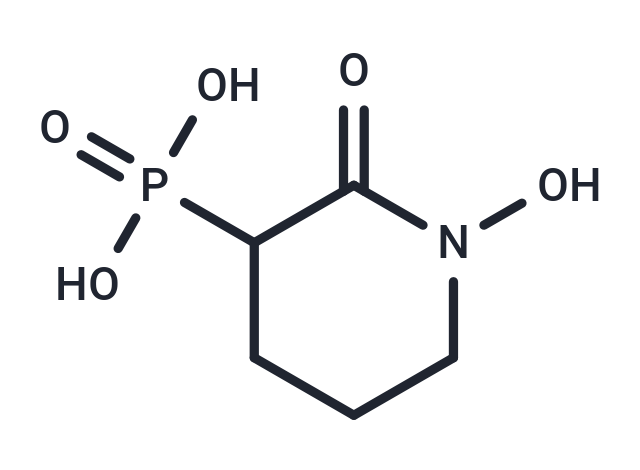
| Pack Size | Price | USA Stock | Global Stock | Quantity |
|---|---|---|---|---|
| 1 mg | $215 | - | In Stock |
| Description | Hex is an enolase inhibitor and antimalarial agent with Ki values of 74.4 nM and 269.4 nM against ENO2 and ENO1, respectively; its IC50 values against NfENO and TbENO are 0.14 μM and 2.1 μM, respectively. Hex exhibits antimalarial activity against Plasmodium falciparum 3D7, Naegleria fowleri trophozoites, and Plasmodium berghei ANKA strain, and also shows certain antitumor effects against intracranial tumors. |
| Targets & IC50 | ENO1:269.4 nM (Ki), ENO2:74.4 nM (Ki) |
| In vitro | Hex (1-week treatment) is toxic to D423 (ENO1) cells, with an IC50 of approximately 1.3 μM [1]. Hex is a potent NfENO inhibitor with an IC50 of 0.14 μM [2]. Hex (48-hour treatment) significantly inhibits the proliferation of Naegleria fowleri trophozoites, with an EC50 of 0.21 μM [2]. Hex inhibits TbENO with an IC50 of 2.1 μM [3]. Hex shows weak antimalarial activity against Plasmodium falciparum strain 3D7, with an EC50 > 15 μM [6]. |
| In vivo | Hex (150 mg/kg, intravenous and intraperitoneal injection, once daily for 1 week) significantly inhibits tumor growth in a mouse intracranial tumor model, with complete regression of some tumors and no recurrence after long-term treatment [1]. Hex (3 mg/kg, intranasal instillation, once daily for 10 days) prolongs the survival of rats infected with Naegleria fowleri, but cannot achieve complete cure [2]. Hex (100 mg/kg, intraperitoneal injection, once daily for 5 days) reduces the overall parasite burden, improves clinical scores, and significantly increases the survival rate of mice infected with Plasmodium berghei ANKA strain [7]. |
| Molecular Weight | 195.11 |
| Formula | C5H10NO5P |
| Cas No. | 2004714-32-1 |
| Smiles | O=C1N(O)CCCC1P(=O)(O)O |
| Storage | Keep away from moisture Powder: -20°C for 3 years | In solvent: -80°C for 1 year Shipping with blue ice/Shipping at ambient temperature. | |||||||||||||||||||||||||||||||||||
| Solubility Information | DMSO: 112 mg/mL (574.04 mM), Sonication is recommended. | |||||||||||||||||||||||||||||||||||
Solution Preparation Table | ||||||||||||||||||||||||||||||||||||
DMSO
Note : The dilution table applies only to solid products. For liquid products, please calculate the stock solution based on the stated concentration and/or density. | ||||||||||||||||||||||||||||||||||||
 For example, if the intended dosage is 10 mg/kg for animals weighing 20 g , with a dosing volume of 100 μL per animal, and a total of 10 animals are to be administered, using a formulation of
  10% DMSO+ 40% PEG300+ 5% Tween 80+ 45% Saline/PBS/ddH2O , the resulting working solution concentration would be 2 mg/mL.
Dissolve 2 mg of the compound in 100 μL DMSO to obtain a stock solution at a concentration of 20 mg/mL . If the required concentration exceeds the compound's known solubility, please contact us for technical support before proceeding.
1) Add 100 μL of the DMSO stock solution to 400 µL PEG300 and mix thoroughly until the solution becomes clear.
2) Add 50 µL Tween 80 and mix well until fully clarified.
3) Add 450 µL Saline,PBS or ddH2O and mix thoroughly until a homogeneous solution is obtained.
| Size | Quantity | Unit Price | Amount | Operation |
|---|
 Feedback
 Hello! How can I help you today?
Copyright © 2015-2026 TargetMol Chemicals Inc. All Rights Reserved.
