


Shopping Cart
Remove All Your shopping cart is currently empty

Synonyms:
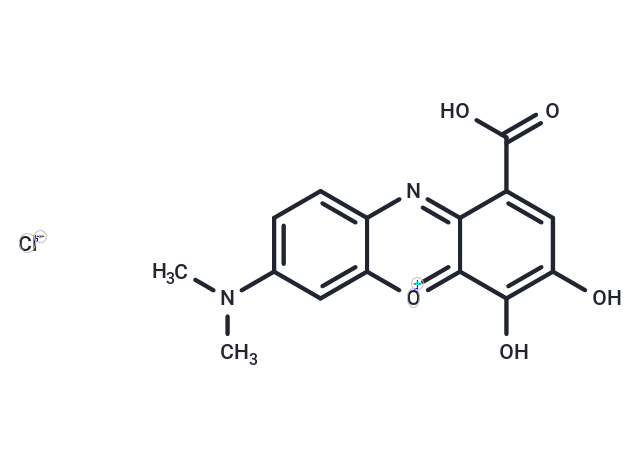
| Pack Size | Price | USA Stock | Global Stock | Quantity |
|---|---|---|---|---|
| 5 mg | $30 | 7-10 days | 7-10 days | |
| 10 mg | $49 | 7-10 days | 7-10 days |
| Description | Gallocyanine is a synthetic azine-based blue dye and a potent inhibitor of DKK1/LRP6 interaction (IC₅₀ = 6.38 μM). It selectively activates the Wnt signaling pathway by blocking the binding of DKK1 to its receptor LRP6, thereby inhibiting the antagonistic effects of this pathway and inducing intracellular β-catenin accumulation. Gallocyanine exhibits antitumor metastasis, anti-inflammatory, and antifibrotic activities and can be used in research related to tumors, inflammatory injuries, and neurodegenerative diseases. Gallocyanine is a histological stain that specifically labels nucleic acids and cell nuclei; it can also serve as a biochemical fluorescent probe for the detection of superoxide anion radicals. |
| In vitro | Methods: MDA-MB-231 and 4T1 cells were co-treated with BCSC-CM and gallocyanine at various concentrations (0–20 μM) for 48 hours. Cell viability was assessed, levels of reactive oxygen species (ROS) were measured using BODIPY-C11 staining, glutathione (GSH) levels were determined, and SLC7A11 protein expression levels were analyzed by Western blot.
Results: Gallocyanine promoted the proliferation of breast cancer cells MDA-MB-231 and 4T1, inhibited lipid peroxidation, and increased GSH and SLC7A11 levels. [1] Methods: Primary AEC2 cells (overexpressing RAB6) were treated with 5 μM Gallocyanine for 48 hours. Western blot analysis was performed to detect β-catenin, SOX2, and nuclear β-catenin, and cell proliferation and colony-forming efficiency (CFE) were assessed. Results: Gallocyanine treatment significantly increased β-catenin and SOX2 protein expression, elevated nuclear β-catenin levels, and promoted the proliferation and clonogenic formation of RAB6-overexpressing AEC2 cells.[2] |
| In vivo | Methods: To investigate the effect of Gallocyanine on lung metastasis following orthotopic transplantation, MDA-MB-231-luc cells were injected orthotopically into the mammary fat pad of BALB/c nude mice. Starting on the fourth day after tumor visibility, Gallocyanine (10 mg/kg) was administered intravenously every two days for four consecutive weeks.
Results: Gallocyanine significantly reduced the lung metastasis burden, significantly decreased the size of metastatic lesions, and significantly prolonged the survival of the mice. [1] Methods: To investigate the therapeutic effects of Gallocyanine on PM2.5-induced pulmonary fibrosis, C57BL/6J mice were administered PM2.5 via intratracheal instillation (100 mg/kg, once weekly for 4 weeks) concurrently with Gallocyanine via intratracheal instillation (1 mg/kg, once weekly for 4 weeks). Results: Gallocyanine treatment significantly reduced PM2.5-induced collagen deposition in lung tissue, decreased hydroxyproline content in lung tissue, lowered α-SMA mRNA and protein levels, and reduced IL-1β and TNF-α levels in bronchoalveolar lavage fluid.[2] |
| Molecular Weight | 336.73 |
| Formula | C15H13ClN2O5 |
| Cas No. | 1562-85-2 |
| Smiles | [Cl-].CN(C)c1ccc2nc3c(cc(O)c(O)c3[o+]c2c1)C(O)=O |
| Storage | Keep away from direct sunlight Powder: -20°C for 3 years | In solvent: -80°C for 1 year Shipping with blue ice/Shipping at ambient temperature. | |||||||||||||||||||||||||||||||||||
| Solubility Information | DMSO: 74 mg/mL (219.76 mM), Sonication is recommended. | |||||||||||||||||||||||||||||||||||
| In Vivo Formulation | 10% DMSO+40% PEG300+5% Tween-80+45% Saline: 1 mg/mL (2.97 mM), Sonication is recommended. Please add the solvents sequentially, clarifying the solution as much as possible before adding the next one. Dissolve by heating and/or sonication if necessary. Working solution is recommended to be prepared and used immediately. The formulation provided above is for reference purposes only. In vivo formulations may vary and should be modified based on specific experimental conditions. | |||||||||||||||||||||||||||||||||||
Solution Preparation Table | ||||||||||||||||||||||||||||||||||||
DMSO
Note : The dilution table applies only to solid products. For liquid products, please calculate the stock solution based on the stated concentration and/or density. | ||||||||||||||||||||||||||||||||||||
 For example, if the intended dosage is 10 mg/kg for animals weighing 20 g , with a dosing volume of 100 μL per animal, and a total of 10 animals are to be administered, using a formulation of
  10% DMSO+ 40% PEG300+ 5% Tween 80+ 45% Saline/PBS/ddH2O , the resulting working solution concentration would be 2 mg/mL.
Dissolve 2 mg of the compound in 100 μL DMSO to obtain a stock solution at a concentration of 20 mg/mL . If the required concentration exceeds the compound's known solubility, please contact us for technical support before proceeding.
1) Add 100 μL of the DMSO stock solution to 400 µL PEG300 and mix thoroughly until the solution becomes clear.
2) Add 50 µL Tween 80 and mix well until fully clarified.
3) Add 450 µL Saline,PBS or ddH2O and mix thoroughly until a homogeneous solution is obtained.
| Size | Quantity | Unit Price | Amount | Operation |
|---|
 Feedback
 Hello! How can I help you today?
Copyright © 2015-2026 TargetMol Chemicals Inc. All Rights Reserved.
