


Shopping Cart
Remove All Your shopping cart is currently empty

Synonyms:
| Pack Size | Price | USA Stock | Global Stock | Quantity |
|---|---|---|---|---|
| 25 mg | $1,520 | 6-8 weeks | 6-8 weeks | |
| 50 mg | $1,980 | 6-8 weeks | 6-8 weeks | |
| 100 mg | $2,500 | 6-8 weeks | 6-8 weeks |
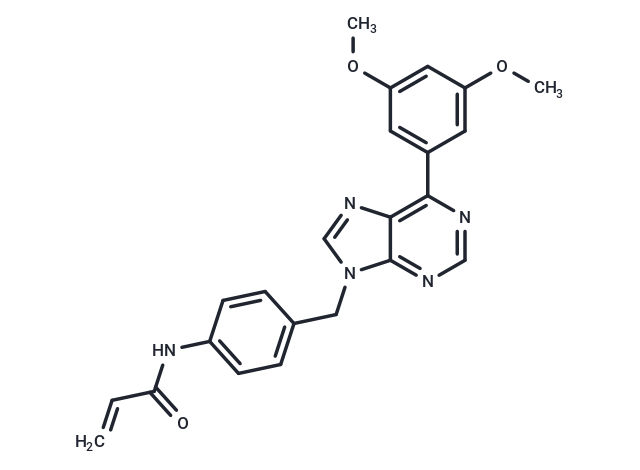
| Description | FGFR-IN-13 (compound III-30), an irreversible covalent inhibitor of the fibroblast growth factor receptor (FGFR), effectively modulates signaling through FGFR1 (IC 50 = 0.20 ± 0.02 nM) and FGFR4 (IC 50 = 0.40 ± 0.03 nM). It suppresses the expression of crucial proteins such as total-PARP and Bcl-2, while enhancing the expression of Cleaved-PARP and Bax in a dose-dependent manner. Notably, FGFR-IN-13 demonstrates considerable antitumor and oral activity [1]. |
| In vitro | FGFR-IN-13 forms a covalent, irreversible bond with FGFR protein at 10 μM over 9 hours, effectively suppressing p-FGFR protein expression in MDA-MB-231 cells, rivaling AZD4547 and TAS-120. At concentrations of 2.5, 5, and 10 μM for 24 hours, it induces apoptosis in a dose-dependent manner, outperforming AZD4547 (45.4% vs. 37.3% at 5 μM), suggesting a similar mechanism yet demonstrating greater sensitivity in MDA-MB-231 cells. When used at 1.25, 2.5, and 5 μM for 12 hours, FGFR-IN-13 effectively inhibits cell migration without significant toxicity, also in a dose-dependent fashion. Furthermore, treatment at 2.5, 5, and 10 μM over 12 hours leads to apoptosis through excess ROS production and MMP reduction. A Western blot analysis on MDA-MB-231 cells showed that a 10 μM concentration inhibits FGFR protein autophosphorylation, with suppression of p-FGFR protein expression persisting 8 hours post-treatment. Cell cycle analysis revealed apoptosis induction in a dose-dependent manner, achieving 56.8% apoptosis at 10 μM after 24 hours. In a proliferation assay conducted over 72 hours, FGFR-IN-13 exhibited superior inhibitory effects on KYSE-150 cells (IC50 = 1.93 μM) compared to two positive controls. |
| In vivo | FGFR-IN-13, administered orally at doses of 10 and 30 mg/kg once daily for 21 days, inhibits tumor growth in a dose-dependent manner while maintaining a favorable safety profile in the MDA-MB-231 xenograft tumor mouse model [1]. At 30 mg/kg, it achieved a tumor growth inhibition (TGI) of 64.21%, and at 10 mg/kg, a TGI of 40.22%, without causing significant weight loss. |
| Molecular Weight | 415.44 |
| Formula | C23H21N5O3 |
| Cas No. | 2962941-25-7 |
| Smiles | C(N1C=2C(=C(N=CN2)C3=CC(OC)=CC(OC)=C3)N=C1)C4=CC=C(NC(C=C)=O)C=C4 |
| Storage | Powder: -20°C for 3 years | In solvent: -80°C for 1 year Shipping with blue ice/Shipping at ambient temperature. |
 For example, if the intended dosage is 10 mg/kg for animals weighing 20 g , with a dosing volume of 100 μL per animal, and a total of 10 animals are to be administered, using a formulation of
  10% DMSO+ 40% PEG300+ 5% Tween 80+ 45% Saline/PBS/ddH2O , the resulting working solution concentration would be 2 mg/mL.
Dissolve 2 mg of the compound in 100 μL DMSO to obtain a stock solution at a concentration of 20 mg/mL . If the required concentration exceeds the compound's known solubility, please contact us for technical support before proceeding.
1) Add 100 μL of the DMSO stock solution to 400 µL PEG300 and mix thoroughly until the solution becomes clear.
2) Add 50 µL Tween 80 and mix well until fully clarified.
3) Add 450 µL Saline,PBS or ddH2O and mix thoroughly until a homogeneous solution is obtained.
| Size | Quantity | Unit Price | Amount | Operation |
|---|
 Feedback
 Hello! How can I help you today?
Copyright © 2015-2026 TargetMol Chemicals Inc. All Rights Reserved.
