


Shopping Cart
Remove All Your shopping cart is currently empty

Synonyms:
| Pack Size | Price | USA Stock | Global Stock | Quantity |
|---|---|---|---|---|
| 2 mg | $164 | 6-8 weeks | 6-8 weeks | |
| 25 mg | $970 | 6-8 weeks | 6-8 weeks | |
| 50 mg | $1,660 | 6-8 weeks | 6-8 weeks | |
| 100 mg | $2,660 | 6-8 weeks | 6-8 weeks |
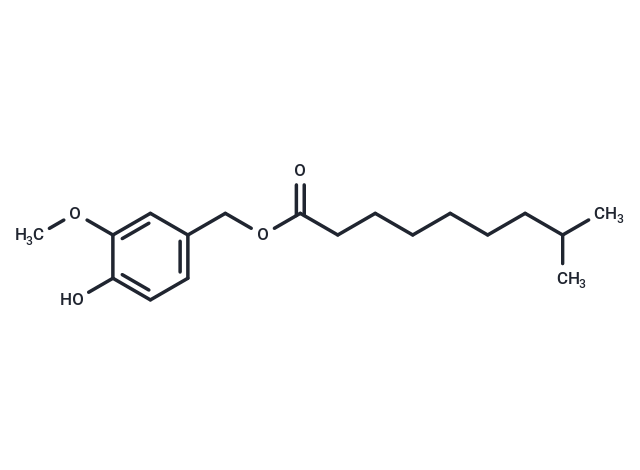
| Description | Dihydrocapsiate is a compound of capsinoid family that can be used in metabolism diseas research. Dihydrocapsiate is an orally active agonist of TRPV1 [1]. |
| In vitro | Dihydrocapsiate treatment at concentrations of 10, 25, and 50 μM for 48 hours does not impact the viability of human preadipocytes, indicating its non-toxic nature at these levels [1]. At lower concentrations of 10 and 20 μM, but over a longer period of 8 days, dihydrocapsiate significantly reduces the expression of various adipogenic (like SREBP1, FABP4, PLIN1, ADIPOQ, and LEPTIN) and inflammatory markers (MCP1 and TNFα) in mature adipocytes. Conversely, it increases the expression of PGC1α, crucial for mitochondrial biogenesis, and TBX1, a marker of "brite" cells, highlighting its potential role in adipocyte metabolism and inflammation modulation [1]. Interestingly, in RAW 264.7 cells, dihydrocapsiate concentrations ranging from 25 to 200 μM effectively inhibit the release of nitric oxide (NO) and the generation of intracellular reactive oxygen species (ROS), providing evidence of its anti-inflammatory and antioxidative properties [1]. |
| In vivo | Dihydrocapsiate administered orally at doses of 2 and 10 mg/kg effectively improves morphometric parameters and insulin levels in HFD-fed mice [1]. It counteracts the enlargement of adipocytes and upregulates energy expenditure-related genes in white adipose tissue (WAT), mitigates hepatic steatosis, and inhibits fat accumulation prompted by a high-fat diet (HFD). Furthermore, it elevates the expression of mitochondrial biogenesis-related genes in brown adipose tissue (BAT), ameliorates intestinal morphology, and modulates the availability of short-chain fatty acids (SCFAs), showcasing its broad pharmacological potential in metabolic regulation. |
| Molecular Weight | 308.41 |
| Formula | C18H28O4 |
| Cas No. | 205687-03-2 |
| Smiles | COc1cc(COC(=O)CCCCCCC(C)C)ccc1O |
| Storage | Powder: -20°C for 3 years | In solvent: -80°C for 1 year Shipping with blue ice/Shipping at ambient temperature. |
 For example, if the intended dosage is 10 mg/kg for animals weighing 20 g , with a dosing volume of 100 μL per animal, and a total of 10 animals are to be administered, using a formulation of
  10% DMSO+ 40% PEG300+ 5% Tween 80+ 45% Saline/PBS/ddH2O , the resulting working solution concentration would be 2 mg/mL.
Dissolve 2 mg of the compound in 100 μL DMSO to obtain a stock solution at a concentration of 20 mg/mL . If the required concentration exceeds the compound's known solubility, please contact us for technical support before proceeding.
1) Add 100 μL of the DMSO stock solution to 400 µL PEG300 and mix thoroughly until the solution becomes clear.
2) Add 50 µL Tween 80 and mix well until fully clarified.
3) Add 450 µL Saline,PBS or ddH2O and mix thoroughly until a homogeneous solution is obtained.
| Size | Quantity | Unit Price | Amount | Operation |
|---|
 Feedback
 Hello! How can I help you today?
Copyright © 2015-2026 TargetMol Chemicals Inc. All Rights Reserved.
