


Shopping Cart
Remove All Your shopping cart is currently empty

Synonyms:
| Pack Size | Price | USA Stock | Global Stock | Quantity |
|---|---|---|---|---|
| 25 mg | $4,020 | 3-6 months | 3-6 months | |
| 50 mg | $5,080 | 3-6 months | 3-6 months | |
| 100 mg | $6,800 | 3-6 months | 3-6 months |
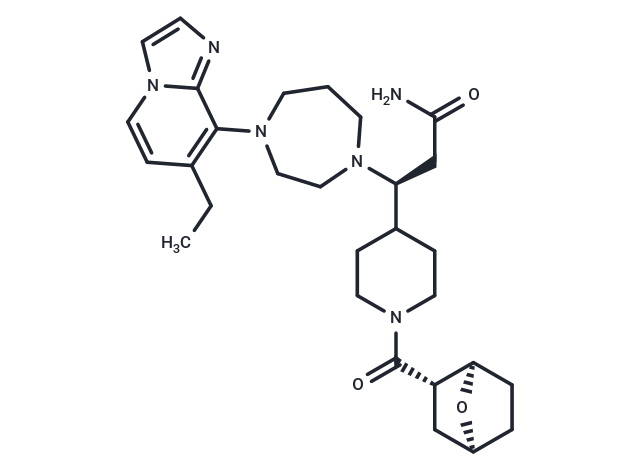
| Description | CXCR7 modulator 2 is a 7-type C-X-C chemokine receptor (CXCR7) modulator with a Ki of 13 nM. |
| Targets & IC50 | CXCR7:13 nM (ki) |
| In vitro | CXCR7 modulator 2 showed strong CXCR7 binding affinity (Ki = 13 nM) and β-arrestin activity (EC50 = 11 nM). Compared with 11c, CXCR7 modulator 2 also showed improved selectivity in the GPCR panel and showed a higher therapeutic index in the hERG patch clamp assay. CXCR7 modulator 2 exhibited medium to high in vitro turnover in NADPH- supplemented mouse liver microsomes (MLM, 93 μL / min / mg) and hepatocytes (28 μL / min per million cells), which was shown to be more comparable in MDCK Poor passive absorption permeability type II permeability measurement method, and has good water solubility. CXCR7 regulator 2 is rapidly absorbed, with an average maximum plasma concentration (Cmax) of 682 ng / mL, which appears at 0.25 h (Tmax). The corresponding average area under the plasma concentration-time curve (AUC) is 740 ng / mL / h. |
| In vivo | The administration of isoproterenol for 9 days induces cardiac fibrosis, evidenced by a fourfold increase in collagen deposition detected by Pixirius red staining relative to the control group. Treatment with CXCR7 modulator 2 significantly reduces cardiac fibrosis, demonstrating its protective effect on CXCR7 modulation in isoproterenol-induced cardiac injury. |
| Molecular Weight | 522.68 |
| Formula | C29H42N6O3 |
| Cas No. | 2227426-37-9 |
| Smiles | CCc1ccn2ccnc2c1N1CCCN(CC1)[C@@H](CC(N)=O)C1CCN(CC1)C(=O)[C@H]1C[C@@H]2CC[C@H]1O2 |
| Relative Density. | 1.40 g/cm3 (Predicted) |
| Storage | Powder: -20°C for 3 years | In solvent: -80°C for 1 year Shipping with blue ice/Shipping at ambient temperature. | |||||||||||||||||||||||||||||||||||
| Solubility Information | DMSO: 250 mg/mL (478.3 mM), Sonication is recommended. | |||||||||||||||||||||||||||||||||||
| In Vivo Formulation | 10% DMSO+40% PEG300+5% Tween-80+45% Saline: 3.3 mg/mL (6.31 mM), Sonication is recommended. Please add the solvents sequentially, clarifying the solution as much as possible before adding the next one. Dissolve by heating and/or sonication if necessary. Working solution is recommended to be prepared and used immediately. The formulation provided above is for reference purposes only. In vivo formulations may vary and should be modified based on specific experimental conditions. | |||||||||||||||||||||||||||||||||||
Solution Preparation Table | ||||||||||||||||||||||||||||||||||||
DMSO
Note : The dilution table applies only to solid products. For liquid products, please calculate the stock solution based on the stated concentration and/or density. | ||||||||||||||||||||||||||||||||||||
 For example, if the intended dosage is 10 mg/kg for animals weighing 20 g , with a dosing volume of 100 μL per animal, and a total of 10 animals are to be administered, using a formulation of
  10% DMSO+ 40% PEG300+ 5% Tween 80+ 45% Saline/PBS/ddH2O , the resulting working solution concentration would be 2 mg/mL.
Dissolve 2 mg of the compound in 100 μL DMSO to obtain a stock solution at a concentration of 20 mg/mL . If the required concentration exceeds the compound's known solubility, please contact us for technical support before proceeding.
1) Add 100 μL of the DMSO stock solution to 400 µL PEG300 and mix thoroughly until the solution becomes clear.
2) Add 50 µL Tween 80 and mix well until fully clarified.
3) Add 450 µL Saline,PBS or ddH2O and mix thoroughly until a homogeneous solution is obtained.
| Size | Quantity | Unit Price | Amount | Operation |
|---|
 Feedback
 Hello! How can I help you today?
Copyright © 2015-2026 TargetMol Chemicals Inc. All Rights Reserved.
