


Shopping Cart
Remove All Your shopping cart is currently empty

Synonyms: RO-7795081, RO7795081, RO 7795081, RG-6652, RG6652, RG 6652

| Pack Size | Price | USA Stock | Global Stock | Quantity |
|---|---|---|---|---|
| 1 mg | $118 | - | In Stock | |
| 5 mg | $297 | - | In Stock | |
| 10 mg | $479 | - | In Stock | |
| 25 mg | $959 | - | In Stock | |
| 50 mg | $1,550 | - | In Stock | |
| 100 mg | $2,470 | - | In Stock | |
| 1 mL x 10 mM (in DMSO) | $379 | - | In Stock |
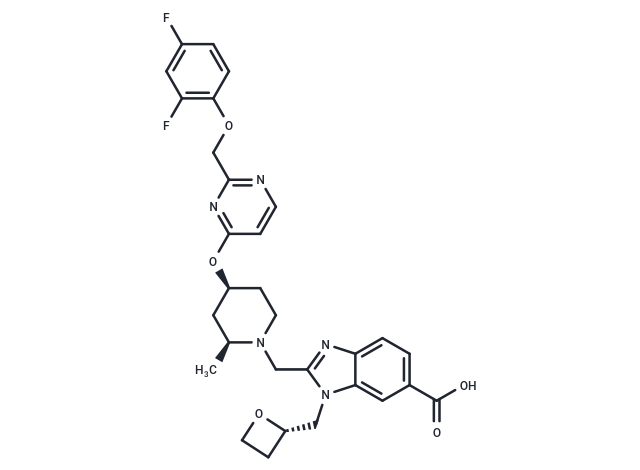
| Description | CT-996 is an orally active GLP-1 receptor agonist that exhibits preferential cAMP signaling and reduces endocytosis. Oral administration of CT-996 improves glycemic control and reduces body weight and body fat. |
| Targets & IC50 | GLP1 receptor:0.49 nM (EC50) |
| In vitro | In vitro experiments show that CT-996 has the same effect in stimulating the accumulation of cAMP in cells expressing human or macaque GLP-1R, and can stimulate the insulin secretion of human β cell line. Compared with natural GLP-1, CT-996 has little effect on the recruitment of β- arrestin, and the internalization of GLP-1R is weak. |
| In vivo | In vivo, a single oral administration of CT-996 can effectively inhibit the postprandial blood glucose level of mice expressing human GLP-1 receptor after mixed meal tolerance test (MMTT), and enhance glucose-stimulated insulin secretion (GSIS) in obese monkeys. In a 4-week study on obese monkeys, daily administration of CT-996 significantly inhibited the fluctuation of plasma glucose and insulin during MMTT. Compared with the control group, CT-996 significantly reduced food intake, body weight and fat mass. All doses were well tolerated. |
| Synonyms | RO-7795081, RO7795081, RO 7795081, RG-6652, RG6652, RG 6652 |
| Molecular Weight | 579.59 |
| Formula | C30H31F2N5O5 |
| Cas No. | 2810808-95-6 |
| Smiles | C(N1C=2C(N=C1CN3[C@@H](C)C[C@@H](OC4=NC(COC5=C(F)C=C(F)C=C5)=NC=C4)CC3)=CC=C(C(O)=O)C2)[C@@H]6CCO6 |
| Relative Density. | no data available |
| Storage | Powder: -20°C for 3 years | In solvent: -80°C for 1 year Shipping with blue ice/Shipping at ambient temperature. | |||||||||||||||||||||||||||||||||||
| Solubility Information | DMSO: 100.00 mg/mL (172.54 mM) | |||||||||||||||||||||||||||||||||||
Solution Preparation Table | ||||||||||||||||||||||||||||||||||||
DMSO
Note : The dilution table applies only to solid products. For liquid products, please calculate the stock solution based on the stated concentration and/or density. | ||||||||||||||||||||||||||||||||||||
 For example, if the intended dosage is 10 mg/kg for animals weighing 20 g , with a dosing volume of 100 μL per animal, and a total of 10 animals are to be administered, using a formulation of
  10% DMSO+ 40% PEG300+ 5% Tween 80+ 45% Saline/PBS/ddH2O , the resulting working solution concentration would be 2 mg/mL.
Dissolve 2 mg of the compound in 100 μL DMSO to obtain a stock solution at a concentration of 20 mg/mL . If the required concentration exceeds the compound's known solubility, please contact us for technical support before proceeding.
1) Add 100 μL of the DMSO stock solution to 400 µL PEG300 and mix thoroughly until the solution becomes clear.
2) Add 50 µL Tween 80 and mix well until fully clarified.
3) Add 450 µL Saline,PBS or ddH2O and mix thoroughly until a homogeneous solution is obtained.
| Size | Quantity | Unit Price | Amount | Operation |
|---|
 Feedback
 Hello! How can I help you today?
Copyright © 2015-2026 TargetMol Chemicals Inc. All Rights Reserved.
