


Shopping Cart
Remove All Your shopping cart is currently empty

Synonyms:
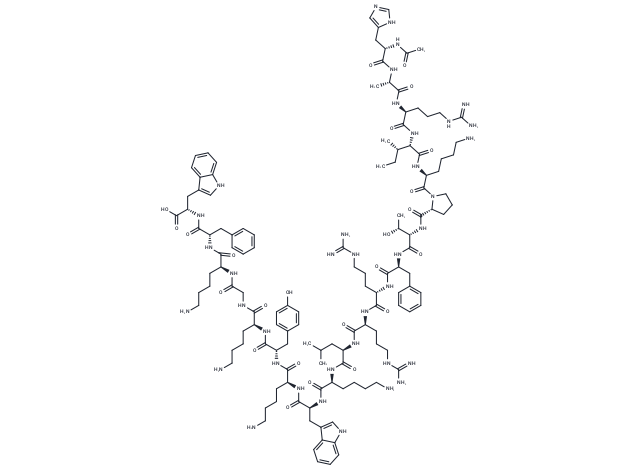
| Pack Size | Price | USA Stock | Global Stock | Quantity |
|---|---|---|---|---|
| 10 mg | Inquiry | Inquiry | Inquiry | |
| 50 mg | Inquiry | Inquiry | Inquiry |
| Description | CIGB-552 is a cell-penetrating peptide with antitumor properties, exhibiting an IC50 of 23 μM in H460 cells. It increases the level of COMMD1 protein and significantly inhibits the NF-κB signaling pathway. Furthermore, CIGB-552 promotes apoptosis (apoptosis) of tumor cells and induces accumulation of reactive oxygen species (ROS) within them. Additionally, it possesses anti-inflammatory and anti-angiogenic effects. CIGB-552 is applicable in research related to lung and colon cancer. |
| In vitro | CIGB-552, when applied at concentrations of 20-60 μM for 5 hours, increases the protein levels of the tumor suppressor COMMD1. At 25 μM for 0-12 hours, it facilitates the ubiquitin-mediated degradation of RelA and suppresses NF-κB signaling in H460 cells. With 25 μM exposure over 0-24 hours, CIGB-552 elevates pro-apoptotic proteins and reduces anti-apoptotic proteins in H460 cells. Administering CIGB-552 at 25 μM for 24-48 hours induces apoptosis in lung cancer cells. Additionally, at 25 μM for 8 hours, it decreases the antioxidant capacity of H460 cells, leading to oxidative damage of proteins and lipids. In a 37.5 μM dose for 1 hour, it induces the accumulation of reactive oxygen species (ROS) by inhibiting SOD1 activity, selectively killing tumor cells. At 75-150 μM for 24 hours, CIGB-552 significantly inhibits TNF-α-induced NF-κB activation. Furthermore, using 2.5-25 μM for 24 hours, it exerts anti-angiogenic effects by inhibiting hypoxia-induced HIF-1 activation through COMMD1. |
| In vivo | CIGB-552, administered at 1 mg/kg through subcutaneous injection three times a week for three weeks, significantly impedes tumor growth in mice with lung cancer and extends survival time without notable toxicity. Additionally, CIGB-552, delivered at doses of 0.2-1.4 mg/kg via subcutaneous injection twice weekly for two weeks, effectively suppresses tumor growth in mice with colon cancer and exhibits anti-angiogenic properties. |
| Molecular Weight | 2689.21 |
| Formula | C131H198N38O24 |
| Cas No. | 1630763-23-3 |
| Smiles | C([C@@H](C(N[C@H](C(N[C@@H](CC1=CC=C(O)C=C1)C(N[C@H](C(NCC(N[C@H](C(N[C@@H](CC2=CC=CC=C2)C(N[C@@H](CC=3C=4C(NC3)=CC=CC4)C(O)=O)=O)=O)CCCCN)=O)=O)CCCCN)=O)=O)CCCCN)=O)NC([C@@H](NC([C@H](NC([C@@H](NC([C@@H](NC([C@H](CC5=CC=CC=C5)NC([C@@H](NC(=O)[C@@H]6N(C([C@@H](NC([C@@H](NC([C@@H](NC([C@@H](NC([C@H](CC7=CN=CN7)NC(C)=O)=O)C)=O)CCCNC(=N)N)=O)[C@H](CC)C)=O)CCCCN)=O)CCC6)[C@@H](C)O)=O)=O)CCCNC(=N)N)=O)CCCNC(=N)N)=O)CC(C)C)=O)CCCCN)=O)C=8C=9C(NC8)=CC=CC9 |
| Sequence | Ac-His-Ala-Arg-Ile-Lys-{D-Pro}-Thr-Phe-Arg-Arg-{D-Leu}-Lys-Trp-Lys-Tyr-Lys-Gly-Lys-Phe-Trp |
| Sequence Short | HARIKPTFRRLKWKYKGKFW |
| Storage | Keep away from moisture Powder: -20°C for 3 years | In solvent: -80°C for 1 year Shipping with blue ice/Shipping at ambient temperature. |
 For example, if the intended dosage is 10 mg/kg for animals weighing 20 g , with a dosing volume of 100 μL per animal, and a total of 10 animals are to be administered, using a formulation of
  10% DMSO+ 40% PEG300+ 5% Tween 80+ 45% Saline/PBS/ddH2O , the resulting working solution concentration would be 2 mg/mL.
Dissolve 2 mg of the compound in 100 μL DMSO to obtain a stock solution at a concentration of 20 mg/mL . If the required concentration exceeds the compound's known solubility, please contact us for technical support before proceeding.
1) Add 100 μL of the DMSO stock solution to 400 µL PEG300 and mix thoroughly until the solution becomes clear.
2) Add 50 µL Tween 80 and mix well until fully clarified.
3) Add 450 µL Saline,PBS or ddH2O and mix thoroughly until a homogeneous solution is obtained.
| Size | Quantity | Unit Price | Amount | Operation |
|---|
 Feedback
 Hello! How can I help you today?
Copyright © 2015-2026 TargetMol Chemicals Inc. All Rights Reserved.
