


Shopping Cart
Remove All Your shopping cart is currently empty

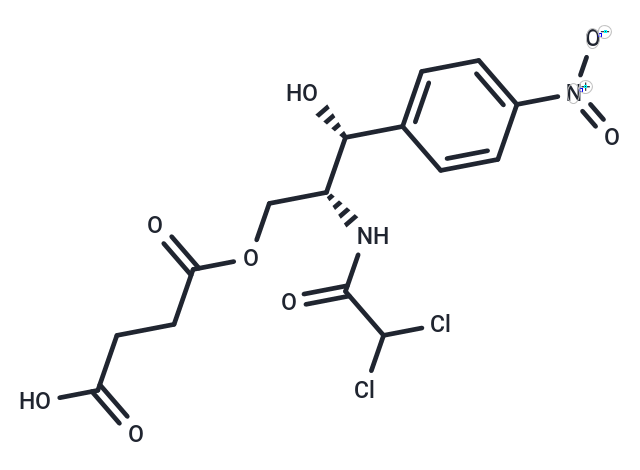
Synonyms: Paraxin succinate, Kemicetine succinate, CPSA
| Pack Size | Price | USA Stock | Global Stock | Quantity |
|---|---|---|---|---|
| 1 mg | $98 | - | In Stock | |
| 5 mg | $243 | - | In Stock | |
| 10 mg | $477 | - | In Stock | |
| 25 mg | $1,080 | - | In Stock | |
| 50 mg | $1,450 | - | In Stock | |
| 100 mg | $1,960 | - | In Stock | |
| 200 mg | $2,630 | - | In Stock |
| Description | Chloramphenicol succinate is a water-soluble prodrug of Chloramphenicol, a bacteriostatic antibiotic that binds to bacterial ribosomes to block their translation. CPSA is a competitive substrate and inhibitor of succinate dehydrogenase (SDH). In vitro, Kemicetine succinate can be oxidized by succinate dehydrogenase to release chloramphenicol. |
| In vitro | Methods: RAW264.7 cells were treated with N,N-Dimethylsphingosine (0-5μM, 24 hours), and cell viability was determined by MTT assay. Results: N,N-Dimethylsphingosine can inhibit the growth of RAW264.7 cells with an IC50 value of 2.3μM. [1] |
| Synonyms | Paraxin succinate, Kemicetine succinate, CPSA |
| Molecular Weight | 423.2 |
| Formula | C15H16Cl2N2O8 |
| Cas No. | 3544-94-3 |
| Smiles | O[C@@H]([C@@H](COC(=O)CCC(O)=O)NC(=O)C(Cl)Cl)c1ccc(cc1)[N+]([O-])=O |
| Relative Density. | 1.536g/cm3 |
| Storage | Store at low temperature Powder: -20°C for 3 years | In solvent: -80°C for 1 year Shipping with blue ice/Shipping at ambient temperature. |
 For example, if the intended dosage is 10 mg/kg for animals weighing 20 g , with a dosing volume of 100 μL per animal, and a total of 10 animals are to be administered, using a formulation of
  10% DMSO+ 40% PEG300+ 5% Tween 80+ 45% Saline/PBS/ddH2O , the resulting working solution concentration would be 2 mg/mL.
Dissolve 2 mg of the compound in 100 μL DMSO to obtain a stock solution at a concentration of 20 mg/mL . If the required concentration exceeds the compound's known solubility, please contact us for technical support before proceeding.
1) Add 100 μL of the DMSO stock solution to 400 µL PEG300 and mix thoroughly until the solution becomes clear.
2) Add 50 µL Tween 80 and mix well until fully clarified.
3) Add 450 µL Saline,PBS or ddH2O and mix thoroughly until a homogeneous solution is obtained.
| Size | Quantity | Unit Price | Amount | Operation |
|---|
 Feedback
 Hello! How can I help you today?
Copyright © 2015-2026 TargetMol Chemicals Inc. All Rights Reserved.
