


Shopping Cart
Remove All Your shopping cart is currently empty

Adropin (34-76) (human, mouse, rat) is a peptide that attenuates liver fibrosis and insulin resistance independent of obesity or food intake.

| Pack Size | Price | USA Stock | Global Stock | Quantity |
|---|---|---|---|---|
| 1 mg | $127 | In Stock | In Stock | |
| 5 mg | $328 | In Stock | In Stock | |
| 10 mg | $496 | In Stock | In Stock | |
| 25 mg | $793 | In Stock | In Stock | |
| 50 mg | $995 | In Stock | In Stock | |
| 100 mg | $1,230 | - | In Stock | |
| 200 mg | $1,650 | - | In Stock |
| Description | Adropin (34-76) (human, mouse, rat) is a peptide that attenuates liver fibrosis and insulin resistance independent of obesity or food intake. |
| In vitro | Method: HUVECs cells were treated with 10 ng/mL Adropin for 18 hours, and then Adropin was added to the culture medium; in addition, HUVECs cell line proteins were isolated, and Adropin (10 ng/mL) was added to the culture medium to stimulate for 0 to 60 minutes to lyse the treated HUVECs. The samples were used to measure phosphorylated ENOs, phosphorylated AKT, and phosphorylated ERK1/2. RESULTS Adropin-treated HUVECs cells showed greater proliferation, migration, and capillary-like tube formation; Adropin upregulated endothelial NO synthase expression through the VEGFR2 2-PI3K-Akt and VEGFR2-extracellular signal-regulated kinase pathways to reduce inflammation. [3] Method: Treat 3T3-L1 cells or rat primary preadipocytes with Adropin (1 - 100 nmol/l) for 24 or 48 hours. After that, add BrdU solution (10µmol/l), incubate the cells for 3 hours, and use Cell Proliferation BrdU Elisa Kit (Roche Diagnostics, Penzberg, Germany) evaluates the binding of BrdU to DNA. RESULTS Adropin (100 nmol/l) stimulated the proliferation of 3T3-L1 preadipocytes after 24 and 48 hours. Adpin at a concentration of 100 nmol/l increased the proliferation of rat preadipocytes after 48 hours; in addition, Adropin stimulated the proliferation of rat preadipocytes through ERK1 /2 and AKT-dependent mechanisms promote 3T3-L1 cell proliferation. [4] |
| In vivo | METHODS: DIO C57BL/6 mice maintained on a 60% kcal fat diet received five intraperitoneal (ip) injections of adropin (450 nmol/kg). After treatment, assess glucose tolerance and systemic insulin sensitivity. RESULTS Adropin treatment improved glucose tolerance, enhanced insulin action, and enhanced metabolic flexibility in glucose utilization in mice. [1] METHODS: C57Bl/6 mice were injected with secretable form of Adropin (450 nmol/kg, ip) three times within 24 hours, then fasted, and the hearts were isolated and perfused. RESULTS Adropin administration improved cardiac function, cardiac efficiency, and coronary blood flow compared with untreated mice. [2] |
| Cas No. | 1802086-30-1 |
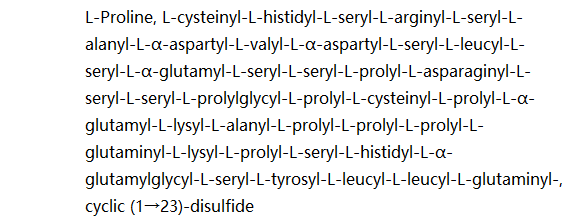
| Sequence | Cys-His-Ser-Arg-Ser-Ala-Asp-Val-Asp-Ser-Leu-Ser-Glu-Ser-Ser-Pro-Asn-Ser-Ser-Pro-Gly-Pro-Cys-Pro-Glu-Lys-Ala-Pro-Pro-Pro-Gln-Lys-Pro-Ser-His-Glu-Gly-Ser-Tyr-Leu-Leu-Gln-Pro (Disulfide bridge: Cys1-Cys23) |
| Sequence Short | CHSRSADVDSLSESSPNSSPGPCPEKAPPPQKPSHEGSYLLQP (Disulfide bridge: Cys1-Cys23) |
| Storage | store at low temperature,keep away from moisture | Powder: -20°C for 3 years | In solvent: -80°C for 1 year | Shipping with blue ice/Shipping at ambient temperature. |
 For example, if the intended dosage is 10 mg/kg for animals weighing 20 g , with a dosing volume of 100 μL per animal, and a total of 10 animals are to be administered, using a formulation of
  10% DMSO+ 40% PEG300+ 5% Tween 80+ 45% Saline/PBS/ddH2O , the resulting working solution concentration would be 2 mg/mL.
Dissolve 2 mg of the compound in 100 μL DMSO to obtain a stock solution at a concentration of 20 mg/mL . If the required concentration exceeds the compound's known solubility, please contact us for technical support before proceeding.
1) Add 100 μL of the DMSO stock solution to 400 μL PEG300 and mix thoroughly until the solution becomes clear.
2) Add 50 μL Tween 80 and mix well until fully clarified.
3) Add 450 μL Saline,PBS or ddH2O and mix thoroughly until a homogeneous solution is obtained.

| Size | Quantity | Unit Price | Amount | Operation |
|---|
 Feedback
 Hello! How can I help you today?
Copyright © 2015-2026 TargetMol Chemicals Inc. All Rights Reserved.
