


Shopping Cart
Remove All Your shopping cart is currently empty

Synonyms: GB88, GB 88
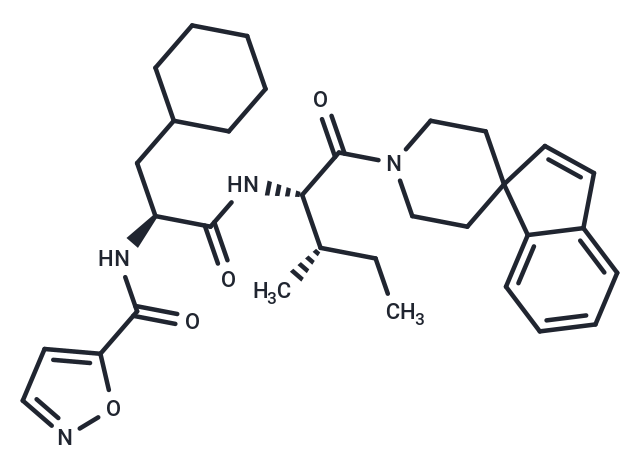
| Pack Size | Price | USA Stock | Global Stock | Quantity |
|---|---|---|---|---|
| 5 mg | $446 | 7-10 days | 7-10 days |
| Description | GB-88 is an orally active, highly selective, non-peptide PAR2 antagonist that blocks downstream inflammatory and pain signaling pathways by inhibiting PAR2-mediated Ca²⁺ release (IC₅₀ = 2 μM). GB-88 exhibits antagonistic activity against various PAR2 agonists, including trypsin, SLIGRL-NH₂, and GB110, and shows no significant cross-reactivity with PAR1, PAR3, or PAR4. GB-88 is suitable for research into diseases such as inflammation, pain, and metabolic disorders. |
| Targets & IC50 | PAR2:2 μM |
| In vitro | Methods: A549 cells were pretreated with GB-88 (50 μM). Following pretreatment, nTyr-p39 (5 μg/ml) was added, and the cells were incubated until morphological changes occurred. Immunofluorescence staining and two-photon microscopy were used to examine cell junctions. Results: nTyr-p39 disrupted the localization of ZO-1 (tight junctions) and E-cadherin (adhesion junctions); pretreatment with GB-88 attenuated this disruption. [1] Methods: Primary rat DRG neurons were pre-incubated with GB-88 (10 μM) for 30 minutes, followed by the addition of trypsin (10 nM). Activation of DRG neurons was monitored in real time for 5 minutes using Fura-2 AM calcium imaging (340/380 nm ratio). Results: Trypsin induced a rapid, transient calcium increase; GB-88 (10 μM) suppressed both the amplitude of the response and the proportion of responding neurons.[2] |
| In vivo | Methods: To investigate the inhibitory effects of GB-88 on protease-induced inflammation and pain, male C57BL/6 mice were administered GB-88 (10 mg/kg) via oral gavage. Two hours later, cathepsin-S (2.5 μM (0.06 U/μL), 10 μL per paw) was injected subcutaneously into the plantar region of each paw. Relevant parameters were measured 1–4 hours after injection. Results: GB-88 completely inhibited cathepsin-S-induced edema and suppressed mechanical and thermal allodynia. [2] |
| Synonyms | GB88, GB 88 |
| Molecular Weight | 546.70 |
| Formula | C32H42N4O4 |
| Cas No. | 1416435-96-5 |
| Smiles | C([C@@H](NC([C@H](CC1CCCCC1)NC(=O)C2=CC=NO2)=O)[C@H](CC)C)(=O)N3CCC4(C=5C(C=C4)=CC=CC5)CC3 |
| Relative Density. | no data available |
| Storage | Powder: -20°C for 3 years | In solvent: -80°C for 1 year Shipping with blue ice/Shipping at ambient temperature. | |||||||||||||||||||||||||
| Solubility Information | DMSO: 25.00 mg/mL (45.73 mM), Sonication is recommended. | |||||||||||||||||||||||||
| In Vivo Formulation | 10% DMSO+40% PEG300+5% Tween-80+45% Saline: 2.00 mg/mL (3.66 mM), Sonication is recommended. Please add the solvents sequentially, clarifying the solution as much as possible before adding the next one. Dissolve by heating and/or sonication if necessary. Working solution is recommended to be prepared and used immediately. The formulation provided above is for reference purposes only. In vivo formulations may vary and should be modified based on specific experimental conditions. | |||||||||||||||||||||||||
Solution Preparation Table | ||||||||||||||||||||||||||
DMSO
Note : The dilution table applies only to solid products. For liquid products, please calculate the stock solution based on the stated concentration and/or density. | ||||||||||||||||||||||||||
 For example, if the intended dosage is 10 mg/kg for animals weighing 20 g , with a dosing volume of 100 μL per animal, and a total of 10 animals are to be administered, using a formulation of
  10% DMSO+ 40% PEG300+ 5% Tween 80+ 45% Saline/PBS/ddH2O , the resulting working solution concentration would be 2 mg/mL.
Dissolve 2 mg of the compound in 100 μL DMSO to obtain a stock solution at a concentration of 20 mg/mL . If the required concentration exceeds the compound's known solubility, please contact us for technical support before proceeding.
1) Add 100 μL of the DMSO stock solution to 400 µL PEG300 and mix thoroughly until the solution becomes clear.
2) Add 50 µL Tween 80 and mix well until fully clarified.
3) Add 450 µL Saline,PBS or ddH2O and mix thoroughly until a homogeneous solution is obtained.
| Size | Quantity | Unit Price | Amount | Operation |
|---|
 Feedback
 Hello! How can I help you today?
Copyright © 2015-2026 TargetMol Chemicals Inc. All Rights Reserved.
