


Shopping Cart
Remove All Your shopping cart is currently empty


Synonyms: 5(6)-Carboxyfluorescein N-hydroxysuccinimide ester
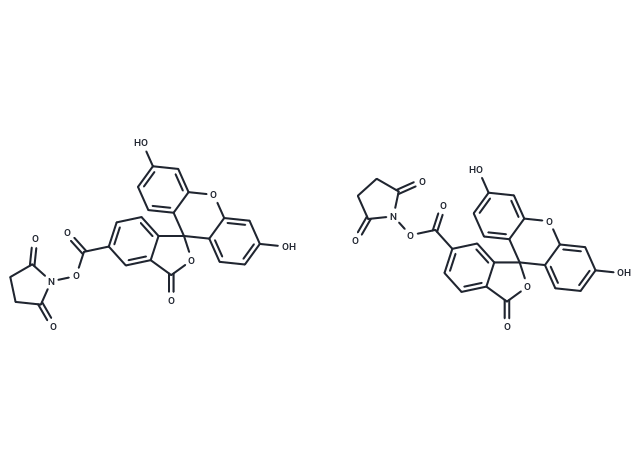

| Pack Size | Price | USA Stock | Global Stock | Quantity |
|---|---|---|---|---|
| 10 mg | $48 | In Stock | In Stock | |
| 50 mg | $79 | In Stock | In Stock | |
| 100 mg | $119 | In Stock | In Stock | |
| 200 mg | $178 | In Stock | In Stock | |
| 500 mg | $297 | In Stock | In Stock | |
| 1 mL x 10 mM (in DMSO) | $54 | In Stock | In Stock |
| Description | 5(6)-FAM SE (5(6)-Carboxyfluorescein N-hydroxysuccinimide ester) is an amine-reactive green fluorescent dye. 5(6)-FAM SE is widely used for labeling proteins or other molecules that contain a primary or secondary aliphatic amine. |
| In vitro | Instructions 1. Solution preparation: Dissolve 5(6)-FAM SE in an appropriate solvent, such as anhydrous DMSO, DMF or methanol, to prepare a stock solution of the required concentration. The recommended stock solution concentration is 10 mM for subsequent dilution. 2. Labeling process: a. Dissolve the molecule to be labeled in an appropriate buffer. b. Add an appropriate amount of 5(6)-FAM SE stock solution to ensure that the dye reacts fully with the target molecule. c. Incubate at room temperature in the dark for 30 minutes to 1 hour to promote the labeling reaction. d. After the reaction is completed, wash the labeled product with an appropriate buffer to remove unbound dye. 3. Fluorescence detection: Use a fluorescence microscope or flow cytometer for detection. The excitation wavelength of 5(6)-FAM SE is approximately 495 nm, and the emission wavelength is approximately 517 nm. Precautions: a. Wear gloves during operation to avoid contact between skin or mucous membranes and reagents. b. Avoid light during incubation and storage to prevent fluorescence quenching. c. After staining is completed, fluorescence detection and analysis should be performed immediately. The above information is based on published literature. Experimental procedures should be appropriately modified to meet specific research demands. |
| Synonyms | 5(6)-Carboxyfluorescein N-hydroxysuccinimide ester |
| Molecular Weight | 946.786 |
| Formula | C50H30N2O18 |
| Cas No. | 117548-22-8 |
| Smiles | Oc1ccc2c(Oc3cc(O)ccc3C22OC(=O)c3cc(ccc23)C(=O)ON2C(=O)CCC2=O)c1.Oc1ccc2c(Oc3cc(O)ccc3C22OC(=O)c3ccc(cc23)C(=O)ON2C(=O)CCC2=O)c1 |
| Relative Density. | no data available |
| Storage | Keep away from direct sunlight,Store at low temperature Powder: -20°C for 3 years | In solvent: -80°C for 1 year Shipping with blue ice/Shipping at ambient temperature. | |||||||||||||||||||||||||||||||||||
| Solubility Information | DMSO: 240 mg/mL (253.49 mM), Sonication and heating are recommended.  | |||||||||||||||||||||||||||||||||||
Solution Preparation Table | ||||||||||||||||||||||||||||||||||||
DMSO
Note : The dilution table applies only to solid products. For liquid products, please calculate the stock solution based on the stated concentration and/or density. | ||||||||||||||||||||||||||||||||||||
 For example, if the intended dosage is 10 mg/kg for animals weighing 20 g , with a dosing volume of 100 μL per animal, and a total of 10 animals are to be administered, using a formulation of
  10% DMSO+ 40% PEG300+ 5% Tween 80+ 45% Saline/PBS/ddH2O , the resulting working solution concentration would be 2 mg/mL.
Dissolve 2 mg of the compound in 100 μL DMSO to obtain a stock solution at a concentration of 20 mg/mL . If the required concentration exceeds the compound's known solubility, please contact us for technical support before proceeding.
1) Add 100 μL of the DMSO stock solution to 400 µL PEG300 and mix thoroughly until the solution becomes clear.
2) Add 50 µL Tween 80 and mix well until fully clarified.
3) Add 450 µL Saline,PBS or ddH2O and mix thoroughly until a homogeneous solution is obtained.
| Size | Quantity | Unit Price | Amount | Operation |
|---|
 Feedback
 Hello! How can I help you today?
Copyright © 2015-2026 TargetMol Chemicals Inc. All Rights Reserved.
