


Shopping Cart
Remove All Your shopping cart is currently empty

Synonyms: K-115 (free base)
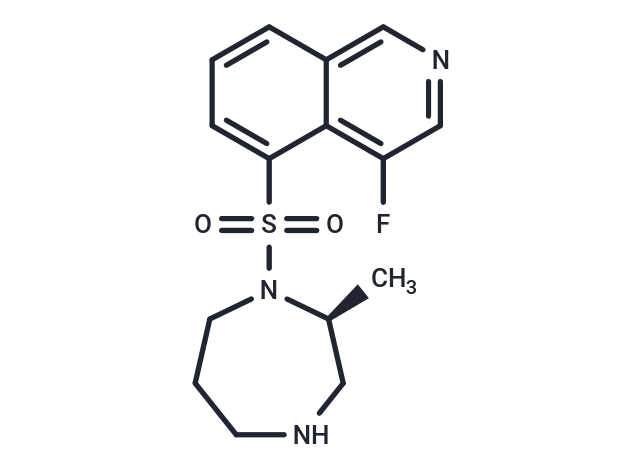

| Pack Size | Price | USA Stock | Global Stock | Quantity |
|---|---|---|---|---|
| 1 mg | $73 | Inquiry | Inquiry | |
| 5 mg | $162 | Inquiry | Inquiry | |
| 10 mg | $264 | Inquiry | Inquiry | |
| 25 mg | $588 | Inquiry | Inquiry | |
| 50 mg | $970 | Inquiry | Inquiry | |
| 100 mg | $1,622 | Inquiry | Inquiry | |
| 1 mL x 10 mM (in DMSO) | $178 | Inquiry | Inquiry |
| Description | Ripasudil free base (K-115 (free base)) is a selective and potent ROCK inhibitor, is a novel and potent antiglaucoma agent. |
| Targets & IC50 | PKACa:2.1 μM, PKC:27 μM, ROCK1:51 nM, ROCK2:19 nM, CaMK IIa:370 nM |
| In vitro | Ripasudil significantly reduced infiltrating cells and protein exudation in the aqueous humor, as well as the number of infiltrating cells in the ICB and adherent leukocytes in retinal vessels in EIU. Additionally, the protein level of MCP-1 in the aqueous humor and mRNA levels of IL-1β, IL-6, TNF-α, MCP-1, and intercellular adhesion molecule-1 in the ICB and retina were suppressed by ripasudil. The production of MCP-1 and nuclear translocation of NF-κB in RAW264.7 cells were also suppressed by ripasudil[1]. |
| In vivo | Ripasudil had selective and potent inhibitory effects on ROCKs.In rabbits, topical instillation of Ripasudil significantly reduced IOP in a dose-dependent manner.Maximum IOP reduction was observed 1 h after topical instillation, which was 8.55 ± 1.09 mmHg (mean ± SE) from the baseline IOP at 0.5%.In monkeys, maximum IOP reduction was observed 2 h after topical instillation, which was 4.36 ± 0.32 mmHg from the baseline IOP at 0.4%, and was significantly stronger than that of 0.005% latanoprost.Whole-head autoradiography showed that the radioactivity level was maximum at 15 min after instillation of [(14)C]Ripasudil in the ipsilateral eye.Single instillation of 0.4% Ripasudil showed no effect on aqueous flow rate or uveoscleral ouTheaflavinlow, but significantly increased conventional ouTheaflavinlow facility by 2.2-fold compared to vehicle-treated eyes in rabbits[2]. |
| Synonyms | K-115 (free base) |
| Cell Research | Endotoxin-induced uveitis was induced by footpad injection of lipopolysaccharide (LPS). Ripasudil was administered intraperitoneally 1 hour before and after LPS injection. The aqueous humor was collected 24 hours after injection, and the infiltrating cells, protein concentration, and levels of monocyte chemotactic protein-1 (MCP-1) were determined. Infiltrating cells in the iris ciliary body (ICB) and adherent leukocytes in retinal vessels were evaluated. The mRNA levels of IL-1β, IL-6, TNF-α, and MCP-1 in the retina and ICB were determined. A mouse macrophage cell line, RAW264.7, was stimulated with LPS in the presence or absence of ripasudil, and the expression of MCP-1 and nuclear translocation of nuclear factor (NF)-κB was analyzed[1]. |
| Animal Research | Kinase inhibition by K-115 was measured by biochemical assay.?IOP was monitored using a pneumatonometer in albino rabbits and monkeys after topical instillation of K-115.?The ocular distribution of [(14)C]K-115 was determined by whole-head autoradiography.?The aqueous flow rate was determined by fluorophotometry.?The total outflow facility and uveoscleral outflow were measured by two-level constant pressure perfusion and perfusion technique using fluorescein isothiocyanate-dextran, respectively[2]. |
| Molecular Weight | 323.39 |
| Formula | C15H18FN3O2S |
| Cas No. | 223645-67-8 |
| Smiles | C[C@H]1CNCCCN1S(=O)(=O)c1cccc2cncc(F)c12 |
| Relative Density. | 1.293 g/cm3 (Predicted) |
| Storage | Powder: -20°C for 3 years | In solvent: -80°C for 1 year Shipping with blue ice/Shipping at ambient temperature. |
 For example, if the intended dosage is 10 mg/kg for animals weighing 20 g , with a dosing volume of 100 μL per animal, and a total of 10 animals are to be administered, using a formulation of
  10% DMSO+ 40% PEG300+ 5% Tween 80+ 45% Saline/PBS/ddH2O , the resulting working solution concentration would be 2 mg/mL.
Dissolve 2 mg of the compound in 100 μL DMSO to obtain a stock solution at a concentration of 20 mg/mL . If the required concentration exceeds the compound's known solubility, please contact us for technical support before proceeding.
1) Add 100 μL of the DMSO stock solution to 400 µL PEG300 and mix thoroughly until the solution becomes clear.
2) Add 50 µL Tween 80 and mix well until fully clarified.
3) Add 450 µL Saline,PBS or ddH2O and mix thoroughly until a homogeneous solution is obtained.
| Size | Quantity | Unit Price | Amount | Operation |
|---|
 Feedback
 Hello! How can I help you today?
Copyright © 2015-2026 TargetMol Chemicals Inc. All Rights Reserved.
