


Shopping Cart
Remove All Your shopping cart is currently empty

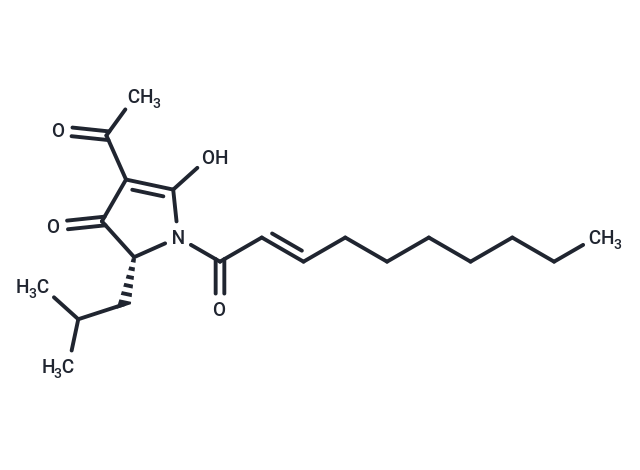
Synonyms: Reutericycline
| Pack Size | Price | USA Stock | Global Stock | Quantity |
|---|---|---|---|---|
| 5 mg | Inquiry | 7-10 days | 7-10 days |
| Description | Reutericyclin is a selective anti-Gram-positive substance with good oral bioavailability, possessing both antibacterial and anti-obesity effects. It disrupts bacterial transmembrane potential specifically, exerting bactericidal or bacteriostatic effects on pathogenic bacteria such as Clostridium difficile and Staphylococcus aureus in a non-bacteriolytic manner, and rapidly eliminates vegetative cells and spores of Clostridium difficile. It is resistant to enzymatic degradation, has iron chelating properties, and is hardly absorbed by colonic epithelial cells. In addition to effectively eliminating Staphylococcus biofilms and inhibiting the proliferation of drug-resistant bacteria, Reutericyclin regulates intestinal flora structure and improves body energy metabolism, thereby alleviating abnormal weight gain induced by risperidone medication. Currently, Reutericyclin has been widely used in basic research on Clostridium difficile infection, drug-induced weight gain and superficial skin infection caused by Staphylococcus. |
| In vitro | Methods: The minimum inhibitory concentration (MIC) and minimum bactericidal concentration (MBC) of Reutericyclin against multiple pathogenic strains were determined. Its cytotoxicity against colon cancer cells was evaluated, and the inhibitory differences between drug‑sensitive and drug‑resistant strains were compared. In addition, its biological activity under human serum environment and extreme treatment conditions, as well as its spore inactivation effect, were investigated. Results: 1.Reutericyclin inhibited and killed Clostridioides difficile strains 9689, BAA-1803 and BAA-1875 in both logarithmic and stationary growth phases. The MIC values for the logarithmic phase ranged from 0.09 to 0.19 mg/L, and the MBC values for the stationary phase ranged from 0.19 to 0.5 mg/L. 2.Reutericyclin at a concentration of 200 mg/L showed no cytotoxicity against Caco-2 colon cancer cells [1]. 3.Reutericyclin at 0.1–1.6 μg/mL inhibited clinical isolates of methicillin‑susceptible and methicillin‑resistant Staphylococcus aureus. The MIC₅₀ values were 0.8 μg/mL and 3.12 μg/mL, and the MIC₉₀ values were 1.6 μg/mL and 6.25 μg/mL, respectively. 4.Reutericyclin at 0.8–3.12 μg/mL inhibited mupirocin‑resistant Staphylococcus aureus, with an MIC₅₀ of 1.6 μg/mL and an MIC₉₀ of 3.12 μg/mL. 5.Reutericyclin at 0.012–0.4 μg/mL inhibited clinical isolates of Streptococcus pyogenes, with both MIC₅₀ and MIC₉₀ of 0.4 μg/mL. 6.In the system containing 50% human serum, the antibacterial activity of reutericyclin against Staphylococcus aureus was completely lost, with MIC ≥ 200 μg/mL. 7.Under treatment conditions of 6.4 mg/L, 60 min, 600 MPa and 90 ℃, reutericyclin produced a tailing effect during spore inactivation of Clostridium perfringens ATCC 7955 and Clostridium beijerinckii ATCC 8260, while showing no obvious effect on spores of Bacillus amyloliquefaciens FAD 11/2 [4]. |
| In vivo | Methods: Female C57BL/6J mice were used to establish a risperidone-induced abnormal body weight gain model. Reutericyclin and (R)-Reutericyclin were administered by daily intragastric gavage with different intervention durations. A combined administration group with a Lactobacillus reuteri mutant strain was also set up. Changes in body weight and energy metabolism-related indicators were comparatively analyzed among groups. Results: 1.Daily intragastric administration of reutericyclin at 2.5 μg/day for 25 consecutive days markedly alleviated risperidone-induced excessive body weight gain in female C57BL/6J mice. Compared with the risperidone-only group, the average body weight gain of mice decreased from 3.58 g to 2.5 g. 2.Continuous intervention with reutericyclin for 50 days effectively restored energy utilization efficiency and significantly inhibited the risperidone-induced obese phenotype in mice. Such beneficial effects were independent of the endogenous reutericyclin synthesis function of Lactobacillus reuteri. 3.Daily intragastric administration of (R)-Reutericyclin at 2.5 μg/day also attenuated risperidone-triggered body weight gain in mice, but its overall intervention efficacy was weaker than that of the (S)-Reutericyclin enantiomer [2]. |
| Synonyms | Reutericycline |
| Molecular Weight | 349.46 |
| Formula | C20H31NO4 |
| Cas No. | 303957-69-9 |
| Smiles | C(/C=C/CCCCCCC)(=O)N1[C@H](CC(C)C)C(=O)C(C(C)=O)=C1O |
| Relative Density. | no data available |
| Storage | Powder: -20°C for 3 years | In solvent: -80°C for 1 year Shipping with blue ice/Shipping at ambient temperature. | ||||||||||||||||||||||||||||||
| Solubility Information | DMSO: 26.66 mg/mL (76.29 mM), Sonication is recommended. | ||||||||||||||||||||||||||||||
Solution Preparation Table | |||||||||||||||||||||||||||||||
DMSO
Note : The dilution table applies only to solid products. For liquid products, please calculate the stock solution based on the stated concentration and/or density. | |||||||||||||||||||||||||||||||
 For example, if the intended dosage is 10 mg/kg for animals weighing 20 g , with a dosing volume of 100 μL per animal, and a total of 10 animals are to be administered, using a formulation of
  10% DMSO+ 40% PEG300+ 5% Tween 80+ 45% Saline/PBS/ddH2O , the resulting working solution concentration would be 2 mg/mL.
Dissolve 2 mg of the compound in 100 μL DMSO to obtain a stock solution at a concentration of 20 mg/mL . If the required concentration exceeds the compound's known solubility, please contact us for technical support before proceeding.
1) Add 100 μL of the DMSO stock solution to 400 µL PEG300 and mix thoroughly until the solution becomes clear.
2) Add 50 µL Tween 80 and mix well until fully clarified.
3) Add 450 µL Saline,PBS or ddH2O and mix thoroughly until a homogeneous solution is obtained.
| Size | Quantity | Unit Price | Amount | Operation |
|---|
 Feedback
 Hello! How can I help you today?
Copyright © 2015-2026 TargetMol Chemicals Inc. All Rights Reserved.
