


Shopping Cart
Remove All Your shopping cart is currently empty

Synonyms:
| Pack Size | Price | USA Stock | Global Stock | Quantity |
|---|---|---|---|---|
| 10 mg | Inquiry | 10-14 weeks | 10-14 weeks | |
| 50 mg | Inquiry | 10-14 weeks | 10-14 weeks |
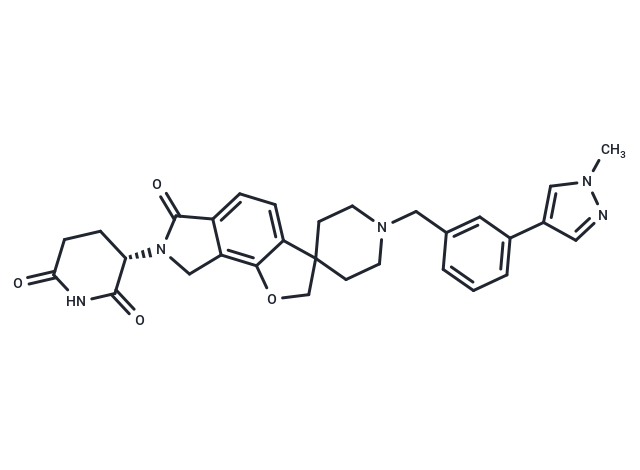
| Description | PVTX-405 is a selective oral IKZF2 molecular glue degrader with a DC50 of 0.7 nM and a maximum degradation (Dmax) of 91%. It enhances degradation efficiency, significantly reduces off-target degradation, and minimizes hERG inhibition with an IC50 of 48 µM. PVTX-405 effectively inhibits MC38 tumor growth in Crbn391VC57BL/6 mouse xenograft models and shows superior synergistic anticancer effects when combined with immune checkpoint therapies (ICTs) such as anti-PD1 or anti-LAG3 antibodies. |
| Targets & IC50 | IZKF2:0.7 nM (DC50) |
| In vitro | PVTX-405 (Compound 16a) exhibits exceptional substrate selectivity, minimally affecting IKZF1, IKZF3, GSPT1, and CK1α protein levels even at concentrations up to 10 µM with a D max of less than 20%. In Jurkat cells, PVTX-405 (0.01-10000 nM, 1-6 hours) degrades IKZF2 in a CRBN-dependent manner, achieving a DC 50 of 6.3 nM and a D max of 65%, with maximum degradation occurring within 3 hours. At concentrations of 1-1000 nM over 24 hours, PVTX-405 effectively modulates established IKZF2 transcription targets, increasing the inflammatory cytokine IL-2 and reducing the suppressive activity of Tregs, thus promoting Teff cell proliferation in Jurkat T cells. Additionally, PVTX-405 (0.1-1000 nM, 3-6 hours) induces dose-dependent degradation of IKZF2, disrupts the stability of human Treg cells, and triggers the proliferation of Teff cells. |
| In vivo | PVTX-405 (Compound 16a), administered orally at 30 mg/kg once daily for 21 days, significantly inhibits the growth of MC38 tumors in the Crbn 391V C57BL/6 mouse-derived MC38 tumor xenograft model. Additionally, when used in combination with anti-PD1 or anti-LAG3 antibodies, it enhances survival rates in mice. |
| Molecular Weight | 525.60 |
| Formula | C30H31N5O4 |
| Cas No. | 2991021-08-8 |
| Smiles | C(N1CCC2(C=3C(OC2)=C4C(=CC3)C(=O)N(C4)[C@@H]5C(=O)NC(=O)CC5)CC1)C6=CC(=CC=C6)C7=CN(C)N=C7 |
| Storage | Powder: -20°C for 3 years | In solvent: -80°C for 1 year Shipping with blue ice/Shipping at ambient temperature. |
 For example, if the intended dosage is 10 mg/kg for animals weighing 20 g , with a dosing volume of 100 μL per animal, and a total of 10 animals are to be administered, using a formulation of
  10% DMSO+ 40% PEG300+ 5% Tween 80+ 45% Saline/PBS/ddH2O , the resulting working solution concentration would be 2 mg/mL.
Dissolve 2 mg of the compound in 100 μL DMSO to obtain a stock solution at a concentration of 20 mg/mL . If the required concentration exceeds the compound's known solubility, please contact us for technical support before proceeding.
1) Add 100 μL of the DMSO stock solution to 400 µL PEG300 and mix thoroughly until the solution becomes clear.
2) Add 50 µL Tween 80 and mix well until fully clarified.
3) Add 450 µL Saline,PBS or ddH2O and mix thoroughly until a homogeneous solution is obtained.
| Size | Quantity | Unit Price | Amount | Operation |
|---|
 Feedback
 Hello! How can I help you today?
Copyright © 2015-2026 TargetMol Chemicals Inc. All Rights Reserved.
