Shopping Cart
Remove All
  • TargetMol
    Your shopping cart is currently empty

Potassium chloride

Catalog No. T65401 Copy Product Info
🥰Excellent
Potassium chloride, is a biological reagent commonly used for protein extraction and buffer preparation. It disrupts the stability of biological membranes by breaking the electrostatic interactions between proteins and lipids, and is widely used in molecular biology research.

Potassium chloride

Copy Product Info
🥰Excellent
Catalog No. T65401

Potassium chloride, is a biological reagent commonly used for protein extraction and buffer preparation. It disrupts the stability of biological membranes by breaking the electrostatic interactions between proteins and lipids, and is widely used in molecular biology research.

Potassium chloride
Cas No. 7447-40-7
Pack SizePriceUSA StockGlobal StockQuantity
5 g$29-In Stock
For In stock only · Estimated delivery: USA Stock (1-2 days) Global Stock (5-7 days)
Add to Cart
Add to Quotation
For research use only—not for human use. No sales to individuals. Use as intended only.
Questions
TargetMol
View More

Batch Information

Select Batch
Appearance:Solid
Color:White
Contact us for more batch information

Resource Download

Product Introduction

Bioactivity
Description
Potassium chloride, is a biological reagent commonly used for protein extraction and buffer preparation. It disrupts the stability of biological membranes by breaking the electrostatic interactions between proteins and lipids, and is widely used in molecular biology research.
Disease Modeling Protocol
Hyperkalemia Model
  • Modeling Mechanism:

    Potassium chloride (KCl), as a potassium supplement, has the following core mechanism of action: ① Excessive intravenous infusion of KCl rapidly increases the concentration of potassium ions in the blood, disrupting the potassium ion balance across the myocardial cell membrane; ② High potassium levels inhibit the opening of sodium channels in the myocardial cell membrane, prolonging the action potential duration, blocking atrioventricular conduction, and inducing arrhythmias (such as ventricular tachycardia and ventricular fibrillation), ultimately leading to sudden cessation of cardiac electrical activity.

  • Related Products:

    Potassium chloride (T65401)

  • Modeling Method:

    Experimental Subject:

    Pigs, Crossbred pigs (Landrace/Yorkshire/Duroc), Female, Body weight 38–42 kg, 3 months old

    Dosage and Administration Route:

    ① Preoperative preparation:
    - Anaesthetic induction: Intramuscular premedication with midazolam (1 mg/kg), followed by supplemental midazolam (0.625 mg/kg)+S - Ketamine (6.25 mg/kg)+Atropine (0.5 mg), intravenous infusion of Fentanyl (15-29 μg/kg/hr)+Propofol (4.0-5.5 mg/kg/hr) for maintenance anaesthesia;
    - Life support: Tracheal intubation (6.5 mm tube), mechanical ventilation (tidal volume 8 mL/kg, PEEP 5 cm H₂O), continuous infusion of lactated Ringer's solution (1 mL/kg/h)+unfractionated heparin (18 IU/kg/h) for volume maintenance and thromboprophylaxis;
    ② Core Modelling: Continuous intravenous infusion of Potassium chloride solution via venous access, rate adjusted as required until cardiac arrest occurs (ECG showing pulseless electrical activity or ventricular fibrillation, sustained aortic pressure < 20 mmHg);
    ③ Control group:
    - Blank control: Infusion of equivalent volume saline solution, with all other procedures identical;

    Dosing Frequency and Duration Model:

    Potassium chloride administration: Single continuous infusion until cardiac arrest occurs

  • Validation:

    1. Electrophysiological parameters (core validation): - Electrocardiogram (ECG): Ventricular arrhythmias (ventricular tachycardia, ventricular fibrillation) are observed, eventually transitioning to pulseless electrical activity or a flat line, consistent with ECG characteristics of cardiac arrest; - Hemodynamics: Aortic pressure drops sharply to < 20 mmHg, coronary perfusion pressure is significantly reduced, and cardiac output (CO) approaches 0; 2. Biochemical parameters: - Arterial blood gas analysis: Serum potassium concentration is significantly elevated (≥6.5 mmol/L, normal reference range 3.5-5.5 mmol/L), which may be accompanied by metabolic acidosis (pH < 7.35); 3. Resuscitation response: - Defibrillation (360 J bidirectional defibrillation) or epinephrine (0.02 mg/kg) intervention is required to restore spontaneous circulation (ROSC), validating model stability.

*Precautions:

*References:Eggertsen MA,et,al. Sodium Bicarbonate and Calcium Chloride for the Treatment of Hyperkalemia-Induced Cardiac Arrest: A Randomized, Blinded, Placebo-Controlled Animal Study. Crit Care Med. 2024 Feb 1;52(2):e67-e78.

Chemical Properties
Molecular Weight74.55
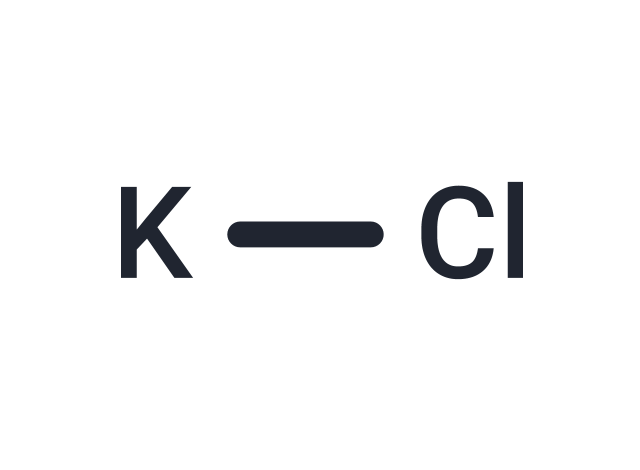
FormulaClK
Cas No.7447-40-7
SmilesCl[K]
Storage & Solubility Information
StoragePowder: -20°C for 3 years | In solvent: -80°C for 1 year

Calculator

  • Molarity Calculator
  • Dilution Calculator
  • Reconstitution Calculator
  • Molecular Weight Calculator

In Vivo Formulation Calculator (Clear solution)

Please enter your animal experiment information in the following box and click Calculate to obtain the stock solution preparation method and in vivo formula preparation method:
TargetMol | Animal experiments For example, if the intended dosage is 10 mg/kg for animals weighing 20 g , with a dosing volume of 100 μL per animal, TargetMol | Animal experiments and a total of 10 animals are to be administered, using a formulation of TargetMol | reagent 10% DMSO+ 40% PEG300+ 5% Tween 80+ 45% Saline/PBS/ddH2O , the resulting working solution concentration would be 2 mg/mL.

Stock Solution Preparation:

Dissolve 2 mg of the compound in 100 μL DMSOTargetMol | reagent to obtain a stock solution at a concentration of 20 mg/mL . If the required concentration exceeds the compound's known solubility, please contact us for technical support before proceeding.

Preparation of the In Vivo Formulation:

1) Add 100 μL of the DMSOTargetMol | reagent stock solution to 400 μL PEG300TargetMol | reagent and mix thoroughly until the solution becomes clear.

2) Add 50 μL Tween 80 and mix well until fully clarified.

3) Add 450 μL Saline,PBS or ddH2OTargetMol | reagent and mix thoroughly until a homogeneous solution is obtained.

This example is provided solely to demonstrate the use of the In Vivo Formulation Calculator and does not constitute a recommended formulation for any specific compound. Please select an appropriate dissolution and formulation strategy based on your experimental model and route of administration.
All co-solvents required for this protocol, includingDMSO, PEG300/PEG400, Tween 80, SBE-β-CD, and Corn oil, are available for purchase on the TargetMol website.
1 Enter information below:
mg/kg
g
μL
2 Enter the in vivo formulation:
% DMSO
%
% Tween 80
% Saline/PBS/ddH2O

Dose Conversion

You can also refer to dose conversion for different animals. More Dose Conversion

Tech Support

Please see Inhibitor Handling Instructions for more frequently ask questions. Topics include: how to prepare stock solutions, how to store products, and cautions on cell-based assays & animal experiments, etc
Related Tags: buy Potassium chloride | purchase Potassium chloride | Potassium chloride cost | order Potassium chloride | Potassium chloride chemical structure | Potassium chloride formula | Potassium chloride molecular weight