


Shopping Cart
Remove All Your shopping cart is currently empty

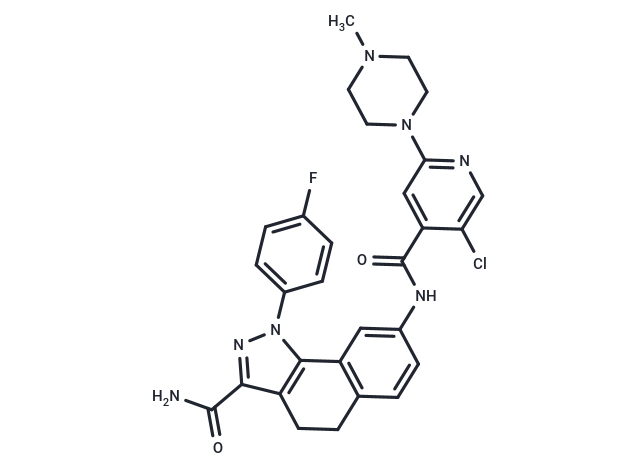
Synonyms: PHA408

| Pack Size | Price | USA Stock | Global Stock | Quantity |
|---|---|---|---|---|
| 1 mg | $89 | - | In Stock | |
| 5 mg | $218 | - | In Stock | |
| 10 mg | $347 | - | In Stock | |
| 25 mg | $577 | - | In Stock | |
| 50 mg | $823 | - | In Stock | |
| 100 mg | $1,090 | - | In Stock | |
| 1 mL x 10 mM (in DMSO) | $269 | - | In Stock |
| Description | PHA-408 is a novel, potent, highly selective, and ATP-competitive inhibitor of IKB kinase-2. The selective inhibitory activity of PHA-408 supports the use of PHA-408 in investigations of NF-κB signaling regulation, inflammatory signaling cascades, kinase biology, and cellular mechanisms involving IKB kinase-2. |
| In vitro | Method: The inhibitory activity of PHA-408 against purified IκB kinase 2 was evaluated in a cell-free kinase assay. Rresult: PHA-408 acted as a tight-binding, ATP-competitive inhibitor of IκB kinase 2 with an IC50 of 40 ± 2 nM and exhibited relatively slow dissociation kinetics.[1] Method: The anti-inflammatory effects of PHA-408 were evaluated in cytokine-stimulated airway epithelial and inflammation-relevant cellular assays by measuring NF-κB pathway activation and inflammatory mediator production. Rresult: PHA-408 inhibited IκBα phosphorylation and degradation, NF-κB activation, and inflammatory mediator production in a concentration-dependent manner.[2] Method: Cultured mdx mouse myotubes were exposed to 20 μM PHA-408 for 52 h, and the subcellular distribution of p65 was evaluated by confocal immunofluorescence. Rresult: PHA-408 substantially reduced nuclear p65 immunofluorescence in mdx myotubes.[5] Method: Human umbilical vein endothelial cells were exposed to TNFα at 10 ng/mL together with 2 μM PHA-408 for 6 days, followed by a 3-day recovery period. NF-κB p65 translocation, reactive oxygen species, cell proliferation, senescence markers, and senescence-associated secretory phenotype factors were evaluated. Rresult: PHA-408 largely prevented TNFα-induced nuclear translocation of p65, mitigated the later increase in reactive oxygen species, reduced growth impairment and cell-cycle arrest, attenuated the reduction in Ki-67-positive cells and increases in p16- and p21-positive cells, and reduced E-selectin, IGFBP-5, IL-6, and IL-8 responses associated with the senescence-associated secretory phenotype.[6] |
| In vivo | Method: Rats with streptococcal cell wall-induced arthritis received PHA-408 orally at 30 mg/kg daily for 3 days, and IKKβ activity, paw swelling, inflammatory signaling, and joint pathology were evaluated. Rresult: PHA-408 inhibited approximately 80% of IKKβ activity and markedly reduced paw swelling. It also suppressed IκBα phosphorylation and degradation, p65 phosphorylation and DNA-binding activity, inflammatory mediator expression, and joint pathology, without evident adverse effects at maximally efficacious doses.[1] Method: PHA-408 was administered to rats exposed to inhaled lipopolysaccharide, and airway inflammatory cell infiltration and cytokine production were measured. Rresult: PHA-408 dose-dependently attenuated lipopolysaccharide-induced inflammatory cell infiltration and cytokine production in the airways.[2] Method: Adult Sprague-Dawley rats received PHA-408 orally at 15 or 45 mg/kg once daily for 3 days and were exposed to lipopolysaccharide aerosol or cigarette smoke. Animals were sacrificed 1, 4, or 24 h after the final exposure, and bronchoalveolar lavage and lung inflammatory responses were evaluated. Rresult: PHA-408 significantly inhibited lipopolysaccharide- and cigarette smoke-induced neutrophil influx into bronchoalveolar lavage fluid; reduced CINC-1 in bronchoalveolar lavage fluid and IL-6, TNF-α, IL-1β, and GM-CSF in lung tissue; and decreased NF-κB nuclear translocation and DNA-binding activity.[3] Method: Pharmacokinetic modeling was used to design an oral steady-state delivery regimen for PHA-408 in rat arthritis efficacy and safety studies. Plasma exposure, disease efficacy, and safety findings were evaluated under steady-state conditions. Rresult: Steady-state delivery established a clear exposure-dependent relationship between plasma PHA-408 concentrations and efficacy in the rat arthritis model and enabled a more reliable assessment of target-related safety and the no-observed-adverse-effect level.[4] Method: Young adult mdx mice received PHA-408 by oral gavage at 50 mg/kg daily for 30 days, a single oral dose of 100 mg/kg, or intraperitoneally at 0.8 mg/kg/day for 30 days in two daily injections. Nuclear p65 and cytosolic IκBα levels in costal diaphragm muscle were measured. Rresult: Thirty-day oral treatment caused a small but significant 14% increase in cytosolic IκBα but did not reduce nuclear p65; a single 100 mg/kg oral dose also had no effect on nuclear p65. In contrast, prolonged intraperitoneal treatment reduced nuclear p65 by approximately 50%.[5] |
| Synonyms | PHA408 |
| Molecular Weight | 560.02 |
| Formula | C29H27ClFN7O2 |
| Cas No. | 503555-55-3 |
| Smiles | O=C(N)C1=NN(C2=CC=C(F)C=C2)C=3C=4C=C(C=CC4CCC13)NC(=O)C5=CC(=NC=C5Cl)N6CCN(C)CC6 |
| Relative Density. | 1.48 g/cm3 (Predicted) |
| Storage | Powder: -20°C for 3 years | In solvent: -80°C for 1 year Shipping with blue ice/Shipping at ambient temperature. | ||||||||||||||||||||||||||||||
| Solubility Information | DMSO: 40 mg/mL (71.43 mM), Sonication is recommended. | ||||||||||||||||||||||||||||||
Solution Preparation Table | |||||||||||||||||||||||||||||||
DMSO
Note : The dilution table applies only to solid products. For liquid products, please calculate the stock solution based on the stated concentration and/or density. | |||||||||||||||||||||||||||||||
 For example, if the intended dosage is 10 mg/kg for animals weighing 20 g , with a dosing volume of 100 μL per animal, and a total of 10 animals are to be administered, using a formulation of
  10% DMSO+ 40% PEG300+ 5% Tween 80+ 45% Saline/PBS/ddH2O , the resulting working solution concentration would be 2 mg/mL.
Dissolve 2 mg of the compound in 100 μL DMSO to obtain a stock solution at a concentration of 20 mg/mL . If the required concentration exceeds the compound's known solubility, please contact us for technical support before proceeding.
1) Add 100 μL of the DMSO stock solution to 400 µL PEG300 and mix thoroughly until the solution becomes clear.
2) Add 50 µL Tween 80 and mix well until fully clarified.
3) Add 450 µL Saline,PBS or ddH2O and mix thoroughly until a homogeneous solution is obtained.
| Size | Quantity | Unit Price | Amount | Operation |
|---|
 Feedback
 Hello! How can I help you today?
Copyright © 2015-2026 TargetMol Chemicals Inc. All Rights Reserved.
