Shopping Cart
Remove All
  • TargetMol
    Your shopping cart is currently empty

Penitrem A

Copy Product Info
😃Good
Catalog No. T12403Cas No. 12627-35-9

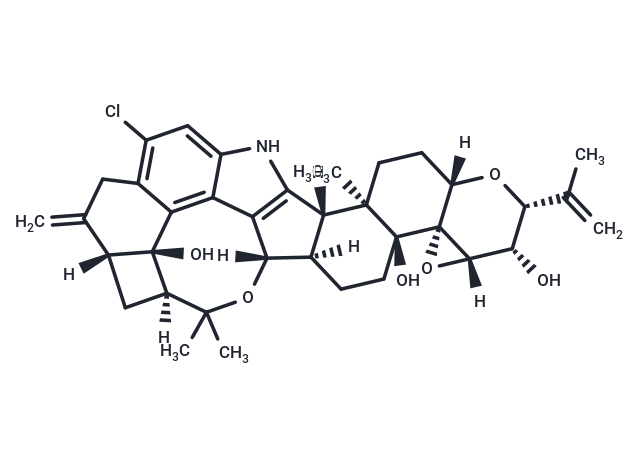
Penitrem A is an indole-diterpenoid neurotoxic alkaloid produced by *Penicillium* species. As a selective BK channel antagonist, it exhibits antiproliferative and anti-invasive activities against various malignancies, and stimulates the spontaneous release of endogenous glutamate, GABA, and aspartate from cortical synaptosomes. It is commonly used to induce tremor models in animals.

Penitrem A

Penitrem A

Copy Product Info
😃Good
Catalog No. T12403Cas No. 12627-35-9
Penitrem A is an indole-diterpenoid neurotoxic alkaloid produced by *Penicillium* species. As a selective BK channel antagonist, it exhibits antiproliferative and anti-invasive activities against various malignancies, and stimulates the spontaneous release of endogenous glutamate, GABA, and aspartate from cortical synaptosomes. It is commonly used to induce tremor models in animals.
Pack SizePriceUSA WarehouseGlobal WarehouseQuantity
1 mg$9835 days35 days
10 mg$69535 days35 days
Add to Cart
Add to Quotation
In Stock Estimated shipping dateUSA Warehouse[1-2 days] Global Warehouse[5-7 days]
All TargetMol products are for research purposes only and cannot be used for human consumption. We do not provide products or services to individuals. Please comply with the intended use and do not use TargetMol products for any other purpose.
Questions
TargetMol
View More

Resource Download

Product Introduction

Bioactivity
Description
Penitrem A is an indole-diterpenoid neurotoxic alkaloid produced by *Penicillium* species. As a selective BK channel antagonist, it exhibits antiproliferative and anti-invasive activities against various malignancies, and stimulates the spontaneous release of endogenous glutamate, GABA, and aspartate from cortical synaptosomes. It is commonly used to induce tremor models in animals.
Disease Modeling Protocol
Tremor-Related Neurological Disease Models
  • Modeling Mechanism:

    Penitrem A (PA), as a potent tremorogen, induces neurological abnormalities through core mechanisms: ① It selectively antagonizes calcium-dependent potassium-BK (Maxi-K) channels in the central nervous system (CNS), inhibiting potassium ion efflux and leading to abnormally increased neuronal excitability; ② It disrupts neurotransmitter balance, upregulating levels of glutamate (GLU), aspartate (ASP), γ-aminobutyric acid (GABA), dopamine (DA), and serotonin (5-HT), while downregulating norepinephrine (NE), causing signal transduction disorders; ③ It induces oxidative stress (increased NO and MDA, decreased TAC), leading to cerebellar Purkinje cell necrosis, cerebral neuronal apoptosis, and focal hemorrhage, mimicking the core pathological features of tremor-related neurological diseases.

  • Related Products:

    Penitrem A (T12403)

  • Modeling Method:

    Experimental Subject:

    Caenorhabditis elegans, N2 wild-type, L1 larval stage
    Rat, Sprague Dawley, 3 months old, 100–120 g

    Dosage and Administration Route:

    ① Core modelling:
    - Nematodes: PA (1–2 μM) added to Nematode Growth Medium (NGM), incubated for 42 hours;
    - Rats: PA (46.5 mg/kg feed) mixed into standard diet, administered orally for 4 consecutive weeks;
    ② Control treatment: sham group (rats fed standard diet only, nematodes cultured in NGM medium only);
    ③ Intervention validation (optional):
    - Astaxanthin (AST): Rats 12 mg/kg, dissolved in corn oil, oral gavage;
    - Docosahexaenoic acid (DHA): Rats 250 mg/kg, dissolved in corn oil, oral gavage;
    - Administration timing: synchronised with PA modelling.

    Dosing Frequency and Duration Model:

    Continuous feeding for 4 weeks

  • Validation:

    Behavioral indicators: 1. Nematodes: PA (2 μM) treatment significantly increased the number of reverse movements (p<0.05), and AST/DHA intervention could reverse this abnormality; 2. Rats: Spontaneous tremor appeared after 4 weeks of PA feeding, and AST/DHA could alleviate the tremor symptoms; Molecular indicators: Rat brain homogenates: GLU, ASP, GABA, DA, and 5-HT were significantly increased (p<0.05), and NE was significantly decreased (p<0.05); serum/brain NO and MDA were increased (p<0.05), and TAC was decreased (p<0.05); Histological indicators: Purkinje cell necrosis, molecular layer vacuolation, neuronal necrosis, and focal hemorrhage in rat cerebellum (HE staining verification) were observed, and AST/DHA intervention could significantly improve pathological damage.

*Precautions: After blood samples were collected, the animal was euthanized via cervical dislocation.

*References:Goda AA,et,al. Astaxanthin and Docosahexaenoic Acid Reverse the Toxicity of the Maxi-K (BK) Channel Antagonist Mycotoxin Penitrem A. Mar Drugs. 2016 Nov 9;14(11):208.

Chemical Properties
Molecular Weight634.2
FormulaC37H44ClNO6
Cas No.12627-35-9
Smiles[H][C@@]12O[C@]11[C@]([H])(CC[C@]3(C)[C@@]4(C)c5[nH]c6cc(Cl)c7CC(=C)[C@@]8([H])C[C@@]9([H])[C@@]8(O)c7c6c5[C@@]([H])(OC9(C)C)[C@]4([H])CC[C@@]13O)O[C@@H]([C@@H]2O)C(C)=C
Relative Density.1.44 g/cm3
Storage & Solubility Information
StoragePowder: -20°C for 3 years | In solvent: -80°C for 1 year | Shipping with blue ice/Shipping at ambient temperature.

Calculator

  • Molarity Calculator
  • Dilution Calculator
  • Reconstitution Calculator
  • Molecular Weight Calculator

In Vivo Formulation Calculator (Clear solution)

Please enter your animal experiment information in the following box and click Calculate to obtain the stock solution preparation method and in vivo formula preparation method:
TargetMol | Animal experiments For example, if the intended dosage is 10 mg/kg for animals weighing 20 g , with a dosing volume of 100 μL per animal, TargetMol | Animal experiments and a total of 10 animals are to be administered, using a formulation of TargetMol | reagent 10% DMSO+ 40% PEG300+ 5% Tween 80+ 45% Saline/PBS/ddH2O , the resulting working solution concentration would be 2 mg/mL.

Stock Solution Preparation:

Dissolve 2 mg of the compound in 100 μL DMSOTargetMol | reagent to obtain a stock solution at a concentration of 20 mg/mL . If the required concentration exceeds the compound's known solubility, please contact us for technical support before proceeding.

Preparation of the In Vivo Formulation:

1) Add 100 μL of the DMSOTargetMol | reagent stock solution to 400 μL PEG300TargetMol | reagent and mix thoroughly until the solution becomes clear.

2) Add 50 μL Tween 80 and mix well until fully clarified.

3) Add 450 μL Saline,PBS or ddH2OTargetMol | reagent and mix thoroughly until a homogeneous solution is obtained.

This example is provided solely to demonstrate the use of the In Vivo Formulation Calculator and does not constitute a recommended formulation for any specific compound. Please select an appropriate dissolution and formulation strategy based on your experimental model and route of administration.
All co-solvents required for this protocol, includingDMSO, PEG300/PEG400, Tween 80, SBE-β-CD, and Corn oil, are available for purchase on the TargetMol website.
1 Enter information below:
mg/kg
g
μL
2 Enter the in vivo formulation:
% DMSO
%
% Tween 80
% Saline/PBS/ddH2O

Dose Conversion

You can also refer to dose conversion for different animals. More Dose Conversion

Tech Support

Please see Inhibitor Handling Instructions for more frequently ask questions. Topics include: how to prepare stock solutions, how to store products, and cautions on cell-based assays & animal experiments, etc

Keywords

Related Tags: buy Penitrem A | purchase Penitrem A | Penitrem A cost | order Penitrem A | Penitrem A chemical structure | Penitrem A formula | Penitrem A molecular weight