


Shopping Cart
Remove All Your shopping cart is currently empty

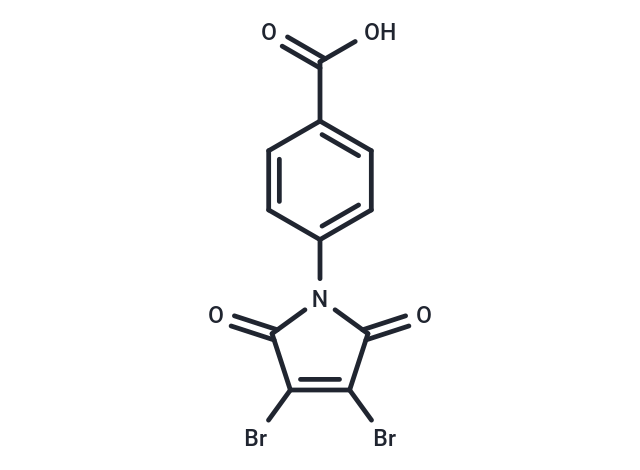
Synonyms: 4-(3,4-Dibromo-2,5-dihydro-2,5-dioxo-1H-pyrrol-1-yl)benzoic acid
| Pack Size | Price | USA Stock | Global Stock | Quantity |
|---|---|---|---|---|
| 1 mg | $99 | - | In Stock |
| Description | PBENZ-DBRMD (4-(3,4-Dibromo-2,5-dihydro-2,5-dioxo-1H-pyrrol-1-yl)benzoic acid) is a potent inhibitor of type 3 iodothyronine deiodinase (DIO3). It not only suppresses cell proliferation but also induces apoptosis, holding potential value for cancer research. |
| In vitro | Method: DIO3-positive HGSOC cells (OVCAR3 and KURAMOCHI) and DIO3-negative normal ovary cells (CHOK1) were treated with PBENZ-DBRMD (0.5, 1, 10 μM) for 96 h, with daily administration. Cell density was observed using light microscopy. Cell counting was performed by flow cytometry. Apoptosis was assessed by Annexin-PI staining, cell cycle analysis was conducted, cell proliferation was measured using the CyQUANT assay, and DIO3 as well as proliferation-related protein expression were detected by Western blot. Result: PBENZ-DBRMD dose-dependently reduced the number of DIO3-positive HGSOC cells, induced apoptosis (increased percentages of Annexin+/PI- and Annexin+/PI+ cells), increased the proportion of cells in the Sub-G1 phase, and significantly inhibited cell proliferation, while having no obvious effect on DIO3-negative CHOK1 cells. Under DIO3 knockdown or T3-deficient conditions, PBENZ-DBRMD lost its antitumor efficacy. Western blot analysis showed that PBENZ-DBRMD reduced the expression of the DIO3 dimer (75 kDa) and downregulated various pro-cancer proteins, including mutant p53, PKM2, c-Myc, pERK, PCNA, Cyclin D1, and CDK4 [1]. |
| In vivo | Method: OVCAR3 cells were subcutaneously injected into the left flank of female nude mice to establish an HGSOC xenograft model. Eleven days after tumor inoculation, mice were randomly divided into three groups (n = 6) and treated with daily intraperitoneal injections of PBENZ-DBRMD (5 mM, approximately 18.5 mg/kg), ITYR-DBRMD, or vehicle control (5% DMSO-PBS), five days per week for three weeks. Tumor volume and weight were measured. Western blot analysis was performed to detect the expression of relevant proteins in tumor tissues. IHC was used to detect DIO3 and Ki67 expression, and H&E staining was conducted to observe tissue morphology. Result: PBENZ-DBRMD significantly inhibited tumor volume growth and reduced tumor weight (p = 0.054, borderline significant). The expression of β-catenin, PAX8, mutant p53, PCNA, Cyclin D1, and CDK4 was decreased in tumor tissues. IHC showed a marked reduction in the positive rates of membranous DIO3 and Ki67 in tumor tissues. In the DIO3-knockdown OVCAR3 cell transplantation model, PBENZ-DBRMD had no significant effect on tumor volume or weight, further confirming that its antitumor effect is dependent on DIO3 expression [1]. |
| Synonyms | 4-(3,4-Dibromo-2,5-dihydro-2,5-dioxo-1H-pyrrol-1-yl)benzoic acid |
| Molecular Weight | 374.97 |
| Formula | C11H5Br2NO4 |
| Cas No. | 1454662-41-9 |
| Smiles | O=C(O)C1=CC=C(C=C1)N2C(=O)C(Br)=C(Br)C2=O |
| Storage | Powder: -20°C for 3 years | In solvent: -80°C for 1 year Shipping with blue ice/Shipping at ambient temperature. | |||||||||||||||||||||||||||||||||||
| Solubility Information | DMSO: 80 mg/mL (213.35 mM), Sonication is recommended. | |||||||||||||||||||||||||||||||||||
Solution Preparation Table | ||||||||||||||||||||||||||||||||||||
DMSO
Note : The dilution table applies only to solid products. For liquid products, please calculate the stock solution based on the stated concentration and/or density. | ||||||||||||||||||||||||||||||||||||
 For example, if the intended dosage is 10 mg/kg for animals weighing 20 g , with a dosing volume of 100 μL per animal, and a total of 10 animals are to be administered, using a formulation of
  10% DMSO+ 40% PEG300+ 5% Tween 80+ 45% Saline/PBS/ddH2O , the resulting working solution concentration would be 2 mg/mL.
Dissolve 2 mg of the compound in 100 μL DMSO to obtain a stock solution at a concentration of 20 mg/mL . If the required concentration exceeds the compound's known solubility, please contact us for technical support before proceeding.
1) Add 100 μL of the DMSO stock solution to 400 µL PEG300 and mix thoroughly until the solution becomes clear.
2) Add 50 µL Tween 80 and mix well until fully clarified.
3) Add 450 µL Saline,PBS or ddH2O and mix thoroughly until a homogeneous solution is obtained.
| Size | Quantity | Unit Price | Amount | Operation |
|---|
 Feedback
 Hello! How can I help you today?
Copyright © 2015-2026 TargetMol Chemicals Inc. All Rights Reserved.
