


Shopping Cart
Remove All Your shopping cart is currently empty

Synonyms: Neocuproin
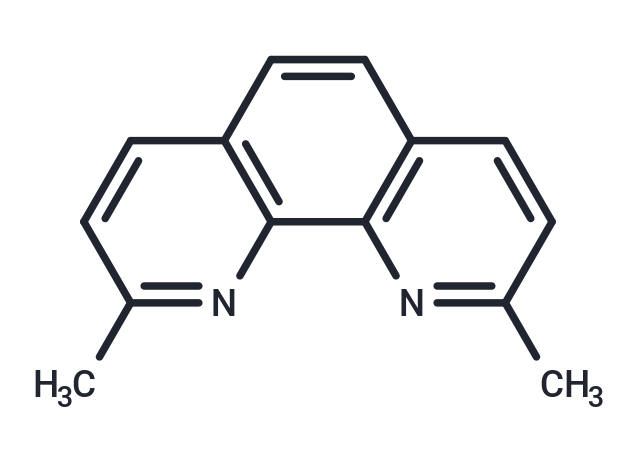
| Pack Size | Price | USA Stock | Global Stock | Quantity |
|---|---|---|---|---|
| 5 g | $29 | - | In Stock |
| Description | Neocuproine is a copper(I) chelator that enhances the purinergic component of vasoconstriction induced by electric field stimulation, and is often used as a ligand reagent and copper ion detector.Neocuproine forms stable complexes with copper ions and can play a catalytic role in certain chemical reactions and analytical methods.Neocuproine acts as a redox-active on the iron and cobalt ligand platform for protection against oxidative damage in NSC34 cells. |
| In vitro | Neocuproine (100 lM) generally inhibits the production of inflammatory mediators.[2] Neocuproine treatment reduced IFN-γ, MCP-1, MCP-3, and VEGF-A levels. The production of KC/GRO was downregulated by neocuproine deficiency.[2] Neocuproine, but not ATP7A deficiency, reduced the production of FGF-9, IL-1α, IL-12p70, IL-2, IL-3, IL-4, IL-6, MIP-1β, MIP-2, RANTES, and TNFα.[2] |
| In vivo | Neocuproine (100 microM) significantly suppressed the amplitude and frequency of the spontaneous contractions in the ovariectomized non-pregnant rat uterus while this agent facilitated the frequency of the spontaneous or oxytocin-induced contractions in the pregnant rat and human uterus without altering the amplitude of these contractions.[3] Neocuproine (200 microM) could enhance the amplitude of the contractions in the pregnant uterus. These effects were blocked by a purinergic receptor antagonist, suramin (100 microM) and did not occur following the administration of neocuproine-copper(I) complex or copper(II) chelator cuprizone. alpha, beta-methylene ATP increased the amplitude and frequency of contractions in the pregnant uterus, but not affected the contractions in the ovariectomized non-pregnant rat uterus, and neocuproine potentiated this facilitation effect.[3] |
| Synonyms | Neocuproin |
| Molecular Weight | 208.26 |
| Formula | C14H12N2 |
| Cas No. | 484-11-7 |
| Smiles | Cc1ccc2ccc3ccc(C)nc3c2n1 |
| Relative Density. | 1.178 g/cm3 |
| Storage | Keep away from direct sunlight,Keep away from moisture Powder: -20°C for 3 years | In solvent: -80°C for 1 year Shipping with blue ice/Shipping at ambient temperature. | |||||||||||||||||||||||||||||||||||
| Solubility Information | DMSO: 70.71 mg/mL (339.53 mM), Sonication is recommended.  | |||||||||||||||||||||||||||||||||||
| In Vivo Formulation | 10% DMSO+40% PEG300+5% Tween 80+45% Saline: 8.33 mg/mL (40 mM), Solution. 10% DMSO+90% Saline: < 7.07 mg/mL (33.95 mM), Lower concentrations may be soluble, but exact solubility limit is unknown. 10% DMSO+40% PEG300+5% Tween-80+45% Saline: 3.3 mg/mL (15.85 mM), Sonication is recommended. Please add the solvents sequentially, clarifying the solution as much as possible before adding the next one. Dissolve by heating and/or sonication if necessary. Working solution is recommended to be prepared and used immediately. The formulation provided above is for reference purposes only. In vivo formulations may vary and should be modified based on specific experimental conditions. | |||||||||||||||||||||||||||||||||||
Solution Preparation Table | ||||||||||||||||||||||||||||||||||||
DMSO
Note : The dilution table applies only to solid products. For liquid products, please calculate the stock solution based on the stated concentration and/or density. | ||||||||||||||||||||||||||||||||||||
 For example, if the intended dosage is 10 mg/kg for animals weighing 20 g , with a dosing volume of 100 μL per animal, and a total of 10 animals are to be administered, using a formulation of
  10% DMSO+ 40% PEG300+ 5% Tween 80+ 45% Saline/PBS/ddH2O , the resulting working solution concentration would be 2 mg/mL.
Dissolve 2 mg of the compound in 100 μL DMSO to obtain a stock solution at a concentration of 20 mg/mL . If the required concentration exceeds the compound's known solubility, please contact us for technical support before proceeding.
1) Add 100 μL of the DMSO stock solution to 400 µL PEG300 and mix thoroughly until the solution becomes clear.
2) Add 50 µL Tween 80 and mix well until fully clarified.
3) Add 450 µL Saline,PBS or ddH2O and mix thoroughly until a homogeneous solution is obtained.
| Size | Quantity | Unit Price | Amount | Operation |
|---|
 Feedback
 Hello! How can I help you today?
Copyright © 2015-2026 TargetMol Chemicals Inc. All Rights Reserved.
