Shopping Cart
Remove All
  • TargetMol
    Your shopping cart is currently empty

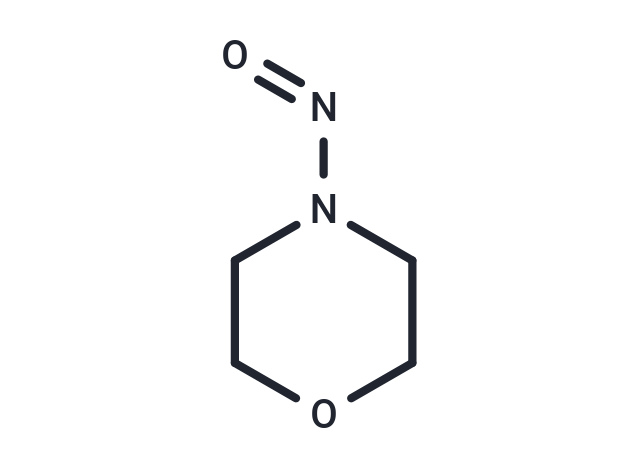
N-Nitrosomorpholine

Copy Product Info
😃Good
Catalog No. T40684Cas No. 59-89-2

N-Nitrosomorpholine is a light-sensitive nitrosamine with strong carcinogenicity in animals and is commonly used to induce liver cancer models.

N-Nitrosomorpholine

N-Nitrosomorpholine

Copy Product Info
😃Good
Catalog No. T40684Cas No. 59-89-2
N-Nitrosomorpholine is a light-sensitive nitrosamine with strong carcinogenicity in animals and is commonly used to induce liver cancer models.
Pack SizePriceUSA WarehouseGlobal WarehouseQuantity
500 mg$29-In Stock
1 mL x 10 mM (in DMSO)$29-In Stock
Add to Cart
Add to Quotation
In Stock Estimated shipping dateUSA Warehouse[1-2 days] Global Warehouse[5-7 days]
All TargetMol products are for research purposes only and cannot be used for human consumption. We do not provide products or services to individuals. Please comply with the intended use and do not use TargetMol products for any other purpose.
Questions
TargetMol
View More

Batch Information

Select Batch
Purity:≥98%
Appearance:Viscous
Color:Yellow
Contact us for more batch information

Resource Download

Product Introduction

N-Nitrosomorpholine AI Summary
N-Nitrosomorpholine affects various blood parameters such as red blood cell count, hemoglobin levels, hematocrit, mean corpuscular volume, mean corpuscular hemoglobin, mean corpuscular hemoglobin concentration, platelet count, and white blood cell count. It also impacts the percentage of different types of white blood cells including neutrophils, eosinophils, basophils, monocytes, and lymphocytes. Additionally, this compound influences levels of albumin, alkaline phosphatase, cholesterol, triglycerides, phospholipids, bilirubin, blood urea nitrogen, aspartate transaminase, creatinine, sodium, potassium, chloride, calcium, phosphorus, protein, alanine transaminase, lactate dehydrogenase, and gamma-glutamyl transferase. Furthermore, it impact body weight during the study..
Note: Summary generated by AI. Data source: ChEMBL
Bioactivity
Description
N-Nitrosomorpholine is a light-sensitive nitrosamine with strong carcinogenicity in animals and is commonly used to induce liver cancer models.
Disease Modeling Protocol
Liver tumor model
  • Modeling Mechanism:

    N-Nitrosomorpholine (NNM), a liver-specific chemical carcinogen, is introduced into mice through drinking water. It is activated by liver metabolic enzymes (such as cytochrome P450), producing alkylating intermediates that cause DNA damage in hepatocytes (such as base alkylation and chain breaks), initiating the "initiation-promotion" process of hepatocellular carcinoma. Continued exposure can induce abnormal hepatocyte proliferation, forming precancerous liver lesions (including G6Pase-negative and G6Pase-positive lesions) with altered glucose-6-phosphatase (G6Pase) activity. This provides a target for subsequent tumor promoters (such as TCBs), mimicking the pathological basis of early-stage human liver tumors.

  • Related Products:

    N-Nitrosomorpholine (T40684)

  • Modeling Method:

    Experimental Subject:

    Mice, B6C3F1, Male

    Dosage and Administration Route:

    ① Core modelling (initiation phase):
    - Carcinogen exposure: N-nitrosomorpholine, 160 mg/L, dissolved in drinking water, ad libitum consumption;
    - Interval period: Following cessation of N-nitrosomorpholine administration, standard drinking water provided for 22 weeks (allowing natural development of precancerous lesions);
    - Promoter phase (optional): 3,4,3′,4′-tetrachlorobiphenyl (TCB), 50 mg/kg, intraperitoneal injection or oral gavage, once every 3 days for 5 doses, commencing after the interval period;
    ② Control treatment: Control group administered ordinary drinking water without N-nitrosomorpholine; all other housing and treatment conditions identical;

    Dosing Frequency and Duration Model:

    Free access for 7 weeks

  • Validation:

    1. Pathological Indicators: - Liver Lesion Count: 29 weeks after modeling, G6Pase-negative and positive precancerous lesions were visible in the liver, with the total number of lesions per liver significantly higher than that in the control group; after combined TCB treatment, although the number of lesions decreased to 32%-57% of the control group, the proportion of large lesions (>0.5 mm²) increased, and the average volume increased; - Tissue Damage: HE staining showed disordered hepatocyte arrangement and abnormal cytoplasm; long-term treatment showed persistent liver inflammation and cell necrosis; 2. Enzymatic Indicators: - Serum Transaminases: The level of aspartate aminotransferase (AST) was significantly elevated, indicating persistent liver damage; 3. Histochemical Indicators: - G6Pase Activity Detection: Histochemical staining showed abnormal G6Pase activity (negative or positive) in the lesion area, which is a characteristic marker of precancerous lesions.

*Precautions:

*References:Ren L,et,al. Vasculoprotective effects of rosiglitazone through modulating renin-angiotensin system in vivo and vitro. Cardiovasc Diabetol. 2011 Jan 26;10:10.

Chemical Properties
Molecular Weight116.12
FormulaC4H8N2O2
Cas No.59-89-2
SmilesO=NN1CCOCC1
Relative Density.1.2829 g/cm3 (Estimated)
Storage & Solubility Information
StoragePure form: -20°C for 3 years | In solvent: -80°C for 1 year | Shipping with blue ice/Shipping at ambient temperature.
Solubility Information
DMSO: 98 mg/mL (843.95 mM), Sonication is recommended.
In Vivo Formulation
10% DMSO+40% PEG300+5% Tween 80+45% Saline: 3.3 mg/mL (28.42 mM), Sonication is recommended.
Please add the solvents sequentially, clarifying the solution as much as possible before adding the next one. Dissolve by heating and/or sonication if necessary. Working solution is recommended to be prepared and used immediately. The formulation provided above is for reference purposes only. In vivo formulations may vary and should be modified based on specific experimental conditions.
Solution Preparation Table
DMSO
1mg5mg10mg50mg
1 mM8.6118 mL43.0589 mL86.1178 mL430.5890 mL
5 mM1.7224 mL8.6118 mL17.2236 mL86.1178 mL
10 mM0.8612 mL4.3059 mL8.6118 mL43.0589 mL
20 mM0.4306 mL2.1529 mL4.3059 mL21.5295 mL
50 mM0.1722 mL0.8612 mL1.7224 mL8.6118 mL
100 mM0.0861 mL0.4306 mL0.8612 mL4.3059 mL

Calculator

  • Molarity Calculator
  • Dilution Calculator
  • Reconstitution Calculator
  • Molecular Weight Calculator

In Vivo Formulation Calculator (Clear solution)

Please enter your animal experiment information in the following box and click Calculate to obtain the stock solution preparation method and in vivo formula preparation method:
TargetMol | Animal experiments For example, if the intended dosage is 10 mg/kg for animals weighing 20 g , with a dosing volume of 100 μL per animal, TargetMol | Animal experiments and a total of 10 animals are to be administered, using a formulation of TargetMol | reagent 10% DMSO+ 40% PEG300+ 5% Tween 80+ 45% Saline/PBS/ddH2O , the resulting working solution concentration would be 2 mg/mL.

Stock Solution Preparation:

Dissolve 2 mg of the compound in 100 μL DMSOTargetMol | reagent to obtain a stock solution at a concentration of 20 mg/mL . If the required concentration exceeds the compound's known solubility, please contact us for technical support before proceeding.

Preparation of the In Vivo Formulation:

1) Add 100 μL of the DMSOTargetMol | reagent stock solution to 400 μL PEG300TargetMol | reagent and mix thoroughly until the solution becomes clear.

2) Add 50 μL Tween 80 and mix well until fully clarified.

3) Add 450 μL Saline,PBS or ddH2OTargetMol | reagent and mix thoroughly until a homogeneous solution is obtained.

This example is provided solely to demonstrate the use of the In Vivo Formulation Calculator and does not constitute a recommended formulation for any specific compound. Please select an appropriate dissolution and formulation strategy based on your experimental model and route of administration.
All co-solvents required for this protocol, includingDMSO, PEG300/PEG400, Tween 80, SBE-β-CD, and Corn oil, are available for purchase on the TargetMol website.
1 Enter information below:
mg/kg
g
μL
2 Enter the in vivo formulation:
% DMSO
%
% Tween 80
% Saline/PBS/ddH2O

Dose Conversion

You can also refer to dose conversion for different animals. More Dose Conversion

Tech Support

Please see Inhibitor Handling Instructions for more frequently ask questions. Topics include: how to prepare stock solutions, how to store products, and cautions on cell-based assays & animal experiments, etc

Keywords

Related Tags: buy N-Nitrosomorpholine | purchase N-Nitrosomorpholine | N-Nitrosomorpholine cost | order N-Nitrosomorpholine | N-Nitrosomorpholine chemical structure | N-Nitrosomorpholine formula | N-Nitrosomorpholine molecular weight