Shopping Cart
Remove All
  • TargetMol
    Your shopping cart is currently empty

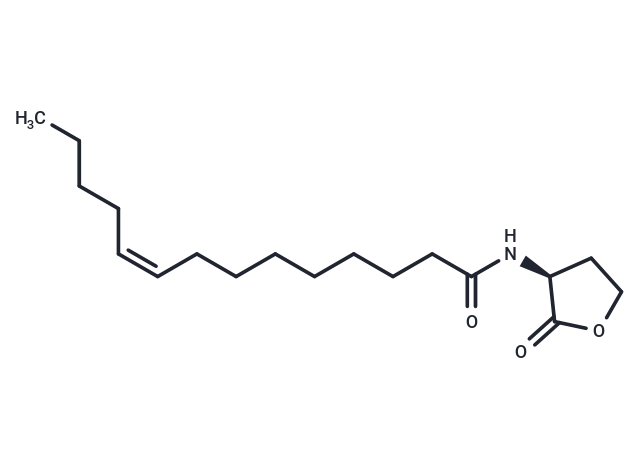
N-cis-tetradec-9Z-enoyl-L-Homoserine lactone

😃Good
Catalog No. T37738Cas No. 1675245-06-3

Quorum sensing is a regulatory process used by bacteria for controlling gene expression in response to increasing cell density. This regulatory process manifests itself with a variety of phenotypes including biofilm formation and virulence factor production. Coordinated gene expression is achieved by the production, release, and detection of small diffusible signal molecules called autoinducers. The N-acylated homoserine lactones (AHLs) comprise one such class of autoinducers, each of which generally consists of a fatty acid coupled with homoserine lactone (HSL). AHLs vary in acyl group length (C4-C18), in the substitution of C3 (hydrogen, hydroxyl, or oxo group) and in the presence or absence of one or more carbon-carbon double bonds in the fatty acid chain. These differences confer signal specificity through the affinity of transcriptional regulators of the LuxR family. C14:1-δ9-cis-(L)-HSL is a long-chain AHL that functions as a signaling molecule in the quorum sensing of A. vitis. Regulating bacterial quorum sensing signaling can be used to inhibit pathogenesis and thus, represents a new approach to antimicrobial therpy in the treatment of infectious diseases.

N-cis-tetradec-9Z-enoyl-L-Homoserine lactone

N-cis-tetradec-9Z-enoyl-L-Homoserine lactone

😃Good
Catalog No. T37738Cas No. 1675245-06-3
Quorum sensing is a regulatory process used by bacteria for controlling gene expression in response to increasing cell density. This regulatory process manifests itself with a variety of phenotypes including biofilm formation and virulence factor production. Coordinated gene expression is achieved by the production, release, and detection of small diffusible signal molecules called autoinducers. The N-acylated homoserine lactones (AHLs) comprise one such class of autoinducers, each of which generally consists of a fatty acid coupled with homoserine lactone (HSL). AHLs vary in acyl group length (C4-C18), in the substitution of C3 (hydrogen, hydroxyl, or oxo group) and in the presence or absence of one or more carbon-carbon double bonds in the fatty acid chain. These differences confer signal specificity through the affinity of transcriptional regulators of the LuxR family. C14:1-δ9-cis-(L)-HSL is a long-chain AHL that functions as a signaling molecule in the quorum sensing of A. vitis. Regulating bacterial quorum sensing signaling can be used to inhibit pathogenesis and thus, represents a new approach to antimicrobial therpy in the treatment of infectious diseases.
Pack SizePriceUSA WarehouseGlobal WarehouseQuantity
5 mg$16835 days35 days
10 mg$31635 days35 days
25 mg$74635 days35 days
50 mg$1,27035 days35 days
Add to Cart
Add to Quotation
In Stock Estimated shipping dateUSA Warehouse[1-2 days] Global Warehouse[5-7 days]
All TargetMol products are for research purposes only and cannot be used for human consumption. We do not provide products or services to individuals. Please comply with the intended use and do not use TargetMol products for any other purpose.
Questions
TargetMol
View More

Resource Download

Product Introduction

Bioactivity
Description
Quorum sensing is a regulatory process used by bacteria for controlling gene expression in response to increasing cell density. This regulatory process manifests itself with a variety of phenotypes including biofilm formation and virulence factor production. Coordinated gene expression is achieved by the production, release, and detection of small diffusible signal molecules called autoinducers. The N-acylated homoserine lactones (AHLs) comprise one such class of autoinducers, each of which generally consists of a fatty acid coupled with homoserine lactone (HSL). AHLs vary in acyl group length (C4-C18), in the substitution of C3 (hydrogen, hydroxyl, or oxo group) and in the presence or absence of one or more carbon-carbon double bonds in the fatty acid chain. These differences confer signal specificity through the affinity of transcriptional regulators of the LuxR family. C14:1-δ9-cis-(L)-HSL is a long-chain AHL that functions as a signaling molecule in the quorum sensing of A. vitis. Regulating bacterial quorum sensing signaling can be used to inhibit pathogenesis and thus, represents a new approach to antimicrobial therpy in the treatment of infectious diseases.
Chemical Properties
Molecular Weight309.45
FormulaC18H31NO3
Cas No.1675245-06-3
SmilesCCCC\C=C/CCCCCCCC(=O)N[C@H]1CCOC1=O
Storage & Solubility Information
StoragePowder: -20°C for 3 years | In solvent: -80°C for 1 year | Shipping with blue ice/Shipping at ambient temperature.
Solubility Information
Ethanol: 2 mg/mL (6.46 mM), Sonication is recommended.
DMF: 20 mg/mL (64.63 mM), Sonication is recommended.
DMSO:PBS(pH7.2) 1:1: 0.5 mg/mL (1.62 mM), Sonication is recommended.
DMSO: 20 mg/mL (64.63 mM), Sonication is recommended.
Solution Preparation Table
Ethanol/DMF/DMSO
1mg5mg10mg50mg
5 mM0.6463 mL3.2315 mL6.4631 mL32.3154 mL
DMF/DMSO
1mg5mg10mg50mg
10 mM0.3232 mL1.6158 mL3.2315 mL16.1577 mL
20 mM0.1616 mL0.8079 mL1.6158 mL8.0788 mL
50 mM0.0646 mL0.3232 mL0.6463 mL3.2315 mL

Calculator

  • Molarity Calculator
  • Dilution Calculator
  • Reconstitution Calculator
  • Molecular Weight Calculator

In Vivo Formulation Calculator (Clear solution)

Please enter your animal experiment information in the following box and click Calculate to obtain the stock solution preparation method and in vivo formula preparation method:
TargetMol | Animal experiments For example, if the intended dosage is 10 mg/kg for animals weighing 20 g , with a dosing volume of 100 μL per animal, TargetMol | Animal experiments and a total of 10 animals are to be administered, using a formulation of TargetMol | reagent 10% DMSO+ 40% PEG300+ 5% Tween 80+ 45% Saline/PBS/ddH2O , the resulting working solution concentration would be 2 mg/mL.

Stock Solution Preparation:

Dissolve 2 mg of the compound in 100 μL DMSOTargetMol | reagent to obtain a stock solution at a concentration of 20 mg/mL . If the required concentration exceeds the compound's known solubility, please contact us for technical support before proceeding.

Preparation of the In Vivo Formulation:

1) Add 100 μL of the DMSOTargetMol | reagent stock solution to 400 μL PEG300TargetMol | reagent and mix thoroughly until the solution becomes clear.

2) Add 50 μL Tween 80 and mix well until fully clarified.

3) Add 450 μL Saline,PBS or ddH2OTargetMol | reagent and mix thoroughly until a homogeneous solution is obtained.

This example is provided solely to demonstrate the use of the In Vivo Formulation Calculator and does not constitute a recommended formulation for any specific compound. Please select an appropriate dissolution and formulation strategy based on your experimental model and route of administration.
All co-solvents required for this protocol, includingDMSO, PEG300/PEG400, Tween 80, SBE-β-CD, and Corn oil, are available for purchase on the TargetMol website.
1 Enter information below:
mg/kg
g
μL
2 Enter the in vivo formulation:
% DMSO
%
% Tween 80
% Saline/PBS/ddH2O

Dose Conversion

You can also refer to dose conversion for different animals. More Dose Conversion

Tech Support

Please see Inhibitor Handling Instructions for more frequently ask questions. Topics include: how to prepare stock solutions, how to store products, and cautions on cell-based assays & animal experiments, etc

Keywords

Related Tags: buy N-cis-tetradec-9Z-enoyl-L-Homoserine lactone | purchase N-cis-tetradec-9Z-enoyl-L-Homoserine lactone | N-cis-tetradec-9Z-enoyl-L-Homoserine lactone cost | order N-cis-tetradec-9Z-enoyl-L-Homoserine lactone | N-cis-tetradec-9Z-enoyl-L-Homoserine lactone chemical structure | N-cis-tetradec-9Z-enoyl-L-Homoserine lactone formula | N-cis-tetradec-9Z-enoyl-L-Homoserine lactone molecular weight