


Shopping Cart
Remove All Your shopping cart is currently empty

Synonyms: MOG (35-55)
| Pack Size | Price | USA Stock | Global Stock | Quantity |
|---|---|---|---|---|
| 1 mg | $56 | In Stock | In Stock | |
| 5 mg | $156 | In Stock | In Stock | |
| 10 mg | $239 | In Stock | In Stock | |
| 25 mg | $392 | In Stock | In Stock | |
| 50 mg | $597 | - | In Stock | |
| 100 mg | $852 | - | In Stock | |
| 200 mg | $1,170 | - | In Stock |
| Description | MOG (35-55) mouse, rat is a minor component of the central nervous system myelin with high brain specificity and strong immunogenicity. It can induce T and B cell responses, trigger relapsing-remitting neurological disorders with plaque-like demyelination, and is commonly used for inducing experimental autoimmune encephalomyelitis (EAE) models. |
| In vitro | METHODS: Dendritic cells (DCs) were loaded with MOG35-55 peptide at a concentration of 10 μg/mL. Two hours later, lipopolysaccharide (LPS, Sigma-Aldrich) was added to the cultures at a concentration of 0.25 μg/mL. Two days later (day 8 of culture), DCs were phenotyped using flow cytometry. RESULTS In cultures of DCs loaded with Myelin Oligodendrocyte Glycoprotein Peptide (35-55), mouse, rat (MOG (35-55)), the cytokines secreted were IL-6, IL-10, IFN-γ, TNF-α, and TGF-β, with TGF-β secreted at the highest concentration; IL-4 and IL-17 were not detected in any of the cultures. [2] |
| In vivo | METHODS: Female C57BL/6 mice (n = 20) were subcutaneously injected with 200 μL of 200 μg Myelin Oligodendrocyte Glycoprotein Peptide (35-55), mouse, rat (MOG (35-55)). 14 days after immunization, T cells were isolated from the spleen and purified into CD4 and CD8 T cells using CD4 and CD8 isolation kits, and then the purity was determined by flow cytometric analysis; these cells were stimulated with Myelin Oligodendrocyte Glycoprotein Peptide (35-55), mouse, rat (MOG (35-55)) and used in proliferation assays. Enzyme-linked immunosorbent assay (ELISA) was used to detect interferon-γ (IFN-γ) and interleukin (IL)-4 secretion from the supernatants of cultured CD4 and CD8 T cells. RESULTS After CD8/CD4 enrichment, CD8CD3 and CD4CD3 cells accounted for 86% and 94% of the total CD3 cells, respectively. CD8 T cells secreted less IFN-γ and IL-4 than CD4 T cells. [1] |
| Synonyms | MOG (35-55) |
| Disease Modeling Protocol | Experimental autoimmune encephalomyelitis (EAE) model
*Precautions: All mice were sacrificed 40 days after modeling. |
| Animal Research | Female C57BL/6 mice (n?=?20) were induced by myelin oligodendrocyte glycoprotein (MOG)35-55 peptide.?At 14 days after immunization, T cells were isolated from the spleen and purified as CD4 and CD8 T cells by using CD4 and CD8 isolation kits, and then the purity was determined by flow cytometric analysis.?These cells were stimulated by MOG35-55 peptide and applied to proliferation assays.?The interferon-gamma (IFN-γ) and interleukin (IL)-4 secretion of supernatant of cultured CD4 and CD8 T cells were measured by enzyme-linked immunosorbent assays (ELISA).?For adoptive transfer, recipient mice were injected with MOG35-55-specific CD8 or CD4 T cells.?EAE clinical course was measured by EAE score at 0-5 scale and spinal cord was examined by staining with hematoxylin and eosin and Luxol fast blue staining[1]. |
| Molecular Weight | 2581.95 |
| Formula | C118H177N35O29S |
| Cas No. | 149635-73-4 |
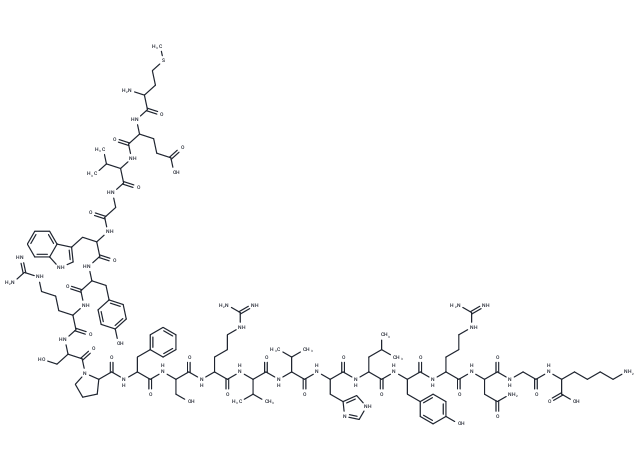
| Smiles | CSCCC(N)C(=O)NC(CCC(O)=O)C(=O)NC(C(C)C)C(=O)NCC(=O)NC(Cc1c[nH]c2ccccc12)C(=O)NC(Cc1ccc(O)cc1)C(=O)NC(CCCNC(N)=N)C(=O)NC(CO)C(=O)N1CCCC1C(=O)NC(Cc1ccccc1)C(=O)NC(CO)C(=O)NC(CCCNC(N)=N)C(=O)NC(C(C)C)C(=O)NC(C(C)C)C(=O)NC(Cc1c[nH]cn1)C(=O)NC(CC(C)C)C(=O)NC(Cc1ccc(O)cc1)C(=O)NC(CCCNC(N)=N)C(=O)NC(CC(N)=O)C(=O)NCC(=O)NC(CCCCN)C(O)=O |
| Relative Density. | 1.48 g/cm3 (Predicted) |
| Sequence | H-{DL-Met}-{DL-Glu}-{DL-Val}-Gly-{DL-Trp}-{DL-Tyr}-{DL-Arg}-{DL-Ser}-{DL-Pro}-{DL-Phe}-{DL-Ser}-{DL-Arg}-{DL-Val}-{DL-Val}-{DL-His}-{DL-Leu}-{DL-Tyr}-{DL-Arg}-{DL-Asn}-Gly-{DL-Lys}-OH |
| Sequence Short | MEVGWYRSPFSRVVHLYRNGK |
| Storage | Keep away from moisture,Store at low temperature Powder: -20°C for 3 years | In solvent: -80°C for 1 year Shipping with blue ice/Shipping at ambient temperature. | |||||||||||||||
| Solubility Information | H2O: 14.38 mg/mL (5.57 mM), Sonication is recommended.  DMSO: Insoluble | |||||||||||||||
Solution Preparation Table | ||||||||||||||||
H2O
Note : The dilution table applies only to solid products. For liquid products, please calculate the stock solution based on the stated concentration and/or density. | ||||||||||||||||
 For example, if the intended dosage is 10 mg/kg for animals weighing 20 g , with a dosing volume of 100 μL per animal, and a total of 10 animals are to be administered, using a formulation of
  10% DMSO+ 40% PEG300+ 5% Tween 80+ 45% Saline/PBS/ddH2O , the resulting working solution concentration would be 2 mg/mL.
Dissolve 2 mg of the compound in 100 μL DMSO to obtain a stock solution at a concentration of 20 mg/mL . If the required concentration exceeds the compound's known solubility, please contact us for technical support before proceeding.
1) Add 100 μL of the DMSO stock solution to 400 µL PEG300 and mix thoroughly until the solution becomes clear.
2) Add 50 µL Tween 80 and mix well until fully clarified.
3) Add 450 µL Saline,PBS or ddH2O and mix thoroughly until a homogeneous solution is obtained.
| Size | Quantity | Unit Price | Amount | Operation |
|---|
 Feedback
 Hello! How can I help you today?
Copyright © 2015-2026 TargetMol Chemicals Inc. All Rights Reserved.
