


Shopping Cart
Remove All Your shopping cart is currently empty

Synonyms: INV-202, INV202, INV 202, (S)-MRI-1891, (S)-MRI1891, (S)-MRI 1891
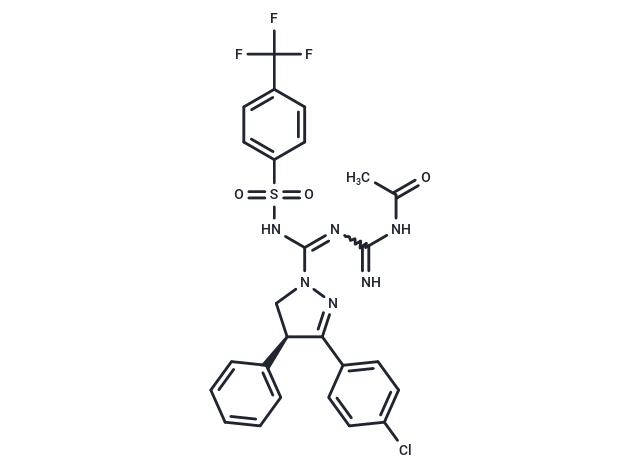
| Pack Size | Price | USA Stock | Global Stock | Quantity |
|---|---|---|---|---|
| 1 mg | $61 | - | In Stock | |
| 5 mg | $140 | - | In Stock | |
| 10 mg | $219 | - | In Stock | |
| 25 mg | $436 | - | In Stock | |
| 50 mg | $612 | - | In Stock | |
| 1 mL x 10 mM (in DMSO) | $183 | - | In Stock |
| Description | Monlunabant is a selective CB1 antagonist that blocks CB1 receptor signaling to reduce appetite and fat accumulation, making it suitable for research on obesity and metabolic syndrome. Monlunabant binds to hCB1 and hCB2 with Ki values of 0.3 nM and 613 nM, respectively. |
| In vitro | Monlunabant inhibits CB1-induced β-arrestin-2 recruitment (IC₅₀ = 21 pM) and G protein activation (IC₅₀ = 6 nM). [2] Methods: INS-1 (832/13) rat insulinoma cells were incubated with Monlunabant (0.3, 3 nM) and glucose for 1 h, and insulin release was measured using AlphaLISA. Results: Monlunabant significantly enhanced insulin secretion stimulated by 10 mM glucose at concentrations of 0.3 and 3 nM. [3] Methods: Human islets (from 3 non-obese male donors with normal HbA1c levels) were treated with monlunabant (3 nM) and incubated for 30 min. After 30 min, treated with apoptotic cytokines (IL-1β (10 ng/mL) + IFNγ (100 ng/mL)), incubated for 48 h, and apoptosis and survival were assessed by flow cytometry (Annexin V-FITC / FVD eFlore 780). Results: Monlunabant significantly reduced cytokine-induced apoptosis. [3] |
| In vivo | Methods: Using CB1flox/flox mice as controls, a single oral dose of monlunabant (3 mg/kg) was administered. One and a half hours later, ethanol (5 g/kg) was administered orally, and the mice were sacrificed 3 hours after ethanol administration. Results: Monlunabant significantly reduced alcohol-induced intestinal permeability in CB1flox/flox mice, upregulated tight junction protein mRNA, and decreased p-ERK1/2 expression. [1] Methods: To investigate the effects of monlunabant on glucose metabolism, HFD-induced obese wild-type mice were administered a single oral dose of monlunabant (1 mg/kg). Clamping was initiated 1 hour after dosing, followed by detection of radiolabeled 2-deoxyglucose. Results: Monlunabant increased systemic glucose clearance and enhanced 2-deoxyglucose uptake in skeletal muscle.[2] |
| Synonyms | INV-202, INV202, INV 202, (S)-MRI-1891, (S)-MRI1891, (S)-MRI 1891 |
| Molecular Weight | 591 |
| Formula | C26H22ClF3N6O3S |
| Cas No. | 2712480-46-9 |
| Smiles | C(NS(=O)(=O)C1=CC=C(C(F)(F)F)C=C1)(=NC(NC(C)=O)=N)N2N=C([C@H](C2)C3=CC=CC=C3)C4=CC=C(Cl)C=C4 |
| Storage | Powder: -20°C for 3 years | In solvent: -80°C for 1 year Shipping with blue ice/Shipping at ambient temperature. | |||||||||||||||||||||||||||||||||||
| Solubility Information | DMSO: 80.00 mg/mL (135.36 mM), Sonication is recommended. | |||||||||||||||||||||||||||||||||||
Solution Preparation Table | ||||||||||||||||||||||||||||||||||||
DMSO
Note : The dilution table applies only to solid products. For liquid products, please calculate the stock solution based on the stated concentration and/or density. | ||||||||||||||||||||||||||||||||||||
 For example, if the intended dosage is 10 mg/kg for animals weighing 20 g , with a dosing volume of 100 μL per animal, and a total of 10 animals are to be administered, using a formulation of
  10% DMSO+ 40% PEG300+ 5% Tween 80+ 45% Saline/PBS/ddH2O , the resulting working solution concentration would be 2 mg/mL.
Dissolve 2 mg of the compound in 100 μL DMSO to obtain a stock solution at a concentration of 20 mg/mL . If the required concentration exceeds the compound's known solubility, please contact us for technical support before proceeding.
1) Add 100 μL of the DMSO stock solution to 400 µL PEG300 and mix thoroughly until the solution becomes clear.
2) Add 50 µL Tween 80 and mix well until fully clarified.
3) Add 450 µL Saline,PBS or ddH2O and mix thoroughly until a homogeneous solution is obtained.
| Size | Quantity | Unit Price | Amount | Operation |
|---|
 Feedback
 Hello! How can I help you today?
Copyright © 2015-2026 TargetMol Chemicals Inc. All Rights Reserved.
