


Shopping Cart
Remove All Your shopping cart is currently empty

Synonyms:
| Pack Size | Price | USA Stock | Global Stock | Quantity |
|---|---|---|---|---|
| 5 mg | $105 | 35 days | 35 days | |
| 10 mg | $157 | 35 days | 35 days | |
| 25 mg | $338 | 35 days | 35 days | |
| 50 mg | $623 | 35 days | 35 days |
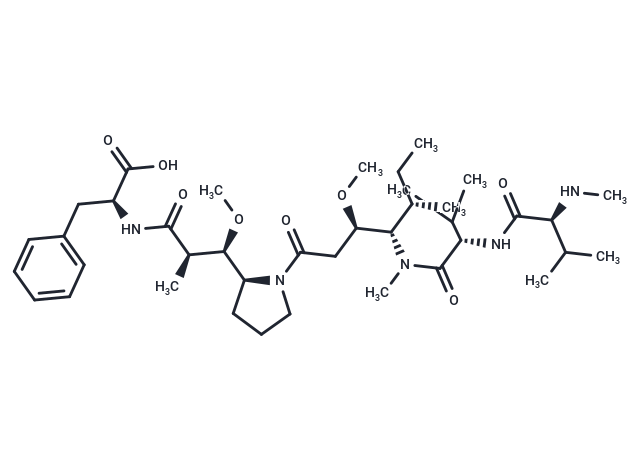
| Description | MMAF (GMP) refers to the GMP grade reagents of MMAF. MMAF (MonoMethyl auristatin F), an antimitotic agent, inhibits cell division by blocking the polymerization of tubulin. |
| In vitro | MMAF shows in vitro cytotoxicity against a panel of cell lines. The IC50 values for Karpas 299, H3396, 786-O and Caki-1 are 119, 105, 257, and 200 nM, respectively. Targeted MMAF is much more potent than the free drug, and that cAC10 conjugates of MMAF display pronounced activities. On a molar basis, the cAC10-L1-MMAF4 is an average of over 2200-fold more potent than free MMAF and is active on all the CD30-positive cell lines tested[1]. |
| In vivo | The maximum tolerated dose in mice of MMAF (>16 mg/kg) is much higher than MMAE (1 mg/kg). cAC10-L1-MMAF4 has an MTD of 50 mg/kg in mice and 15 mg/kg in rats. The corresponding cAC10-L4-MMAF4 ADC was much less toxic, having MTDs in mice and rats of >150 mg/ kg and 90 mg/kg in rats, respectively[1]. |
| Molecular Weight | 731.962 |
| Formula | C39H65N5O8 |
| Cas No. | 745017-94-1 |
| Smiles | O=C(O)[C@@H](NC([C@H](C)[C@H]([C@H]1N(C(C[C@@H](OC)[C@@H](N(C)C([C@@H](NC([C@@H](NC)C(C)C)=O)C(C)C)=O)[C@@H](C)CC)=O)CCC1)OC)=O)CC2=CC=CC=C2 |
| Relative Density. | 1.116 g/cm3 (Predicted) |
| Storage | Powder: -20°C for 3 years | In solvent: -80°C for 1 year Shipping with blue ice/Shipping at ambient temperature. |
 For example, if the intended dosage is 10 mg/kg for animals weighing 20 g , with a dosing volume of 100 μL per animal, and a total of 10 animals are to be administered, using a formulation of
  10% DMSO+ 40% PEG300+ 5% Tween 80+ 45% Saline/PBS/ddH2O , the resulting working solution concentration would be 2 mg/mL.
Dissolve 2 mg of the compound in 100 μL DMSO to obtain a stock solution at a concentration of 20 mg/mL . If the required concentration exceeds the compound's known solubility, please contact us for technical support before proceeding.
1) Add 100 μL of the DMSO stock solution to 400 µL PEG300 and mix thoroughly until the solution becomes clear.
2) Add 50 µL Tween 80 and mix well until fully clarified.
3) Add 450 µL Saline,PBS or ddH2O and mix thoroughly until a homogeneous solution is obtained.
| Size | Quantity | Unit Price | Amount | Operation |
|---|
 Feedback
 Hello! How can I help you today?
Copyright © 2015-2026 TargetMol Chemicals Inc. All Rights Reserved.
