


Shopping Cart
Remove All Your shopping cart is currently empty

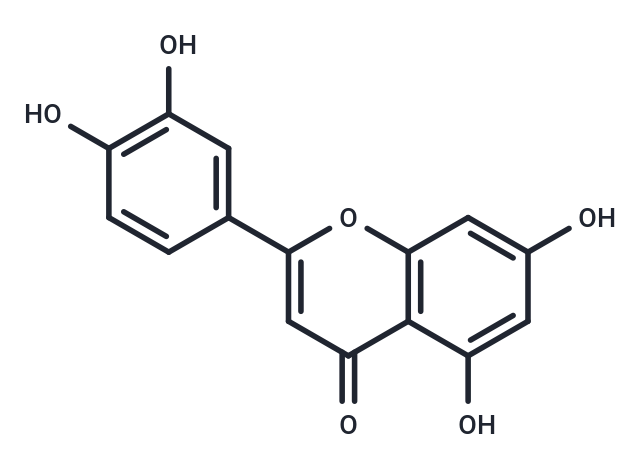
Synonyms: Luteolol (Standard), Luteoline (Standard), Digitoflavone (Standard)
| Pack Size | Price | USA Stock | Global Stock | Quantity |
|---|---|---|---|---|
| 25 mg | $48 | 7-10 days | 7-10 days |
| Description | Luteolin (Standard) is a reference compound for analytical and biochemical research involving Luteolin. Luteolin (Standard) belongs to the flavonoid class and functions as a Nrf2 inhibitor and PDE inhibitor. Luteolin (Standard) is utilized in biomedical research focused on flavonoid signaling modulation, oxidative stress regulation, inflammatory pathway analysis, and enzyme inhibition profiling across tumor, infectious, and allergic disease models. |
| In vitro | Methods Human lung cancer NCI-H460 cells were treated with luteolin at various concentrations for different durations. Cell viability, cell cycle, apoptosis and the expression of related proteins were detected. Results 1.Luteolin at 0–160 μM inhibited the viability of NCI-H460 cells in a concentration-dependent manner after 24-hour treatment . 2.Treatment with 20–80 μM luteolin for 24 hours induced S-phase cell cycle arrest . 3.Luteolin at 320–580 μM induced cell apoptosis following 48-hour incubation . 4.After 24-hour treatment with 20–80 μM luteolin, the Bax/Bcl-2 ratio was upregulated in a concentration-dependent manner. Only 80 μM luteolin downregulated Bad expression, and Sirt1 protein levels were decreased dose-dependently within this concentration range [1]. |
| In vivo | Methods:Male Wistar rats with non-alcoholic steatohepatitis induced by high-fat and high-sugar diet were intragastrically administered luteolin at doses of 10–100 mg/kg daily for 12 consecutive weeks. The antioxidant capacity and changes of inflammation-related pathways were evaluated. Results:Luteolin exhibited antioxidant activity. It targeted and inhibited the pro-inflammatory pathways of IL-1 and IL-18, thereby effectively preventing non-alcoholic steatohepatitis in rats [2]. |
| Synonyms | Luteolol (Standard), Luteoline (Standard), Digitoflavone (Standard) |
| Molecular Weight | 286.24 |
| Formula | C15H10O6 |
| Cas No. | 491-70-3 |
| Smiles | O=C1C=C(OC=2C=C(O)C=C(O)C12)C=3C=CC(O)=C(O)C3 |
| Relative Density. | 1.2981 g/cm3 (Estimated) |
| Storage | Keep away from direct sunlight Powder: -20°C for 3 years | In solvent: -80°C for 1 year Shipping with blue ice/Shipping at ambient temperature. | |||||||||||||||||||||||||||||||||||
| Solubility Information | DMSO: 80 mg/mL (279.49 mM), Sonication is recommended. | |||||||||||||||||||||||||||||||||||
Solution Preparation Table | ||||||||||||||||||||||||||||||||||||
DMSO
Note : The dilution table applies only to solid products. For liquid products, please calculate the stock solution based on the stated concentration and/or density. | ||||||||||||||||||||||||||||||||||||
 For example, if the intended dosage is 10 mg/kg for animals weighing 20 g , with a dosing volume of 100 μL per animal, and a total of 10 animals are to be administered, using a formulation of
  10% DMSO+ 40% PEG300+ 5% Tween 80+ 45% Saline/PBS/ddH2O , the resulting working solution concentration would be 2 mg/mL.
Dissolve 2 mg of the compound in 100 μL DMSO to obtain a stock solution at a concentration of 20 mg/mL . If the required concentration exceeds the compound's known solubility, please contact us for technical support before proceeding.
1) Add 100 μL of the DMSO stock solution to 400 µL PEG300 and mix thoroughly until the solution becomes clear.
2) Add 50 µL Tween 80 and mix well until fully clarified.
3) Add 450 µL Saline,PBS or ddH2O and mix thoroughly until a homogeneous solution is obtained.
| Size | Quantity | Unit Price | Amount | Operation |
|---|
 Feedback
 Hello! How can I help you today?
Copyright © 2015-2026 TargetMol Chemicals Inc. All Rights Reserved.
