


Shopping Cart
Remove All Your shopping cart is currently empty

Synonyms:
| Pack Size | Price | USA Stock | Global Stock | Quantity |
|---|---|---|---|---|
| 25 mg | $2,500 | - | In Stock | |
| 50 mg | $3,850 | - | In Stock | |
| 100 mg | $6,150 | - | In Stock |
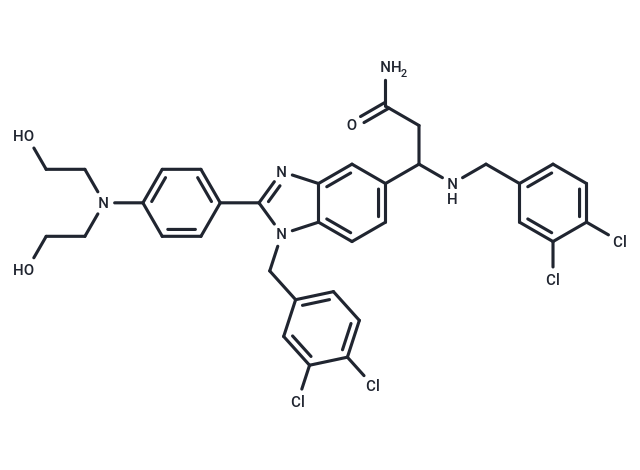
| Description | LLS30 is an allosteric inhibitor of Galectin-1 (Gal-1). LLS30 inhibits the downstream MEK/ERK signaling pathway and also inhibits Akt phosphorylation. LLS30 exhibits potent proliferation-inhibitory activity against various prostate cancer cell lines. |
| In vitro | Methods: NF96.2 and NF02.2 cells were treated with LLS30 at various concentrations (0, 1.5, 3, 10, 20, 50, 100 μM) for 72 hours, and cell viability was assessed using the MTT assay. Results: LLS30 inhibited proliferation in a dose-dependent manner, with IC₅₀ values of 2.9 μM and 3.6 μM for NF96.2 and NF02.2, respectively. [1] Methods: NF96.2 and NF02.2 cells were treated with 5 μM LLS30 for 12 and 24 hours, and caspase-3/7 activity was detected. Results: LLS30 significantly increased caspase-3/7 activity and induced MPNST cell apoptosis in a time-dependent manner. [1] Methods: PC3, DU145, 22RV1, and CWR-R1 cells were seeded at 3 × 10³ cells per well and treated with (1, 5, 10, 25, 50, 100 μM) LLS30 for 72 h; cell viability was assessed using the CellTiter-Glo assay. Results: LLS30 inhibited CRPC cell proliferation in a dose-dependent manner, with IC₅₀ values of 10.4 μM for PC3, 5.3 μM for DU145, 3.3 μM for 22RV1, and 5.9 μM for CWR-R1.[2] |
| In vivo | Methods: An in situ tumor model was established by injecting NF96.2 cells into the sciatic nerve of nude mice. After tumor formation, LLS30 (10 mg/kg, once daily for 14 consecutive days) was administered intraperitoneally, and tumor burden was monitored using in vivo imaging. Results: In the LLS30 group, tumor bioluminescence signals were significantly reduced, tumor growth was strongly inhibited, and the formation of lung metastases was almost completely suppressed. [1] Methods: Nude mice were subcutaneously inoculated with 22RV1 cells. After tumor formation, LLS30 (30 mg/kg, daily for 2 consecutive weeks) was administered intraperitoneally, and tumor volume and body weight were monitored. Results: LLS30 significantly inhibited tumor growth, reduced the Ki-67 positivity rate by 38.8%, and caused no significant weight loss in mice, demonstrating good safety. [2] |
| Molecular Weight | 701.47 |
| Formula | C34H33Cl4N5O3 |
| Cas No. | 2138367-58-3 |
| Smiles | O=C(N)CC(NCC1=CC=C(Cl)C(Cl)=C1)C2=CC=C3C(N=C(C=4C=CC(=CC4)N(CCO)CCO)N3CC5=CC=C(Cl)C(Cl)=C5)=C2 |
| Storage | Powder: -20°C for 3 years | In solvent: -80°C for 1 year Shipping with blue ice/Shipping at ambient temperature. |
 For example, if the intended dosage is 10 mg/kg for animals weighing 20 g , with a dosing volume of 100 μL per animal, and a total of 10 animals are to be administered, using a formulation of
  10% DMSO+ 40% PEG300+ 5% Tween 80+ 45% Saline/PBS/ddH2O , the resulting working solution concentration would be 2 mg/mL.
Dissolve 2 mg of the compound in 100 μL DMSO to obtain a stock solution at a concentration of 20 mg/mL . If the required concentration exceeds the compound's known solubility, please contact us for technical support before proceeding.
1) Add 100 μL of the DMSO stock solution to 400 µL PEG300 and mix thoroughly until the solution becomes clear.
2) Add 50 µL Tween 80 and mix well until fully clarified.
3) Add 450 µL Saline,PBS or ddH2O and mix thoroughly until a homogeneous solution is obtained.
| Size | Quantity | Unit Price | Amount | Operation |
|---|
 Feedback
 Hello! How can I help you today?
Copyright © 2015-2026 TargetMol Chemicals Inc. All Rights Reserved.
