


Shopping Cart
Remove All Your shopping cart is currently empty


Synonyms:
| Pack Size | Price | USA Stock | Global Stock | Quantity |
|---|---|---|---|---|
| 1 mg | $118 | In Stock | In Stock | |
| 5 mg | $248 | In Stock | In Stock | |
| 10 mg | $389 | In Stock | In Stock | |
| 25 mg | $652 | In Stock | In Stock | |
| 50 mg | $928 | In Stock | In Stock | |
| 100 mg | $1,260 | In Stock | In Stock |
| Description | LL-37, Human acetate(154947-66-7 free base) is a 37-residue, amphipathic, cathelicidin-derived antimicrobial peptide. LL-37, Human acetate (154947-66-7 free base) exhibits multiple activities including antimicrobial, immunomodulatory, chemotactic, wound-healing, antiviral, and antitumor effects.LL-37, Human acetate (154947-66-7 free base) helps protect the cornea from infection and regulates wound healing. |
| Targets & IC50 | PANC1 cells:10.17 µM, MIAPaCa2 cells:11.52 µM, SARS-CoV-2 pseudovirion:4.74 μg/mL |
| In vitro | Methods: A suspension of Pseudomonas aeruginosa (PA) was treated with LL-37, Human acetate(154947-66-7 free base) (0.05–100 μg/mL), incubated with shaking at 37°C for 2 hours, and then colony counts were performed. Results: LL-37, Human acetate (154947-66-7 free base) effectively killed the bacteria, with an EC₅₀ of 2.8 ± 1.3 μg/mL. [1] Methods: Human primary corneal epithelial cells (P-HCEC) were treated with LL-37, Human acetate (154947-66-7 free base) (0.1–20 μg/mL) were added to the lower chamber (blind chemotaxis chamber), treated for 16 h, and cell migration was counted under high-power magnification after staining the migration membrane. Results: LL-37, Human acetate (154947-66-7 free base) significantly induced cell migration, with the maximum migration concentration at 5 μg/mL. [1] Methods: Human airway epithelial BEAS-2B cells were infected with rhinovirus RV1B at a 0.15 MOI and treated with 4 μM LL-37 for 24 or 48 h. IFNβ expression and RV viral load were detected using qPCR, ELISA, and dot blot. Results: LL-37 increased RV-induced IFNβ mRNA expression by approximately 6-fold and reduced RV viral load by approximately 40%, without significantly altering IFNβ protein levels. [3] Methods: BEAS-2B cells were loaded with the Ca²⁺ fluorescent probe Fluo-4 AM and treated with 4 μM LL-37; intracellular Ca²⁺ fluorescence was continuously monitored for 40 min. Results: LL-37 significantly increased intracellular Ca²⁺ concentrations in BEAS-2B cells, with levels approximately 70% higher than the control group at 40 min.[3] |
| In vivo | Methods: Mice with MRSA pneumonia were administered 0–2 mg/kg of LL-37, Human acetate(154947-66-7 free base) via endotracheal instillation. Effective doses were identified 24 hours later based on lung tissue histopathology scores. Results: The effective dose of LL-37, Human acetate was 0.8 mg/kg; doses >2 mg/kg provided no protective effect and were toxic. [2] |
| Molecular Weight | 4553.31 |
| Formula | C207H344N60O55 |
| Smiles | CC[C@H](C)[C@@H](C(=O)NCC(=O)N[C@@H](CCCCN)C(=O)N[C@@H](CCC(=O)O)C(=O)N[C@@H](CC1=CC=CC=C1)C(=O)N[C@@H](CCCCN)C(=O)N[C@@H](CCCNC(=N)N)C(=O)N[C@@H]([C@@H](C)CC)C(=O)N[C@@H](C(C)C)C(=O)N[C@@H](CCC(=O)N)C(=O)N[C@@H](CCCNC(=N)N)C(=O)N[C@@H]([C@@H](C)CC)C(=O)N[C@@H](CCCCN)C(=O)N[C@@H](CC(=O)O)C(=O)N[C@@H](CC2=CC=CC=C2)C(=O)N[C@@H](CC(C)C)C(=O)N[C@@H](CCCNC(=N)N)C(=O)N[C@@H](CC(=O)N)C(=O)N[C@@H](CC(C)C)C(=O)N[C@@H](C(C)C)C(=O)N3CCC[C@H]3C(=O)N[C@@H](CCCNC(=N)N)C(=O)N[C@@H]([C@@H](C)O)C(=O)N[C@@H](CCC(=O)O)C(=O)N[C@@H](CO)C(=O)O)NC(=O)[C@H](CCCCN)NC(=O)[C@H](CCC(=O)O)NC(=O)[C@H](CCCCN)NC(=O)[C@H](CO)NC(=O)[C@H](CCCCN)NC(=O)[C@H](CCCNC(=N)N)NC(=O)[C@H](CC4=CC=CC=C4)NC(=O)[C@H](CC5=CC=CC=C5)NC(=O)[C@H](CC(=O)O)NC(=O)CNC(=O)[C@H](CC(C)C)NC(=O)[C@H](CC(C)C)N.CC(=O)O |
| Relative Density. | no data available |
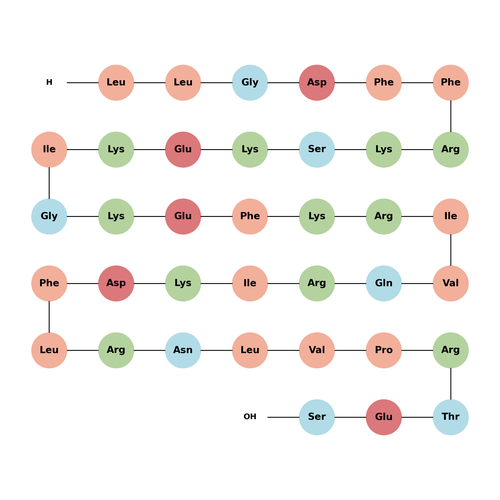
| Sequence | H-Leu-Leu-Gly-Asp-Phe-Phe-Arg-Lys-Ser-Lys-Glu-Lys-Ile-Gly-Lys-Glu-Phe-Lys-Arg-Ile-Val-Gln-Arg-Ile-Lys-Asp-Phe-Leu-Arg-Asn-Leu-Val-Pro-Arg-Thr-Glu-Ser-OH |
| Sequence Short | LLGDFFRKSKEKIGKEFKRIVQRIKDFLRNLVPRTES |
| Storage | Keep away from moisture,Store at low temperature Powder: -20°C for 3 years | In solvent: -80°C for 1 year Shipping with blue ice/Shipping at ambient temperature. | |||||||||||||||
| Solubility Information | DMSO: Insoluble H2O: 25.8 mg/mL (5.67 mM), Sonication is recommended.  | |||||||||||||||
Solution Preparation Table | ||||||||||||||||
H2O
Note : The dilution table applies only to solid products. For liquid products, please calculate the stock solution based on the stated concentration and/or density. | ||||||||||||||||
 For example, if the intended dosage is 10 mg/kg for animals weighing 20 g , with a dosing volume of 100 μL per animal, and a total of 10 animals are to be administered, using a formulation of
  10% DMSO+ 40% PEG300+ 5% Tween 80+ 45% Saline/PBS/ddH2O , the resulting working solution concentration would be 2 mg/mL.
Dissolve 2 mg of the compound in 100 μL DMSO to obtain a stock solution at a concentration of 20 mg/mL . If the required concentration exceeds the compound's known solubility, please contact us for technical support before proceeding.
1) Add 100 μL of the DMSO stock solution to 400 µL PEG300 and mix thoroughly until the solution becomes clear.
2) Add 50 µL Tween 80 and mix well until fully clarified.
3) Add 450 µL Saline,PBS or ddH2O and mix thoroughly until a homogeneous solution is obtained.
| Size | Quantity | Unit Price | Amount | Operation |
|---|
 Feedback
 Hello! How can I help you today?
Copyright © 2015-2026 TargetMol Chemicals Inc. All Rights Reserved.
