


Shopping Cart
Remove All Your shopping cart is currently empty

Synonyms:
| Pack Size | Price | USA Stock | Global Stock | Quantity |
|---|---|---|---|---|
| 5 mg | Inquiry | Inquiry | Inquiry |
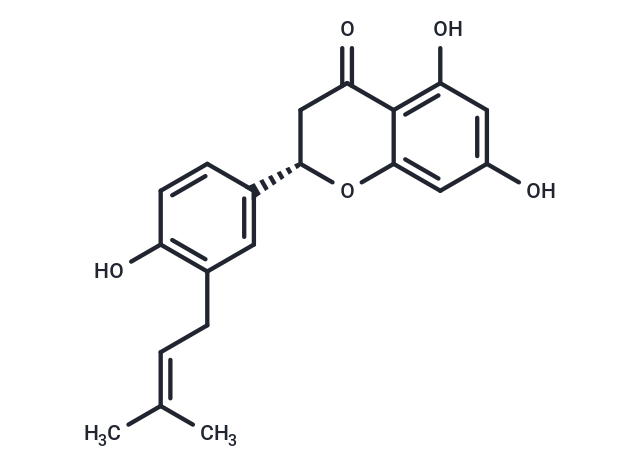
| Description | Licoflavanone exhibits antioxidant and anti-inflammatory activities,it markedly decreases pro-inflammatory cytokines and cyclooxygenase 2/inducible nitric oxide synthase (COX-2/iNOS) expression levels. |
| In vitro | Inflammation represents an adaptive response generated by injuries or harmful stimuli. Natural remedies represent an interesting alternative to traditional therapies, involving several biochemical pathways. Besides, the valorization of agrochemical wastes nowadays seems to be a feasible way to reduce the health spending and improve the accessibility at bioactive natural compounds. METHODS AND RESULTS: In this context, the chemical composition of three Glycyrrhiza glabra L. (licorice) leaf extracts, obtained through maceration or ultrasound-assisted method (fresh and dried leaves) was investigated. A guided fractionation obtained three main components: pinocembrin, glabranin and Licoflavanone. All the extracts showed similar antioxidant properties, evaluated by 2,2'-diphenyl-1-picrylhydrazyl (DPPH) or 2,2'-azino-bis(3-ethylbenzothiazoline-6-sulfonic acid) Diammonium Salt (ABTS) assay, while, among the isolated compounds, Licoflavanone exhibited the best antioxidant activity. The anti-inflammatory activity of the extracts and the purified compounds was investigated in lipopolysaccharide (LPS)-stimulated RAW 264.7 murine macrophages. Extract C and Licoflavanone showed a good anti-inflammatory activity without affecting cell viability, as they decreased nitrite levels even when used at 12.5 μg/mL (p < 0.005) and 50 μM concentration (p < 0.001), respectively. CONCLUSIONS: Interestingly, Licoflavanone markedly decreased pro-inflammatory cytokines and cyclooxygenase 2/inducible nitric oxide synthase (COX-2/iNOS) expression levels (p < 0.001). A modulation of nuclear factor kappa B/mitogen-activated protein kinases (NF-kB/MAPK) pathway underlay such behavior, highlighting the potential of this natural compound as a new scaffold in anti-inflammatory drug research. |
| Molecular Weight | 340.375 |
| Formula | C20H20O5 |
| Cas No. | 119240-82-3 |
| Smiles | C\C(C)=C\CC1=C(O)C=CC(=C1)[C@@H]1CC(=O)C2=C(O)C=C(O)C=C2O1 |
| Relative Density. | 1.351g/cm3 |
| Storage | Powder: -20°C for 3 years | In solvent: -80°C for 1 year Shipping with blue ice/Shipping at ambient temperature. |
 For example, if the intended dosage is 10 mg/kg for animals weighing 20 g , with a dosing volume of 100 μL per animal, and a total of 10 animals are to be administered, using a formulation of
  10% DMSO+ 40% PEG300+ 5% Tween 80+ 45% Saline/PBS/ddH2O , the resulting working solution concentration would be 2 mg/mL.
Dissolve 2 mg of the compound in 100 μL DMSO to obtain a stock solution at a concentration of 20 mg/mL . If the required concentration exceeds the compound's known solubility, please contact us for technical support before proceeding.
1) Add 100 μL of the DMSO stock solution to 400 µL PEG300 and mix thoroughly until the solution becomes clear.
2) Add 50 µL Tween 80 and mix well until fully clarified.
3) Add 450 µL Saline,PBS or ddH2O and mix thoroughly until a homogeneous solution is obtained.
| Size | Quantity | Unit Price | Amount | Operation |
|---|
 Feedback
 Hello! How can I help you today?
Copyright © 2015-2026 TargetMol Chemicals Inc. All Rights Reserved.
