


Shopping Cart
Remove All Your shopping cart is currently empty

Synonyms:
| Pack Size | Price | USA Stock | Global Stock | Quantity |
|---|---|---|---|---|
| 25 mg | $1,520 | 1-2 weeks | 1-2 weeks | |
| 50 mg | $1,980 | 1-2 weeks | 1-2 weeks | |
| 100 mg | $2,500 | 1-2 weeks | 1-2 weeks |
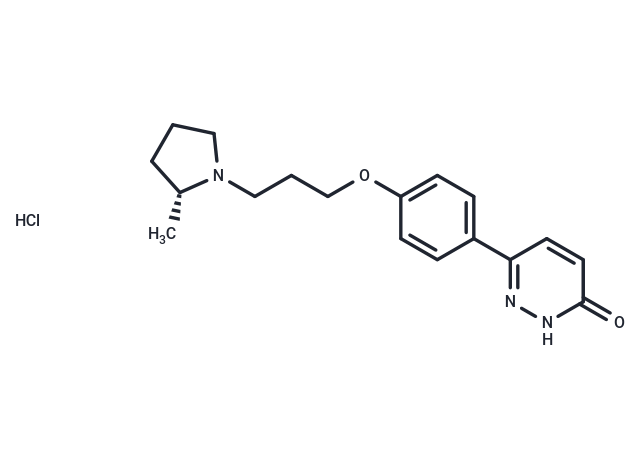
| Description | Irdabisant hydrochloride (CEP-26401) is a selective, orally active, and blood-brain barrier penetrating histamine H3 receptor (H3R) inverse agonist, demonstrating high affinity with K*i values of 7.2 nM and 2.0 nM for rat and human H3R, respectively. Exhibiting relatively low hERG current inhibitory activity with an IC*50 of 13.8 μM, this compound has shown to enhance cognition and promote wakefulness in rat social recognition models, suggesting potential applications in schizophrenia or cognitive impairment research. |
| Targets & IC50 | H3 receptor (rat):7.2 nM (Ki), H3 receptor (human):2 nM (Ki) |
| In vitro | Irdabisant (CEP-26401, compound 8a) demonstrates antagonist activities against rat and human H3 receptors with K(b, app) values of 1.0 nM and 0.4 nM, respectively, and inverse agonist activities with EC50 values of 2.0 nM for rat H3R and 1.1 nM for human H3R. It also exhibits moderate affinity for Muscarinic M2 (K(i) 3.7 μM), Adrenergic α1A (K(i) 9.8 μM), Dopamine transporters (K(i) 11 μM), Norepinephrine transporters (K(i) 10 μM), and phosphodiesterase PDE3 (IC50 15 μM). Additionally, Irdabisant inhibits cytochrome P450 enzymes CYP1A2, 2C9, 2C19, 2D6, and 3A4 with IC50 values over 30 μM, suggesting minimal drug-drug interaction potential. |
| In vivo | CEP-26401, administered orally in single doses ranging from 0.01 to 0.3 mg/kg, dose-dependently suppresses RAMH-induced dipsogenia in rats, a condition characterized by excessive drinking [1]. At doses between 0.0001 and 0.1 mg/kg, given intravenously (i.v.) or orally (p.o.), it enhances performance in a rat model for short-term memory by improving social recognition [1]. Furthermore, when given orally at dosages from 3 to 30 mg/kg, CEP-26401 promotes wakefulness in rats, with significant activity observed at 30 mg/kg where treated animals remained awake for up to 90% of the time three hours post-administration [2]. Similarly, doses of 3 to 30 mg/kg administered intraperitoneally (i.p.) increase prepulse inhibition (PPI) in DBA/2NCrl mice, suggesting antipsychotic-like properties [2]. Pharmacokinetic analyses reveal that CEP-26401, at 1 mg/kg i.v. and 3 mg/kg p.o., is rapidly absorbed with high oral bioavailability in rats and monkeys. It exhibits a moderate clearance rate in monkeys and dogs in comparison to rats. The compound's pharmacokinetic profile includes a half-life of 2.6 to 5.4 hours, volume of distribution, and clearance rates across different species, alongside significant brain to plasma ratio, indicative of its effective penetration into the brain [1]. |
| Molecular Weight | 349.86 |
| Formula | C18H24ClN3O2 |
| Cas No. | 1005398-61-7 |
| Smiles | Cl.C[C@@H]1CCCN1CCCOc1ccc(cc1)-c1ccc(=O)[nH]n1 |
| Storage | Powder: -20°C for 3 years | In solvent: -80°C for 1 year Shipping with blue ice/Shipping at ambient temperature. |
 For example, if the intended dosage is 10 mg/kg for animals weighing 20 g , with a dosing volume of 100 μL per animal, and a total of 10 animals are to be administered, using a formulation of
  10% DMSO+ 40% PEG300+ 5% Tween 80+ 45% Saline/PBS/ddH2O , the resulting working solution concentration would be 2 mg/mL.
Dissolve 2 mg of the compound in 100 μL DMSO to obtain a stock solution at a concentration of 20 mg/mL . If the required concentration exceeds the compound's known solubility, please contact us for technical support before proceeding.
1) Add 100 μL of the DMSO stock solution to 400 µL PEG300 and mix thoroughly until the solution becomes clear.
2) Add 50 µL Tween 80 and mix well until fully clarified.
3) Add 450 µL Saline,PBS or ddH2O and mix thoroughly until a homogeneous solution is obtained.
| Size | Quantity | Unit Price | Amount | Operation |
|---|
 Feedback
 Hello! How can I help you today?
Copyright © 2015-2026 TargetMol Chemicals Inc. All Rights Reserved.
