


Shopping Cart
Remove All Your shopping cart is currently empty

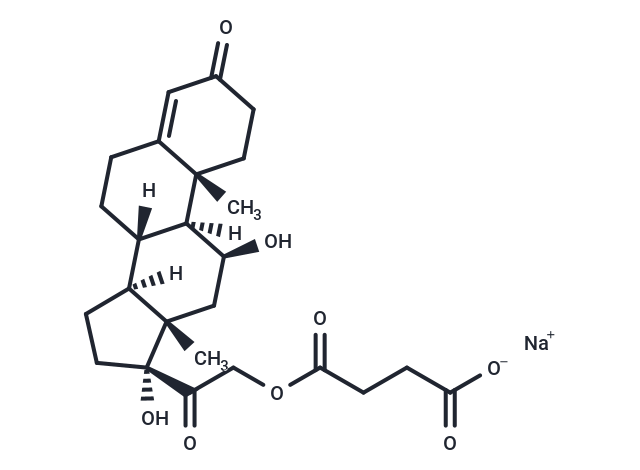
Synonyms: Hydrocortisone sodium succinate
| Pack Size | Price | USA Stock | Global Stock | Quantity |
|---|---|---|---|---|
| 25 mg | $39 | - | In Stock | |
| 50 mg | $53 | - | In Stock | |
| 100 mg | $75 | - | In Stock | |
| 500 mg | $198 | - | In Stock | |
| 1 mL x 10 mM (in DMSO) | $29 | - | In Stock |
| Description | Hydrocortisone hemisuccinate sodium, as a glucocorticoid, is an orally active steroidal anti-inflammatory agent (SAID) with both anti-inflammatory and immunomodulatory functions. It inhibits the biological activities of IL-6 and IL-3, with IC50 values of 6.7 μM and 21.4 μM, respectively. Hydrocortisone sodium succinate is also used in research related to ulcerative colitis (UC) and recurrent aphthous ulcers. |
| Targets & IC50 | IL-3:21.4 μM, IL-6:6.7 μM |
| In vitro | Method: Human peripheral blood lymphocytes (PBL) and T lymphocytes were stimulated with PHA and treated with different concentrations (0, 1.2, 6.0, 24, 60, 240, 600 × 10⁻⁷ M) of Hydrocortisone hemisuccinate for 72 h, followed by incubation with ¹⁴C-thymidine for 20 h. Cell proliferation inhibition was measured using liquid scintillation counting.
Result: Hydrocortisone hemisuccinate exhibited moderate immunosuppressive potency in vitro, with a relative potency 1/11 that of Methylprednisolone. It was significantly less potent than Methylprednisolone (P < 0.0005) and Fluorohydrocortisone, but significantly more potent than its metabolites (Cortisone, Dihydrocortisol, Tetrahydrocortisol) and Aldosterone [1]. Method: Murine hybridoma MH60/BSF-2 cells (IL-6-dependent) were treated with Hydrocortisone sodium succinate (100 μM) in the presence of 1.2 unit/ml recombinant human IL-6 (rhIL-6) for 48 h. Cell proliferation was measured using the MTT assay, and the inhibition rate of IL-6 bioactivity was calculated. Result: Hydrocortisone sodium succinate achieved 92% ± 2% inhibition of IL-6 bioactivity at 100 μM, with an IC50 of 6.7 μM. It showed no cytotoxicity in IL-6-independent MH60 cells (IC50 > 100 μM), but exhibited moderate inhibitory effects in the IL-3 bioassay (IC50 = 21.4 μM) [2]. Method: Hydrocortisone sodium succinate was loaded into KGM-XG-GLY-SA hydrogel and release experiments were conducted under simulated gastrointestinal conditions: pH 1.2 phosphate buffer for 2 h, followed by pH 6.8 buffer for 4 h, and finally pH 7.4 buffer for 4 h (in some experiments, 10% colon tissue was added to the pH 7.4 buffer). The cumulative drug release rate at different time points was determined by HPLC. Result: The release of Hydrocortisone sodium succinate from the hydrogel was pH-dependent, with 23.40% release at pH 1.2 (2 h), 25.88% at pH 6.8 (4 h), and a significant increase to 70.20% at pH 7.4 (4 h). After the addition of 10% colon tissue, the cumulative release rate further increased from 70.20% to 81.05% within 10 h. The hydrogel without glycerol released over 90% of the drug during the gastric and small intestinal phases (6 h), whereas the hydrogel containing glycerol released only 68% during the same period, indicating that glycerol exerts a significant sustained-release and lag effect on the hydrophilic drug HSS [3]. |
| In vivo | Method: SD rats with TNBS-induced ulcerative colitis (UC) were orally administered Hydrocortisone sodium succinate loaded hydrogel (HSS-GEL) or HSS solution (30 mg/kg, twice daily for 5 consecutive days). Therapeutic effects were evaluated by DAI score, colonic MPO activity, and body weight changes. Additionally, rats were orally administered HSS or HSS-GEL (200 mg/kg, once daily for 10 consecutive days), and spleen and thymus indices were measured to assess adverse drug reactions. Pharmacokinetic studies were also conducted (plasma drug concentrations were measured after oral administration of HSS-GEL or HSS), along with determination of gastrointestinal drug residue distribution.
Result: Compared with the HSS group, the HSS-GEL group significantly reduced DAI score (P < 0.05) and colonic MPO activity (P < 0.01), and attenuated body weight loss (P < 0.05), demonstrating superior therapeutic effects on UC. The spleen index and thymus index in the HSS-GEL group were significantly higher than those in the HSS group (P < 0.05, P < 0.01), indicating lower immunotoxicity. Pharmacokinetic results showed that, compared with the HSS group, the HSS-GEL group exhibited a 70.78% decrease in Cmax (44.37 vs. 151.87 μg/mL), a 58.21% decrease in AUC (242.58 vs. 580.43 μg·h/L) (P < 0.01), and a prolongation of Tmax from 0.68 h to 1.71 h. Gastrointestinal drug residue distribution showed that HSS-GEL reached maximum drug concentration in the colon and cecum at 7 h post-administration, demonstrating its colon-targeting properties [3]. |
| Synonyms | Hydrocortisone sodium succinate |
| Molecular Weight | 484.51 |
| Formula | C25H33NaO8 |
| Cas No. | 125-04-2 |
| Smiles | C[C@@]12[C@](CC[C@]2(O)C(COC(CCC([O-])=O)=O)=O)([H])[C@@]3([H])[C@]([C@@]4(C(CC3)=CC(CC4)=O)C)([H])[C@H](C1)O.[Na+] |
| Relative Density. | no data available |
| Storage | Keep away from moisture, Powder: -20°C for 3 years | In solvent: -80°C for 1 year Shipping with blue ice/Shipping at ambient temperature. | |||||||||||||||||||||||||||||||||||
| Solubility Information | DMSO: 140 mg/mL (288.95 mM), Sonication is recommended. H2O: 80 mg/mL (165.12 mM), Sonication is recommended. | |||||||||||||||||||||||||||||||||||
Solution Preparation Table | ||||||||||||||||||||||||||||||||||||
H2O/DMSO
Note : The dilution table applies only to solid products. For liquid products, please calculate the stock solution based on the stated concentration and/or density. | ||||||||||||||||||||||||||||||||||||
 For example, if the intended dosage is 10 mg/kg for animals weighing 20 g , with a dosing volume of 100 μL per animal, and a total of 10 animals are to be administered, using a formulation of
  10% DMSO+ 40% PEG300+ 5% Tween 80+ 45% Saline/PBS/ddH2O , the resulting working solution concentration would be 2 mg/mL.
Dissolve 2 mg of the compound in 100 μL DMSO to obtain a stock solution at a concentration of 20 mg/mL . If the required concentration exceeds the compound's known solubility, please contact us for technical support before proceeding.
1) Add 100 μL of the DMSO stock solution to 400 µL PEG300 and mix thoroughly until the solution becomes clear.
2) Add 50 µL Tween 80 and mix well until fully clarified.
3) Add 450 µL Saline,PBS or ddH2O and mix thoroughly until a homogeneous solution is obtained.
| Size | Quantity | Unit Price | Amount | Operation |
|---|
 Feedback
 Hello! How can I help you today?
Copyright © 2015-2026 TargetMol Chemicals Inc. All Rights Reserved.
