


Shopping Cart
Remove All Your shopping cart is currently empty

Synonyms: GSK-1059865, GSK 1059865
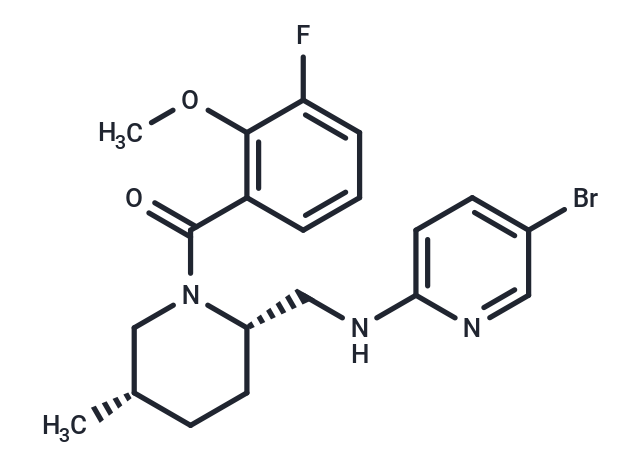

| Pack Size | Price | USA Stock | Global Stock | Quantity |
|---|---|---|---|---|
| 1 mg | $66 | - | In Stock | |
| 5 mg | $158 | - | In Stock | |
| 10 mg | $255 | - | In Stock | |
| 25 mg | $429 | - | In Stock | |
| 50 mg | $647 | - | In Stock | |
| 100 mg | $970 | - | In Stock | |
| 1 mL x 10 mM (in DMSO) | $176 | - | In Stock |
| Description | GSK1059865 is a highly selective orexin-1 receptor antagonist that significantly reduces voluntary ethanol intake in ethanol-dependent mice following chronic intermittent ethanol exposure, producing dose-dependent suppression of alcohol consumption without affecting sucrose intake, while exhibiting minimal effects in non-dependent controls except at high doses, thereby highlighting its utility for investigating orexin signaling in alcohol dependence and addictive behaviors. |
| Targets & IC50 | OX1 receptor:8.77 (pKb) |
| In vitro | In receptor assays, GSK1059865 acted as an Orexin-1 (OX1) receptor antagonist with a pKB of 8.77. At low concentrations (0.3-10 nM), it functioned as an insurmountable antagonist suppressing the maximal Orexin-A response, whereas at higher concentrations (0.1-3.3 μM), it exhibited a surmountable profile characterized by a parallel rightward shift of the EC50 [1]. |
| In vivo | In ethanol-dependent mice (CIE model), GSK1059865 reduced ethanol consumption in a dose-dependent manner. In control mice (air-exposed), consumption was only affected at the highest dose tested. The compound showed no effect on sucrose intake. In rat fMRI studies, intraperitoneal administration of GSK1059865 inhibited the relative cerebral blood volume (rCBV) response induced by Yohimbine in specific brain regions. Pretreatment with the compound was associated with a baseline mean arterial blood pressure higher than that of the control group [1][3]. |
| Synonyms | GSK-1059865, GSK 1059865 |
| Molecular Weight | 436.32 |
| Formula | C20H23BrFN3O2 |
| Cas No. | 1191044-58-2 |
| Smiles | C(=O)(N1[C@H](CNC2=CC=C(Br)C=N2)CC[C@H](C)C1)C3=C(OC)C(F)=CC=C3 |
| Relative Density. | 1.376 g/cm3 (Predicted) |
| Storage | Store at low temperature Powder: -20°C for 3 years | In solvent: -80°C for 1 year Shipping with blue ice/Shipping at ambient temperature. | |||||||||||||||||||||||||||||||||||
| Solubility Information | DMSO: 160 mg/mL (366.7 mM), Sonication is recommended. | |||||||||||||||||||||||||||||||||||
Solution Preparation Table | ||||||||||||||||||||||||||||||||||||
DMSO
Note : The dilution table applies only to solid products. For liquid products, please calculate the stock solution based on the stated concentration and/or density. | ||||||||||||||||||||||||||||||||||||
 For example, if the intended dosage is 10 mg/kg for animals weighing 20 g , with a dosing volume of 100 μL per animal, and a total of 10 animals are to be administered, using a formulation of
  10% DMSO+ 40% PEG300+ 5% Tween 80+ 45% Saline/PBS/ddH2O , the resulting working solution concentration would be 2 mg/mL.
Dissolve 2 mg of the compound in 100 μL DMSO to obtain a stock solution at a concentration of 20 mg/mL . If the required concentration exceeds the compound's known solubility, please contact us for technical support before proceeding.
1) Add 100 μL of the DMSO stock solution to 400 µL PEG300 and mix thoroughly until the solution becomes clear.
2) Add 50 µL Tween 80 and mix well until fully clarified.
3) Add 450 µL Saline,PBS or ddH2O and mix thoroughly until a homogeneous solution is obtained.
| Size | Quantity | Unit Price | Amount | Operation |
|---|
 Feedback
 Hello! How can I help you today?
Copyright © 2015-2026 TargetMol Chemicals Inc. All Rights Reserved.
