


Shopping Cart
Remove All Your shopping cart is currently empty

Synonyms: FM1 43

| Pack Size | Price | USA Stock | Global Stock | Quantity |
|---|---|---|---|---|
| 1 mg | $113 | In Stock | In Stock | |
| 5 mg | $289 | In Stock | In Stock | |
| 10 mg | $433 | In Stock | In Stock | |
| 25 mg | $689 | - | In Stock | |
| 50 mg | $976 | - | In Stock |
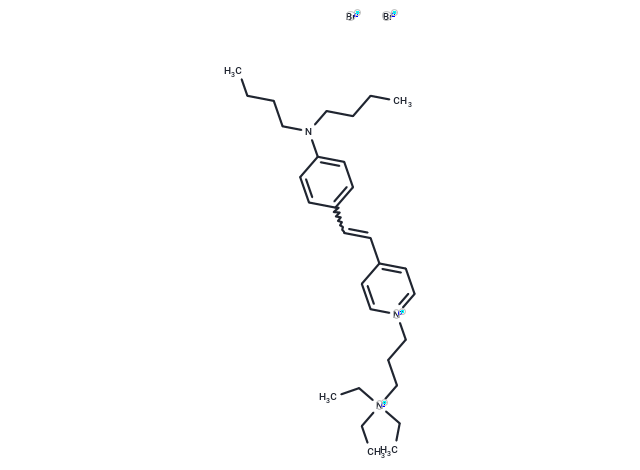
| Description | FM1-43 is a highly lipophilic, water-soluble styrene dye that acts as an osmotic blocker of hair cell mechanical transducer channels and can be used to study neuropeptide granule dynamics and cytotoxicity. dFdCTP trisodium is a Gemcitabine triphosphate trisodium derivative that inhibits DNA synthesis. |
| Synonyms | FM1 43 |
| Cell Research | Cell staining experiment a. Solution preparation: 1. Mother solution preparation: Prepare 5 mM mother solution with DMSO, store at -20℃ or -80℃ in the dark after aliquoting. 2. Working solution preparation: Use preheated HBSS solution to prepare 5-20 μM FM 1-43 working solution (select the appropriate working solution concentration according to experimental requirements, and prepare it for immediate use). b. Cell staining 1. Suspended cell staining 1.1 Collect cells by centrifugation and wash twice with PBS for 5 minutes each time. Add 1 mL FM1-43 working solution and incubate at room temperature for 5-30 minutes. 1.2 Centrifuge at 400 g for 3-4 minutes and discard the supernatant. 1.3 Add PBS to wash cells twice for 5 minutes each time. 1.4 Resuspend cells with 1 mL serum-free medium or PBS and observe using a fluorescence microscope or flow cytometer. 2. Adherent cell staining 2.1 Culture iron-adherent cells on sterile slides, discard the culture medium, and remove excess residual liquid. 2.2 Add 100 μL of dye working solution, gently shake to completely cover the cells, and incubate for 5-30 minutes. 2.3 Aspirate the dye working solution, wash with culture medium 2-3 times, 5 minutes each time, and observe using a fluorescence microscope or flow cytometer. The above information is based on published literature. Experimental procedures should be appropriately modified to meet specific research demands. |
| Molecular Weight | 611.54 |
| Formula | C30H49Br2N3 |
| Cas No. | 149838-22-2 |
| Smiles | [Br-].[Br-].CCCCN(CCCC)c1ccc(C=Cc2cc[n+](CCC[N+](CC)(CC)CC)cc2)cc1 |
| Storage | Store at low temperature Powder: -20°C for 3 years | In solvent: -80°C for 1 year Shipping with blue ice/Shipping at ambient temperature. | ||||||||||||||||||||||||||||||
| Solubility Information | DMSO: 40 mg/mL (65.41 mM), Sonication is recommended. | ||||||||||||||||||||||||||||||
Solution Preparation Table | |||||||||||||||||||||||||||||||
DMSO
Note : The dilution table applies only to solid products. For liquid products, please calculate the stock solution based on the stated concentration and/or density. | |||||||||||||||||||||||||||||||
 For example, if the intended dosage is 10 mg/kg for animals weighing 20 g , with a dosing volume of 100 μL per animal, and a total of 10 animals are to be administered, using a formulation of
  10% DMSO+ 40% PEG300+ 5% Tween 80+ 45% Saline/PBS/ddH2O , the resulting working solution concentration would be 2 mg/mL.
Dissolve 2 mg of the compound in 100 μL DMSO to obtain a stock solution at a concentration of 20 mg/mL . If the required concentration exceeds the compound's known solubility, please contact us for technical support before proceeding.
1) Add 100 μL of the DMSO stock solution to 400 µL PEG300 and mix thoroughly until the solution becomes clear.
2) Add 50 µL Tween 80 and mix well until fully clarified.
3) Add 450 µL Saline,PBS or ddH2O and mix thoroughly until a homogeneous solution is obtained.
| Size | Quantity | Unit Price | Amount | Operation |
|---|
 Feedback
 Hello! How can I help you today?
Copyright © 2015-2026 TargetMol Chemicals Inc. All Rights Reserved.
