


Shopping Cart
Remove All Your shopping cart is currently empty

Synonyms: 8-hydroxy-1,2,3,4-tetrahydroquinoline, 1,2,3,4-Tetrahydroquinolin-8-ol
| Pack Size | Price | USA Stock | Global Stock | Quantity |
|---|---|---|---|---|
| 10 mg | Inquiry | 10-14 weeks | 10-14 weeks | |
| 50 mg | Inquiry | 10-14 weeks | 10-14 weeks |
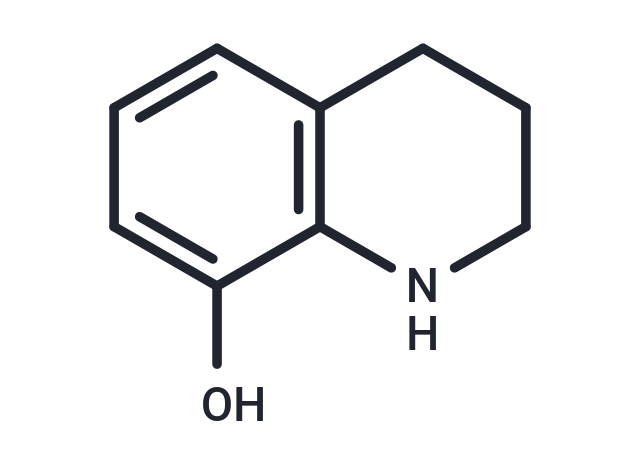
| Description | Ferroptosis-IN-21 is an inhibitor of ferroptosis that combats renal ischemia-reperfusion injury by directly scavenging peroxy free radicals to prevent cell death. It demonstrates broad-spectrum, nanomolar-level inhibitory potency against various ferroptosis inducers in renal tubular epithelial cells and effectively suppresses the accumulation of lipid reactive oxygen species (ROS). Additionally, Ferroptosis-IN-21 significantly alleviates renal ischemia-reperfusion injury in mice, as evidenced by improved histological damage and functional impairment, reduced expression of inflammatory cytokines, and decreased levels of lipid peroxidation biomarkers such as 4-hydroxynonenal. Ferroptosis-IN-21 is a potential candidate in research for developing ferroptosis-targeted therapeutics. |
| In vitro | Ferroptosis-IN-21 (compound 6) at concentrations of 0.01-10 μM over 24 hours exhibits nanomolar-level cytoprotective activity in HT-1080 cells (EC50 = 61.7 nM) and can completely reverse cell death at a concentration of 200 nM. It also dose-dependently protects human renal cortical epithelial cells (HKC) and human renal proximal tubule epithelial cells (HK-2) from ferroptosis induced by RSL-3 and FIN-56, demonstrating its broad-spectrum anti-ferroptosis efficacy. Additionally, Ferroptosis-IN-21 at 50-500 nM for 24 hours significantly inhibits RSL-3-induced lipid ROS accumulation and MDA elevation without affecting GPX4 protein levels. At 10 μM, it lacks iron chelation capabilities, ruling out mechanisms involving iron chelation. Furthermore, at concentrations of 1-80 μM over 30 minutes, Ferroptosis-IN-21 displays potent direct radical scavenging activity in cell-free DPPH assays. |
| In vivo | Ferroptosis-IN-21 (administered at 5 and 10 mg/kg via intraperitoneal injection 24 and 1 hour before modeling) demonstrates significant renal protective effects against ischemic acute kidney injury in a mouse model of renal ischemia-reperfusion. |
| Synonyms | 8-hydroxy-1,2,3,4-tetrahydroquinoline, 1,2,3,4-Tetrahydroquinolin-8-ol |
| Molecular Weight | 149.19 |
| Formula | C9H11NO |
| Cas No. | 6640-50-2 |
| Smiles | C1=CC=C(O)C2=C1CCCN2 |
| Storage | Powder: -20°C for 3 years | In solvent: -80°C for 1 year Shipping with blue ice/Shipping at ambient temperature. |
 For example, if the intended dosage is 10 mg/kg for animals weighing 20 g , with a dosing volume of 100 μL per animal, and a total of 10 animals are to be administered, using a formulation of
  10% DMSO+ 40% PEG300+ 5% Tween 80+ 45% Saline/PBS/ddH2O , the resulting working solution concentration would be 2 mg/mL.
Dissolve 2 mg of the compound in 100 μL DMSO to obtain a stock solution at a concentration of 20 mg/mL . If the required concentration exceeds the compound's known solubility, please contact us for technical support before proceeding.
1) Add 100 μL of the DMSO stock solution to 400 µL PEG300 and mix thoroughly until the solution becomes clear.
2) Add 50 µL Tween 80 and mix well until fully clarified.
3) Add 450 µL Saline,PBS or ddH2O and mix thoroughly until a homogeneous solution is obtained.
| Size | Quantity | Unit Price | Amount | Operation |
|---|
 Feedback
 Hello! How can I help you today?
Copyright © 2015-2026 TargetMol Chemicals Inc. All Rights Reserved.
