


Shopping Cart
Remove All Your shopping cart is currently empty

Synonyms: Erythromycin octadecanoate
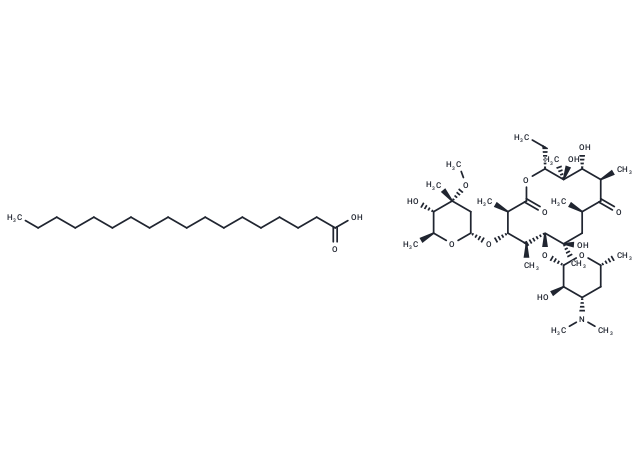

| Pack Size | Price | USA Stock | Global Stock | Quantity |
|---|---|---|---|---|
| 5 mg | $40 | - | In Stock | |
| 10 mg | $56 | - | In Stock | |
| 25 mg | $90 | - | In Stock | |
| 50 mg | $130 | - | In Stock | |
| 100 mg | $191 | - | In Stock | |
| 500 mg | $478 | - | In Stock |
| Description | Erythromycin stearate is a macrolide antibiotic produced by actinomycetes, exhibiting broad-spectrum antibacterial activity. Erythromycin stearate acts by binding to the bacterial 50S ribosomal subunit, blocking transpeptidation and/or translocation reactions, thereby inhibiting RNA-dependent protein synthesis without affecting nucleic acid synthesis. In various research fields, Erythromycin stearate has also demonstrated antitumor properties and neuroprotective effects. |
| Targets & IC50 | P. falciparum:58.2 μM |
| In vitro | Method: The inhibitory effect of Erythromycin stearate on P. falciparum was evaluated using an in vitro inhibition assay. Result: The IC50 and IC90 values of Erythromycin stearate against P. falciparum growth were 58.2 μM and 104.0 μM, respectively [1]. Method: Primary cultured rat cortical neurons were subjected to oxygen-glucose deprivation (OGD) for 3 hours. Prior to OGD, the neurons were treated with either 10 μM or 100 μM Erythromycin stearate. Cell death was assessed using the LDH release assay, and cell viability was evaluated by calcein AM/EthD-1 staining. Result: Treatment with 100 μM Erythromycin stearate significantly reduced neuronal cell death after OGD, decreasing LDH release by approximately 35.9% (p < 0.05), whereas 10 μM Erythromycin stearate showed no significant protective effect. Live/dead cell staining revealed an increase in live cells and a decrease in dead cells following Erythromycin stearate treatment [2]. |
| In vivo | Method: Male SD rats were subjected to 90 min of middle cerebral artery occlusion (MCAO) followed by reperfusion. A single subcutaneous injection of Erythromycin stearate (50 mg/kg) or vehicle control was administered immediately after ischemia. Infarct volume, edema index, and neurological deficit scores were evaluated at 24 h and 72 h after reperfusion. At 24 h after reperfusion, immunohistochemical detection of oxidative stress markers (4-HNE, 8-OHdG) and inflammatory indicators (Iba-1, TNF-α) was performed in the cerebral cortex. Result: Erythromycin stearate treatment significantly reduced cerebral infarct volume (p < 0.01) and brain edema index (p < 0.05), and improved neurological deficit scores (p < 0.05). Erythromycin stearate significantly inhibited the accumulation of 4-HNE and 8-OHdG (p < 0.01), and markedly reduced the expression of Iba-1 and TNF-α (p < 0.01) [2]. Method: Erythromycin stearate was orally administered to mice by gavage at doses ranging from 0.1 to 50 mg/kg for 30 to 120 days, and its effects on tumor growth and survival time were observed. Result: At doses of 5 mg/kg and above, Erythromycin stearate inhibited tumor growth and prolonged survival time in mice [3]. |
| Synonyms | Erythromycin octadecanoate |
| Molecular Weight | 1018.40 |
| Formula | C55H103NO15 |
| Cas No. | 643-22-1 |
| Smiles | C(CCCCCCCCCCC)CCCCCC(O)=O.O([C@@H]1[C@@H](C)[C@H](O[C@H]2C[C@](OC)(C)[C@@H](O)[C@H](C)O2)[C@@H](C)C(=O)O[C@H](CC)[C@@](C)(O)[C@H](O)[C@@H](C)C(=O)[C@H](C)C[C@@]1(C)O)[C@H]3[C@H](O)[C@@H](N(C)C)C[C@@H](C)O3 |
| Storage | Powder: -20°C for 3 years | In solvent: -80°C for 1 year Shipping with blue ice/Shipping at ambient temperature. |
 For example, if the intended dosage is 10 mg/kg for animals weighing 20 g , with a dosing volume of 100 μL per animal, and a total of 10 animals are to be administered, using a formulation of
  10% DMSO+ 40% PEG300+ 5% Tween 80+ 45% Saline/PBS/ddH2O , the resulting working solution concentration would be 2 mg/mL.
Dissolve 2 mg of the compound in 100 μL DMSO to obtain a stock solution at a concentration of 20 mg/mL . If the required concentration exceeds the compound's known solubility, please contact us for technical support before proceeding.
1) Add 100 μL of the DMSO stock solution to 400 µL PEG300 and mix thoroughly until the solution becomes clear.
2) Add 50 µL Tween 80 and mix well until fully clarified.
3) Add 450 µL Saline,PBS or ddH2O and mix thoroughly until a homogeneous solution is obtained.
| Size | Quantity | Unit Price | Amount | Operation |
|---|
 Feedback
 Hello! How can I help you today?
Copyright © 2015-2026 TargetMol Chemicals Inc. All Rights Reserved.
