


Shopping Cart
Remove All Your shopping cart is currently empty

Synonyms: TP-434
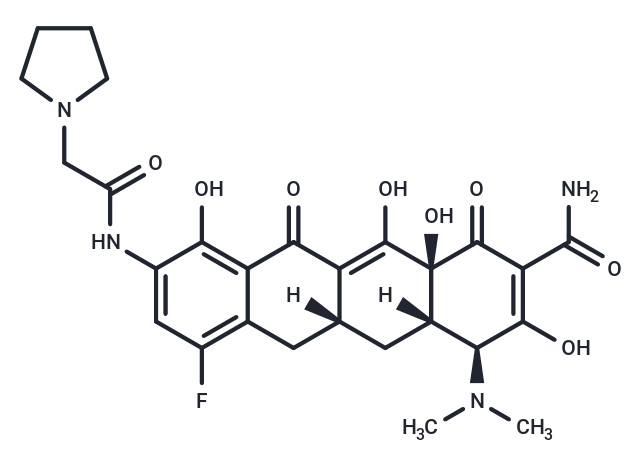
| Pack Size | Price | USA Stock | Global Stock | Quantity |
|---|---|---|---|---|
| 25 mg | $3,620 | 10-14 weeks | 10-14 weeks | |
| 50 mg | $4,780 | 10-14 weeks | 10-14 weeks | |
| 100 mg | $6,700 | 10-14 weeks | 10-14 weeks |
| Description | Eravacycline (TP-434) is a potent and broad-spectrum antibacterial agent. |
| In vitro | Eravacycline dihydrochloride is a synthetic antibiotic that inhibits bacterial protein synthesis by binding to the 30S ribosomal subunit. It exhibits broad-spectrum activity against gram-negative bacteria, excluding P. aeruginosa, and demonstrates exceptional efficacy against major gram-positive pathogens, including methicillin-resistant S. aureus. Eravacycline also shows potent inhibition of the ribosome. It is effective against 90% of bacterial isolates (MIC90) across various species panels at concentrations from ≤0.008 to 2 μg/mL, except for Pseudomonas aeruginosa and Burkholderia cenocepacia, which have MIC90 values of 32 μg/mL for both. The compound is active against multidrug-resistant organisms, even those exhibiting extended-spectrum β-lactamases and resistance to carbapenems. Notably, eravacycline is a potent agent against A. baumannii, even against strains resistant to sulbactam, imipenem/meropenem, levofloxacin, and amikacin/tobramycin. It outperforms comparative antibiotics from the tetracycline class, levofloxacin, amikacin, tobramycin, and colistin, with MIC50/90 values of 0.5/1 mg/L. Moreover, it inhibits six E. coli strains with MICs ranging from 0.125 to 0.25 mg/L[1]. |
| In vivo | Mice received eravacycline doses escalating twofold (3.125 to 50 mg/kg) bi-daily. The average fAUC/MIC values indicating net stasis and a 1-log kill were 27.97±8.29 and 32.60±10.85, respectively[2]. Eravacycline showed effectiveness in various murine infection models targeting significant Gram-positive and Gram-negative bacteria. In septicemia models using mice, eravacycline achieved a 50% protective dose at ≤1 mg/kg daily against S. aureus, including methicillin-resistant S. aureus (MRSA) and tetracycline-resistant strains, and S. pyogenes. The PD50 for E. coli ranged from 1.2 to 4.4 mg/kg daily[5]. |
| Synonyms | TP-434 |
| Molecular Weight | 558.56 |
| Formula | C27H31FN4O8 |
| Cas No. | 1207283-85-9 |
| Smiles | O[C@]12[C@]([C@H](N(C)C)C(O)=C(C(N)=O)C1=O)(C[C@]3(C(=C2O)C(=O)C=4C(C3)=C(F)C=C(NC(CN5CCCC5)=O)C4O)[H])[H] |
| Relative Density. | 1.60 g/cm3 (Predicted) |
| Storage | Powder: -20°C for 3 years | In solvent: -80°C for 1 year Shipping with blue ice/Shipping at ambient temperature. |
 For example, if the intended dosage is 10 mg/kg for animals weighing 20 g , with a dosing volume of 100 μL per animal, and a total of 10 animals are to be administered, using a formulation of
  10% DMSO+ 40% PEG300+ 5% Tween 80+ 45% Saline/PBS/ddH2O , the resulting working solution concentration would be 2 mg/mL.
Dissolve 2 mg of the compound in 100 μL DMSO to obtain a stock solution at a concentration of 20 mg/mL . If the required concentration exceeds the compound's known solubility, please contact us for technical support before proceeding.
1) Add 100 μL of the DMSO stock solution to 400 µL PEG300 and mix thoroughly until the solution becomes clear.
2) Add 50 µL Tween 80 and mix well until fully clarified.
3) Add 450 µL Saline,PBS or ddH2O and mix thoroughly until a homogeneous solution is obtained.
| Size | Quantity | Unit Price | Amount | Operation |
|---|
 Feedback
 Hello! How can I help you today?
Copyright © 2015-2026 TargetMol Chemicals Inc. All Rights Reserved.
