


Shopping Cart
Remove All Your shopping cart is currently empty

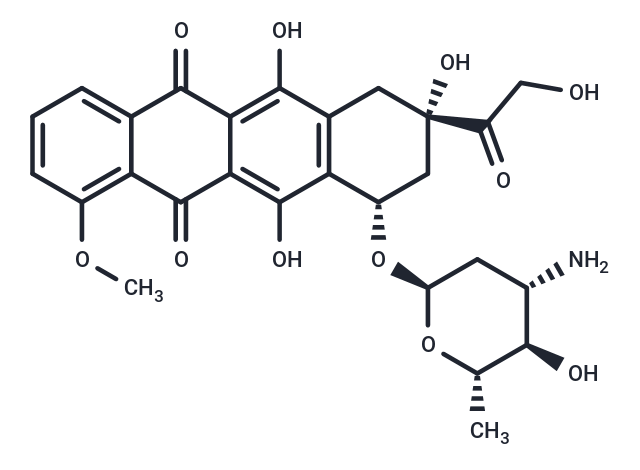
Synonyms: IMI 28, epi DX, 4-epidoxorubicin, 4'-Epidoxorubicin, 4-epiadriamycin, 4-epi DX
| Pack Size | Price | USA Stock | Global Stock | Quantity |
|---|---|---|---|---|
| 2 mg | $34 | - | In Stock | |
| 5 mg | $53 | - | In Stock | |
| 10 mg | $86 | - | In Stock | |
| 25 mg | $173 | - | In Stock | |
| 50 mg | $259 | - | In Stock | |
| 100 mg | $348 | - | In Stock | |
| 1 mL x 10 mM (in DMSO) | $64 | - | In Stock |
| Description | Epirubicin (4'-Epidoxorubicin) is an anthracycline antibiotic that acts as a Topoisomerase II inhibitor. It exerts its antitumor effects by intercalating into DNA base pairs, inhibiting DNA replication and transcription, and inducing DNA strand breaks/apoptosis. Epirubicin is widely used in the treatment of breast, gastric, lung, and ovarian cancers. |
| Targets & IC50 | HepG2 cells:1.6 μg/mL |
| In vitro | In human hepatoma G2 cells, Epirubicin exhibits cytotoxicity (24 h IC50=1.6 μg/mL), induces apoptosis, and upregulates catalase (+50%), GSH-Px (+110%), and SOD (+135–172%) activities [3]. It inhibits DNA/RNA/protein synthesis by complexing with DNA, primarily killing S-phase cells, while high concentrations affect G1/M/G2 phases and membrane integrity [1]. |
| In vivo | In a human breast carcinoma R-27 xenograft model, systemic administration of Epirubicin at a dose of 3.5 mg/kg resulted in a 74.4% reduction in tumor mass. The compound shows broad clinical activity across various malignancies, including malignant lymphomas, lung cancer, and gastrointestinal tumors [4][5]. |
| Synonyms | IMI 28, epi DX, 4-epidoxorubicin, 4'-Epidoxorubicin, 4-epiadriamycin, 4-epi DX |
| Molecular Weight | 543.52 |
| Formula | C27H29NO11 |
| Cas No. | 56420-45-2 |
| Smiles | OC=1C2=C([C@@H](O[C@H]3C[C@H](N)[C@@H](O)[C@H](C)O3)C[C@@](C(CO)=O)(O)C2)C(O)=C4C1C(=O)C=5C(C4=O)=C(OC)C=CC5 |
| Storage | Keep away from moisture Powder: -20°C for 3 years | In solvent: -80°C for 1 year Shipping with blue ice/Shipping at ambient temperature. | |||||||||||||||||||||||||||||||||||
| Solubility Information | DMSO: 100 mg/mL (183.99 mM), Sonication is recommended. | |||||||||||||||||||||||||||||||||||
Solution Preparation Table | ||||||||||||||||||||||||||||||||||||
DMSO
Note : The dilution table applies only to solid products. For liquid products, please calculate the stock solution based on the stated concentration and/or density. | ||||||||||||||||||||||||||||||||||||
 For example, if the intended dosage is 10 mg/kg for animals weighing 20 g , with a dosing volume of 100 μL per animal, and a total of 10 animals are to be administered, using a formulation of
  10% DMSO+ 40% PEG300+ 5% Tween 80+ 45% Saline/PBS/ddH2O , the resulting working solution concentration would be 2 mg/mL.
Dissolve 2 mg of the compound in 100 μL DMSO to obtain a stock solution at a concentration of 20 mg/mL . If the required concentration exceeds the compound's known solubility, please contact us for technical support before proceeding.
1) Add 100 μL of the DMSO stock solution to 400 µL PEG300 and mix thoroughly until the solution becomes clear.
2) Add 50 µL Tween 80 and mix well until fully clarified.
3) Add 450 µL Saline,PBS or ddH2O and mix thoroughly until a homogeneous solution is obtained.
| Size | Quantity | Unit Price | Amount | Operation |
|---|
 Feedback
 Hello! How can I help you today?
Copyright © 2015-2026 TargetMol Chemicals Inc. All Rights Reserved.
