


Shopping Cart
Remove All Your shopping cart is currently empty


Synonyms:

| Pack Size | Price | USA Stock | Global Stock | Quantity |
|---|---|---|---|---|
| 100 µg | $163 | In Stock | In Stock | |
| 500 µg | $438 | In Stock | In Stock | |
| 1 mg | $592 | In Stock | In Stock | |
| 5 mg | $1,160 | In Stock | In Stock | |
| 10 mg | $1,670 | In Stock | In Stock | |
| 25 mg | $2,490 | In Stock | In Stock | |
| 50 mg | $3,360 | In Stock | In Stock |
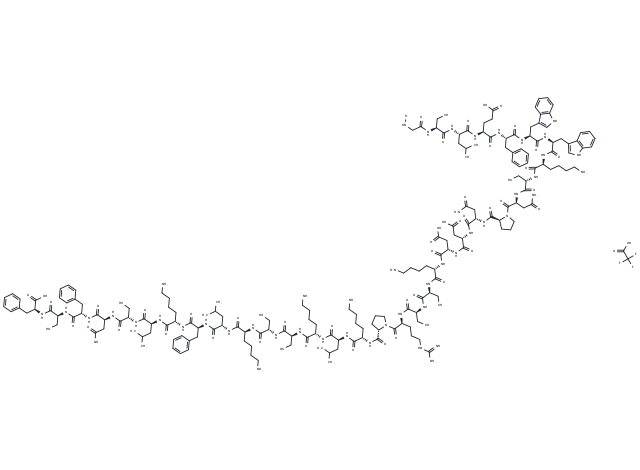
| Description | D-GsMTx4 TFA belongs to natural products and is a TRPC1/6 and Piezo2 channel inhibitor with high selectivity and cell permeability, inhibiting Ca2+ influx and the mTOR pathway. This compound is used in research on myocardial infarction, chronic pain, and pulmonary fibrosis. |
| In vitro | Methods: In isolated mouse cardiomyocytes, D-GsMTx4 TFA (10 μM) was incubated for 15 minutes, followed by assessment via contractility measurement and Fura-2AM calcium imaging. Results: It significantly improved hypoxia-induced contractile dysfunction, restored calcium transient peak and kinetics, and inhibited activation of the JNK/c-Jun apoptotic signaling pathway. [1] Methods: In bEnd.3 mouse brain microvascular endothelial cells, pretreatment with D-GsMTx4 TFA (0.1–10 μM) for 24 hours was performed before OGD/R injury. Results: CCK-8 assay showed significantly improved cell viability in the 10 μM group; wound healing and Transwell experiments demonstrated markedly enhanced cell migration capacity at this concentration.[2] |
| In vivo | Methods: In a C57BL/6J mouse myocardial ischemia-reperfusion model, D-GsMTx4 TFA was administered via tail vein injection (0.1, 1, 10 mg/kg) 20 minutes before ischemia or via intraperitoneal injection (50 mg/kg/day) for 2 days before surgery (vehicle: saline). Results: Intravenous injection of 1 mg/kg reduced infarct area by approximately 40%, improved cardiac function, and significantly decreased the incidence of premature ventricular contractions during early reperfusion. [1] Methods: In a male SD rat chronic cerebral hypoperfusion model induced by bilateral common carotid artery ligation, D-GsMTx4 TFA (0.1, 1, 10 ng/kg) was administered once daily via lateral ventricle cannulation from 3 days before surgery until 28 days after surgery. Results: The 10 ng/kg dose significantly improved cognitive function, reduced brain water content and Evans blue extravasation, and upregulated the expression of tight junction proteins Claudin-1, Occludin, and ZO-1. [2] Methods: In isolated mouse bladder preparations, D-GsMTx4 TFA (1 μM, dissolved in KBS) was administered via bath application during the filling phase to examine its effects on soluble nucleotidase release. Results: Combined use of GsMTx4 and D-GsMTx4 significantly increased stretch-induced eATP degradation and eADP, eAMP, and eADO production, indicating that inhibition of PIEZO channels relieves the restriction on enzyme release. [3] |
| Molecular Weight | 4216.93 |
| Formula | C187H279F3N48O48S6 |
| Smiles | [H]NCC(N[C@@H](CS)C(N[C@H](C(N[C@H](C(N[C@@H](CC1=CC=CC=C1)C(N[C@@H](CC2=CNC3=C2C=CC=C3)C(N[C@@H](CC4=CNC5=C4C=CC=C5)C(N[C@H](C(N[C@@H](CS)C(N[C@H](C(N6CCC[C@H]6C(N[C@H](C(N[C@@H](CC(O)=O)C(N[C@@H](CC(O)=O)C(N[C@H](C(N[C@@H](CS)C(N[C@@H](CS)C(N[C@H](C(N7CCC[C@H]7C(N[C@H](C(N[C@H](C(N[C@H](C(N[C@@H](CS)C(N[C@H](C(N[C@H](C(N[C@H](C(N[C@@H](CC8=CC=CC=C8)C(N[C@H](C(N[C@H](C(N[C@@H](CS)C(N[C@H](C(N[C@@H](CC9=CC=CC=C9)C(N[C@H](C(N[C@@H](CC%10=CC=CC=C%10)C(O)=O)=O)CO)=O)=O)CC(N)=O)=O)=O)CC(C)C)=O)CCCCN)=O)=O)CC(C)C)=O)CCCCN)=O)CO)=O)=O)CCCCN)=O)CC(C)C)=O)CCCCN)=O)=O)CCCNC(N)=N)=O)=O)=O)CCCCN)=O)=O)=O)CC(N)=O)=O)=O)CC(N)=O)=O)=O)CCCCN)=O)=O)=O)=O)CCC(O)=O)=O)CC(C)C)=O)=O.OC(C(F)(F)F)=O |
| Relative Density. | no data available |
| Sequence | Gly-Cys-Leu-Glu-Phe-Trp-Trp-Lys-Cys-Asn-Pro-Asn-Asp-Asp-Lys-Cys-Cys-Arg-Pro-Lys-Leu-Lys-Cys-Ser-Lys-Leu-Phe-Lys-Leu-Cys-Asn-Phe-Ser-Phe-NH₂ (Disulfide bridge:Cys2-Cys17;Cys9-Cys23;Cys16-Cys30) |
| Sequence Short | GCLEFWWKCNPNDDKCCRPKLKCSKLFKLCNFSF |
| Storage | Store at low temperature,Keep away from moisture Powder: -20°C for 3 years | In solvent: -80°C for 1 year Shipping with blue ice/Shipping at ambient temperature. | |||||||||||||||||||||||||||||||||||
| Solubility Information | DMSO: 250 mg/mL (59.28 mM)  H2O: 36 mg/mL (8.54 mM), Sonication is recommended. | |||||||||||||||||||||||||||||||||||
| In Vivo Formulation | 10% DMSO+90% Saline: 3.3 mg/mL (0.78 mM), Sonication is recommended. Please add the solvents sequentially, clarifying the solution as much as possible before adding the next one. Dissolve by heating and/or sonication if necessary. Working solution is recommended to be prepared and used immediately. The formulation provided above is for reference purposes only. In vivo formulations may vary and should be modified based on specific experimental conditions. | |||||||||||||||||||||||||||||||||||
Solution Preparation Table | ||||||||||||||||||||||||||||||||||||
H2O/DMSO
DMSO
Note : The dilution table applies only to solid products. For liquid products, please calculate the stock solution based on the stated concentration and/or density. | ||||||||||||||||||||||||||||||||||||
 For example, if the intended dosage is 10 mg/kg for animals weighing 20 g , with a dosing volume of 100 μL per animal, and a total of 10 animals are to be administered, using a formulation of
  10% DMSO+ 40% PEG300+ 5% Tween 80+ 45% Saline/PBS/ddH2O , the resulting working solution concentration would be 2 mg/mL.
Dissolve 2 mg of the compound in 100 μL DMSO to obtain a stock solution at a concentration of 20 mg/mL . If the required concentration exceeds the compound's known solubility, please contact us for technical support before proceeding.
1) Add 100 μL of the DMSO stock solution to 400 µL PEG300 and mix thoroughly until the solution becomes clear.
2) Add 50 µL Tween 80 and mix well until fully clarified.
3) Add 450 µL Saline,PBS or ddH2O and mix thoroughly until a homogeneous solution is obtained.
| Size | Quantity | Unit Price | Amount | Operation |
|---|
 Feedback
 Hello! How can I help you today?
Copyright © 2015-2026 TargetMol Chemicals Inc. All Rights Reserved.
