


Shopping Cart
Remove All Your shopping cart is currently empty

Synonyms:
| Pack Size | Price | USA Stock | Global Stock | Quantity |
|---|---|---|---|---|
| 25 mg | $1,520 | 1-2 weeks | 1-2 weeks | |
| 50 mg | $1,980 | 1-2 weeks | 1-2 weeks | |
| 100 mg | $2,500 | 1-2 weeks | 1-2 weeks |
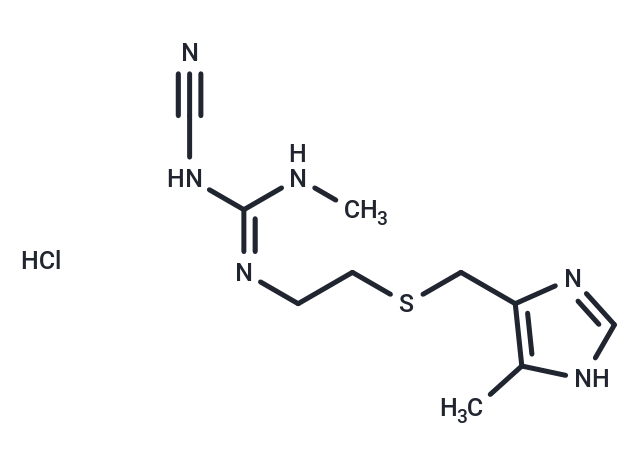
| Description | Cimetidine (SKF-92334) hydrochloride is an orally active inverse histamine H2 receptor antagonist with a Ki of 0.6 μM, demonstrating anti-cancer and anti-inflammatory activity, and is a gastric acid reducer useful in the research of duodenal and gastric ulcers [1] [2] [5]. |
| Targets & IC50 | H2 receptor:.6 μM (Kd) |
| In vitro | Cimetidine (SKF-92334) hydrochloride, distinguished as a partial H2R agonist, exhibits a unique pharmacological profile compared to ranitidine and famotidine, which may underlie its anticancer effects on gastrointestinal malignancies [1]. In ovarian cancer cells expressing high OCT2 mRNA levels (IGROV-1 cells), cimetidine hydrochloride does not affect cisplatin's uptake or cytotoxicity [3]. Additionally, it does not influence the proliferation, survival, migration, or invasion of 3LL cells. However, cimetidine hydrochloride can counteract MDSC-mediated T-cell suppression and enhance IFN-γ production [4]. Its mechanism includes the suppression of NCAM gene expression through inhibiting NF-kappaB nuclear translocation, a key activator of NCAM [5]. |
| In vivo | Cimetidine (SKF-92334) hydrochloride effectively diminishes the accumulation of CD11b(+)Gr-1(+) myeloid derived-suppressive cells (MDSC) in the spleen, blood, and tumor tissues of mice with tumors [4]. Additionally, this compound positively influences periodontal disease in rats by lowering the RANKL/OPG ratio in gingival connective tissue and mitigating alveolar bone resorption [6]. |
| Molecular Weight | 288.8 |
| Formula | C10H17ClN6S |
| Cas No. | 70059-30-2 |
| Smiles | Cl.CN\C(NC#N)=N/CCSCc1nc[nH]c1C |
| Storage | Powder: -20°C for 3 years | In solvent: -80°C for 1 year Shipping with blue ice/Shipping at ambient temperature. |
 For example, if the intended dosage is 10 mg/kg for animals weighing 20 g , with a dosing volume of 100 μL per animal, and a total of 10 animals are to be administered, using a formulation of
  10% DMSO+ 40% PEG300+ 5% Tween 80+ 45% Saline/PBS/ddH2O , the resulting working solution concentration would be 2 mg/mL.
Dissolve 2 mg of the compound in 100 μL DMSO to obtain a stock solution at a concentration of 20 mg/mL . If the required concentration exceeds the compound's known solubility, please contact us for technical support before proceeding.
1) Add 100 μL of the DMSO stock solution to 400 µL PEG300 and mix thoroughly until the solution becomes clear.
2) Add 50 µL Tween 80 and mix well until fully clarified.
3) Add 450 µL Saline,PBS or ddH2O and mix thoroughly until a homogeneous solution is obtained.
| Size | Quantity | Unit Price | Amount | Operation |
|---|
 Feedback
 Hello! How can I help you today?
Copyright © 2015-2026 TargetMol Chemicals Inc. All Rights Reserved.
