


Shopping Cart
Remove All Your shopping cart is currently empty

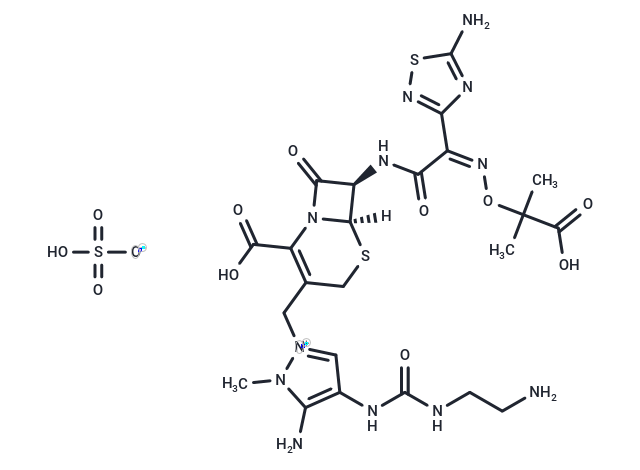
Synonyms: FR-264205, FR264205, FR 264205, CXA-101 sulfate, CXA101 sulfate
| Pack Size | Price | USA Stock | Global Stock | Quantity |
|---|---|---|---|---|
| 1 mg | $456 | In Stock | In Stock | |
| 5 mg | $1,130 | - | In Stock | |
| 10 mg | $1,520 | - | In Stock | |
| 1 mL x 10 mM (in DMSO) | $1,460 | - | In Stock |
| Description | Ceftolozane sulfate (FR-264205/CXA-101) is a cephalosporin antibiotic, a penicillin-binding protein (PBP) inhibitor with antipseudomonal activity, used for infection research including pneumonia. |
| Targets & IC50 | Carbapenem-resistant Pseudomonas aeruginosa:> 8 μg/mL (MIC), P. aeruginosa PAO1:0.5 μg/mL (MIC), Pseudomonas aeruginosa:4 mg/L (MIC) |
| In vitro | Methods: Carbapenem-resistant and multidrug-resistant (MDR) Pseudomonas aeruginosa isolates were treated with various concentrations of Ceftolozane sulfate (≤0.12->64 μg/mL), and MIC values were determined. Results: Ceftolozane sulfate exhibited anti-pseudomonal activity against these resistant isolates; among 11 carbapenem-resistant isolates, 4.7% (i.e., 1 isolate) had MIC >8 μg/mL. [1] Methods: The in vitro activity of ceftolozane/tazobactam was determined in Pseudomonas aeruginosa and Enterobacterales by broth microdilution method. Results: The susceptibility rates of ceftolozane/tazobactam were 95.8%–97.5% for Pseudomonas aeruginosa and 93.3%–95.6% for Enterobacterales. [2] |
| In vivo | Methods: A neutropenic CD-1 mouse thigh infection model was used. Ceftolozane sulfate was administered by intraperitoneal injection at doses of 2–128 mg/kg every 2 hours for 24 hours, with sterile normal saline as the vehicle. Results: Ceftolozane sulfate monotherapy was effective against some Enterobacteriaceae strains but had limited activity against ESBL-producing strains; combination with tazobactam significantly enhanced efficacy.[3] Methods: A high inoculum mouse peritonitis model was used. Ceftolozane sulfate (100/50 mg/kg) was administered by intraperitoneal injection every 2 hours for 24 hours, with sterile normal saline as the vehicle. Results: The in vivo activity of Ceftolozane sulfate against CTX-M-15-producing Escherichia coli was lower than that of imipenem, with higher bacterial counts.[4] |
| Synonyms | FR-264205, FR264205, FR 264205, CXA-101 sulfate, CXA101 sulfate |
| Molecular Weight | 764.77 |
| Formula | C23H32N12O12S3 |
| Cas No. | 936111-69-2 |
| Smiles | S(=O)(=O)([O-])O.C(O)(=O)C=1N2[C@@]([C@H](NC(/C(=N\OC(C(O)=O)(C)C)/C3=NSC(N)=N3)=O)C2=O)(SCC1C[N+]4=CC(NC(NCCN)=O)=C(N)N4C)[H] |
| Relative Density. | no data available |
| Storage | Store at low temperature Powder: -20°C for 3 years | In solvent: -80°C for 1 year Shipping with blue ice/Shipping at ambient temperature. | |||||||||||||||||||||||||||||||||||
| Solubility Information | H2O: 5 mg/mL (6.54 mM), Sonication is recommended. DMSO: 40 mg/mL (52.3 mM), Sonication is recommended. | |||||||||||||||||||||||||||||||||||
Solution Preparation Table | ||||||||||||||||||||||||||||||||||||
H2O/DMSO
DMSO
Note : The dilution table applies only to solid products. For liquid products, please calculate the stock solution based on the stated concentration and/or density. | ||||||||||||||||||||||||||||||||||||
 For example, if the intended dosage is 10 mg/kg for animals weighing 20 g , with a dosing volume of 100 μL per animal, and a total of 10 animals are to be administered, using a formulation of
  10% DMSO+ 40% PEG300+ 5% Tween 80+ 45% Saline/PBS/ddH2O , the resulting working solution concentration would be 2 mg/mL.
Dissolve 2 mg of the compound in 100 μL DMSO to obtain a stock solution at a concentration of 20 mg/mL . If the required concentration exceeds the compound's known solubility, please contact us for technical support before proceeding.
1) Add 100 μL of the DMSO stock solution to 400 µL PEG300 and mix thoroughly until the solution becomes clear.
2) Add 50 µL Tween 80 and mix well until fully clarified.
3) Add 450 µL Saline,PBS or ddH2O and mix thoroughly until a homogeneous solution is obtained.
| Size | Quantity | Unit Price | Amount | Operation |
|---|
 Feedback
 Hello! How can I help you today?
Copyright © 2015-2026 TargetMol Chemicals Inc. All Rights Reserved.
