


Shopping Cart
Remove All Your shopping cart is currently empty

Synonyms: PMX 30063 tetrahydrochloride
| Pack Size | Price | USA Stock | Global Stock | Quantity |
|---|---|---|---|---|
| 25 mg | $3,090 | 10-14 weeks | 10-14 weeks | |
| 50 mg | $4,220 | 10-14 weeks | 10-14 weeks | |
| 100 mg | $4,940 | 10-14 weeks | 10-14 weeks |
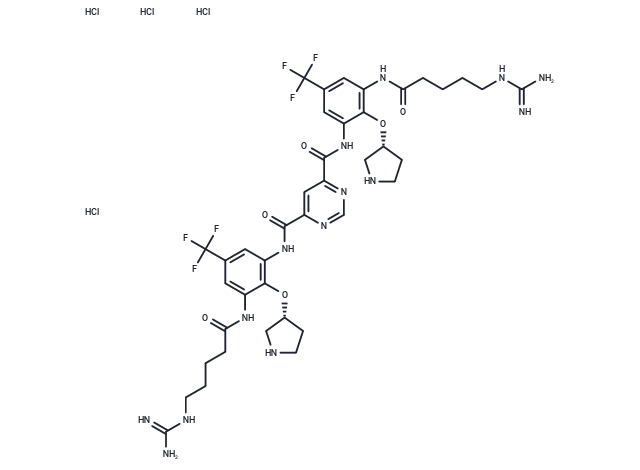
| Description | Brilacidin tetrahydrochloride (PMX 30063 tetrahydrochloride) is a defensin mimetic antibiotic exhibiting potent antimicrobial activity against various bacteria, with MIC90 values of 1 μg/mL for Streptococcus pneumoniae, 8 μg/mL for Streptococcus viridans and Haemophilus influenzae, and 4 μg/mL for Pseudomonas aeruginosa. |
| In vitro | Both Staphylococcus aureus (SA) and Staphylococcus epidermidis (SE) exhibit the lowest minimum inhibitory concentrations (MIC) among the bacterial groups studied. The MIC90s for Brilacidin against Streptococcus pneumonia (SP), Streptococcus viridians (SV), Moraxella (MS), Haemophilus influenza (HI), Pseudomonas aeruginosa (PA), and Serratia marcescens (SM) are 4, 32, 256, 32, 16, and 128 times higher, respectively, than those for SA and SE. Brilacidin demonstrates significant in vitro activity against Gram-positive bacteria (excluding SV) but is considerably less effective against Gram-negative bacteria. Topically applied 0.5% Brilacidin solution is minimally irritating and was found to be as effective as Vancomycin (VAN) in a methicillin-resistant S. aureus (MRSA) keratitis model, particularly when the corneal epithelium had been removed. The mechanism of action for Brilacidin involves depolarization of the bacterial cell membrane, highlighting its potent antibacterial properties against Gram-positive strains. |
| In vivo | In the NZW rabbit ocular toxicity model, Brilacidin exhibits dose-dependent ocular toxicity following seven topical applications every 30 minutes over a three-hour period. A 1% concentration of Brilacidin is classified as Mildly Irritating with a Maximum mean total score (MMTS) of 23.0. Concentrations of 0.5% (MMTS: 6.5) and 0.25% (MMTS: 4.0) are deemed Minimally Irritating. In contrast, a 0.1% solution of Brilacidin, with an MMTS of 2.0, and TBS with an MMTS of 1.0, are categorized as Practically Nonirritating. Moreover, a 0.01% concentration of Brilacidin, showing an MMTS of 0.5, is identified as Nonirritating. |
| Synonyms | PMX 30063 tetrahydrochloride |
| Molecular Weight | 1082.75 |
| Formula | C40H54Cl4F6N14O6 |
| Cas No. | 1224095-99-1 |
| Smiles | Cl.Cl.Cl.Cl.NC(=N)NCCCCC(=O)Nc1cc(cc(NC(=O)c2cc(ncn2)C(=O)Nc2cc(cc(NC(=O)CCCCNC(N)=N)c2O[C@@H]2CCNC2)C(F)(F)F)c1O[C@@H]1CCNC1)C(F)(F)F |
| Storage | Powder: -20°C for 3 years | In solvent: -80°C for 1 year Shipping with blue ice/Shipping at ambient temperature. |
 For example, if the intended dosage is 10 mg/kg for animals weighing 20 g , with a dosing volume of 100 μL per animal, and a total of 10 animals are to be administered, using a formulation of
  10% DMSO+ 40% PEG300+ 5% Tween 80+ 45% Saline/PBS/ddH2O , the resulting working solution concentration would be 2 mg/mL.
Dissolve 2 mg of the compound in 100 μL DMSO to obtain a stock solution at a concentration of 20 mg/mL . If the required concentration exceeds the compound's known solubility, please contact us for technical support before proceeding.
1) Add 100 μL of the DMSO stock solution to 400 µL PEG300 and mix thoroughly until the solution becomes clear.
2) Add 50 µL Tween 80 and mix well until fully clarified.
3) Add 450 µL Saline,PBS or ddH2O and mix thoroughly until a homogeneous solution is obtained.
| Size | Quantity | Unit Price | Amount | Operation |
|---|
 Feedback
 Hello! How can I help you today?
Copyright © 2015-2026 TargetMol Chemicals Inc. All Rights Reserved.
