


Shopping Cart
Remove All Your shopping cart is currently empty

Synonyms:
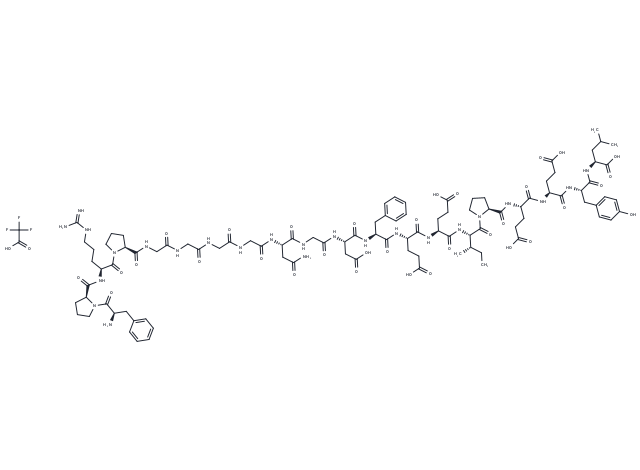
| Pack Size | Price | USA Stock | Global Stock | Quantity |
|---|---|---|---|---|
| 5 mg | $36 | - | In Stock | |
| 10 mg | $58 | - | In Stock | |
| 25 mg | $81 | - | In Stock | |
| 50 mg | $98 | - | In Stock | |
| 100 mg | $123 | - | In Stock |
| Description | Bivalirudin TFA is a hirudin analog and belongs to the class of specific, reversible direct thrombin inhibitors. Bivalirudin TFA exhibits high selectivity, with Ki values of 2.56 nM and 1.84 nM for α-thrombin and ζ-thrombin, respectively, and shows no significant activity against trypsin or γ-thrombin. Bivalirudin TFA also exhibits antiviral and anti-inflammatory activities. Bivalirudin TFA can be used in research on thrombotic diseases and other conditions. |
| In vitro | Methods: HUVECs were incubated with 2 U/ml thrombin and 30 μg/ml Bivalirudin TFA for 10 minutes. Intracellular and extracellular S1P concentrations were measured by ELISA, and S1PR expression was assessed by Western blot. Results: Thrombin significantly increased intracellular and extracellular S1P levels and S1PR2 expression; Bivalirudin TFA completely reversed the thrombin-induced increase in S1P and upregulation of S1PR2. [1] |
| In vivo | Methods: 5- to 7-day-old C57BL/6 newborn mice were selected and anesthetized with ketamine / serazine (0.04 mL/0.02 kg), and a respiratory syncytial virus (RSV) infection model was established via intranasal instillation of 0.035 mL of a solution containing 5 × 10⁶ TCID₅₀ of RSV A2. Starting 1 day prior to viral infection, 2 mg/kg of Bivalirudin TFA was administered intravenously once every other day for 2 consecutive weeks. Results: Following administration of Bivalirudin TFA, the inflammatory score in mouse lung tissue decreased by approximately 50%, and viral copy numbers decreased by approximately 60%. Concurrently, it corrected disorders in the coagulation-fibrinolysis system, downregulated pro-inflammatory factors and the TLR3/7 signaling pathways, and regulated the expression of inflammation-related microRNAs. No significant toxic reactions were observed in the mice during the treatment period. [2] Methods: Wild-type (P2Y₁₂⁺/⁺) and heterozygous (P2Y₁₂⁺/⁻) mice were administered 0.2 mg/mL rhodamine 6G-labeled platelets via tail vein injection; Bivalirudin TFA (2 mg/kg) was administered intravenously 15 minutes prior to the procedure; injury was induced by treating the mesenteric artery with 12.5% FeCl₃-impregnated filter paper for 7 minutes, followed by continuous observation of thrombus formation and vascular occlusion time for 40 minutes. Results: Bivalirudin TFA delayed vascular occlusion time in wild-type mice; in P2Y₁₂⁺/⁻ mice, Bivalirudin TFA completely blocked thrombus formation.[3] |
| Molecular Weight | 2294.31 |
| Formula | C100H139F3N24O35 |
| Cas No. | 1191386-55-6 |
| Smiles | C(C(O)=O)(F)(F)F.C([C@@H](NC([C@@H](NC([C@@H](NC([C@H](CC1=CC=CC=C1)NC([C@@H](NC(CNC([C@@H](NC(CNC(CNC(CNC(CNC(=O)[C@H]2N(C([C@@H](NC(=O)[C@H]3N(C([C@@H](CC4=CC=CC=C4)N)=O)CCC3)CCCNC(=N)N)=O)CCC2)=O)=O)=O)=O)CC(N)=O)=O)=O)CC(O)=O)=O)=O)CCC(O)=O)=O)CCC(O)=O)=O)[C@H](CC)C)(=O)N5[C@H](C(N[C@H](C(N[C@H](C(N[C@@H](CC6=CC=C(O)C=C6)C(N[C@@H](CC(C)C)C(O)=O)=O)=O)CCC(O)=O)=O)CCC(O)=O)=O)CCC5 |
| Sequence | {D-Phe}-Pro-Arg-Pro-Gly-Gly-Gly-Gly-Asn-Gly-Asp-Phe-Glu-Glu-Ile-Pro-Glu-Glu-Tyr-Leu |
| Sequence Short | FPRPGGGGNGDFEEIPEEYL |
| Storage | Keep away from moisture,Keep away from direct sunlight Powder: -20°C for 3 years | In solvent: -80°C for 1 year Shipping with blue ice/Shipping at ambient temperature. | ||||||||||||||||||||||||||||||
| Solubility Information | DMSO: 80 mg/mL (34.87 mM), Sonication is recommended. H2O: 40 mg/mL (17.43 mM), Sonication is recommended. | ||||||||||||||||||||||||||||||
Solution Preparation Table | |||||||||||||||||||||||||||||||
H2O/DMSO
DMSO
Note : The dilution table applies only to solid products. For liquid products, please calculate the stock solution based on the stated concentration and/or density. | |||||||||||||||||||||||||||||||
 For example, if the intended dosage is 10 mg/kg for animals weighing 20 g , with a dosing volume of 100 μL per animal, and a total of 10 animals are to be administered, using a formulation of
  10% DMSO+ 40% PEG300+ 5% Tween 80+ 45% Saline/PBS/ddH2O , the resulting working solution concentration would be 2 mg/mL.
Dissolve 2 mg of the compound in 100 μL DMSO to obtain a stock solution at a concentration of 20 mg/mL . If the required concentration exceeds the compound's known solubility, please contact us for technical support before proceeding.
1) Add 100 μL of the DMSO stock solution to 400 µL PEG300 and mix thoroughly until the solution becomes clear.
2) Add 50 µL Tween 80 and mix well until fully clarified.
3) Add 450 µL Saline,PBS or ddH2O and mix thoroughly until a homogeneous solution is obtained.
| Size | Quantity | Unit Price | Amount | Operation |
|---|
 Feedback
 Hello! How can I help you today?
Copyright © 2015-2026 TargetMol Chemicals Inc. All Rights Reserved.
