


Shopping Cart
Remove All
  • TargetMol
    Your shopping cart is currently empty

Bicuculline methobromide (Alias: d-Bicuculline methobromide, (+)-Bicuculline methobromide ; d-Bicuculline m...)

Catalog No. T72246 Copy Product Info
🥰Excellent
Bicuculline methobromide is a selective GABAA receptor antagonist with an IC50 of 3 μM. It can induce clonic-tonic seizures in mammals and block Ca²⁺-activated potassium channels, commonly used to establish models of epilepsy and related neurological disorders.

Bicuculline methobromide

Copy Product Info
🥰Excellent
Catalog No. T72246
Alias d-Bicuculline methobromide, (+)-Bicuculline methobromide ; d-Bicuculline methobromide, (+)-Bicuculline methobromide
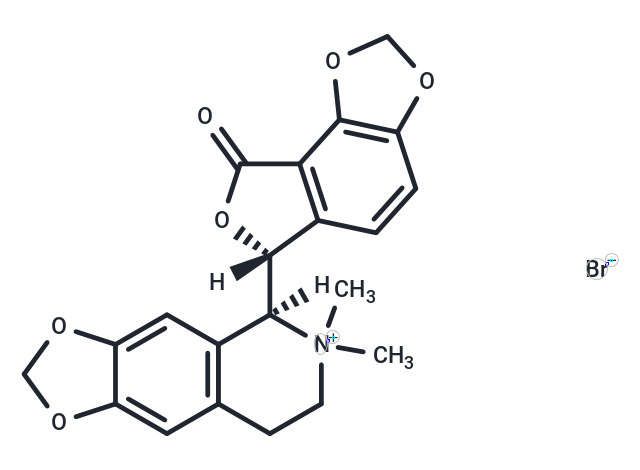
Bicuculline methobromide is a selective GABAA receptor antagonist with an IC50 of 3 μM. It can induce clonic-tonic seizures in mammals and block Ca²⁺-activated potassium channels, commonly used to establish models of epilepsy and related neurological disorders.

Bicuculline methobromide
Cas No. 66016-70-4
Pack SizePriceUSA StockGlobal StockQuantity
10 mg$31935 days35 days
50 mg$1,32035 days35 days
In stock · Estimated delivery: USA Stock (1-2 days) Global Stock (5-7 days)
Add to Cart
Add to Quotation
For research use only—not for human use. No sales to individuals. Use as intended only.
Questions
TargetMol
View More

Resource Download

Product Introduction

Bioactivity
Description
Bicuculline methobromide is a selective GABAA receptor antagonist with an IC50 of 3 μM. It can induce clonic-tonic seizures in mammals and block Ca²⁺-activated potassium channels, commonly used to establish models of epilepsy and related neurological disorders.
Disease Modeling Protocol
Focal Epilepsy Model
  • Modeling Mechanism:

    Bicuculline methobromide, as a competitive antagonist of γ-aminobutyric acid A (GABAₐ) receptors, induces epileptic pathology through multiple mechanisms: ① It blocks GABAₐ receptor-mediated inhibitory synaptic transmission, disrupting the excitability/inhibition balance in the brain, triggering local neuronal overexcitation, and forming focal epileptic seizures; ② It induces hemodynamic changes (increased optical absorption coefficient) in the epileptic focus area, accompanied by abnormal interictal discharges on electroencephalography (EEG), mimicking the core pathological and electrophysiological characteristics of human neocortical epilepsy.

  • Related Products:

    Bicuculline methobromide (T72246)

  • Modeling Method:

    Experimental Subject:

    Rats, Sprague–Dawley (SD), Male, Adult, Body weight 240–260 g

    Dosage and Administration Route:

    ① Core modelling: Bicuculline methiodidee (1.9 mM), 10 μL/animal, dissolved in physiological saline, stereotaxic injection into right/left parietal cortex or specific brain regions (depth 1–3 mm, e.g., sensory cortex S1, caudate nucleus CPu) as a single dose;
    ② Surgical Procedure: Inhalation anaesthesia with isoflurane (induction 4%, maintenance 1.5%)+intraperitoneal injection of propofol (1 g/kg). Head fixed in stereotaxic apparatus. Following removal of skull and scalp, microinjection performed at 0.3 μL/min using a microinjector;
    ③ Control procedure: Equal-volume saline administered via identical injection protocol;
    ④ Preparation for detection: Stainless steel screw electrodes implanted in the occipital bone as reference electrodes; DOT/ESL (Diffusion Optical Tomography/Electroencephalogram Source Localisation) probe adhered to cortical surface

    Dosing Frequency and Duration Model:

    Single dose

  • Validation:

    Electrophysiological indicators: EEG recording: Typical epileptiform discharges (increased amplitude, abnormal frequency) appeared after modeling, lasting for more than 6 minutes, while no abnormal discharges were observed in the control group; Optical imaging: DOT detection showed a significant increase in the optical absorption coefficient of the epileptic focus area (P<0.05 vs. resting state), which could accurately locate epileptic foci with an injection depth of 1-3 mm. ESL was used for auxiliary verification, but there was a slight horizontal offset; Specificity verification: When Bicuculline methobromide was injected outside the field of view of the DOT/ESL probe, DOT showed a negative detection (no epileptic focus signal), and ESL may show false positives, confirming the specificity of DOT localization; Behavioral indicators: After modeling, focal limb twitching, stereotyped movements, and other focal epileptic seizure manifestations appeared, without generalized tonic-clonic seizures (consistent with the characteristics of focal epilepsy).

*Precautions: Animals were euthanized humanely in accordance with ethical requirements after the experiment. If long-term observation is required, the frequency of epileptic seizures should be monitored regularly, and euthanasia should be performed promptly if severe and persistent seizures occur.

*References:Yang H,et,al. In vivo imaging of epileptic foci in rats using a miniature probe integrating diffuse optical tomography and electroencephalographic source localization. Epilepsia. 2015 Jan;56(1):94-100.

Synonymsd-Bicuculline methobromide, (+)-Bicuculline methobromide ; d-Bicuculline methobromide, (+)-Bicuculline methobromide
Chemical Properties
Molecular Weight462.29
FormulaC21H20BrNO6
Cas No.66016-70-4
SmilesC[N+]1(C)[C@]([C@]2(C3=C(C(=O)O2)C4=C(C=C3)OCO4)[H])(C5=C(C=C6C(=C5)OCO6)CC1)[H].[Br-]
Storage & Solubility Information
StoragePowder: -20°C for 3 years | In solvent: -80°C for 1 year | Shipping with blue ice/Shipping at ambient temperature.

Calculator

  • Molarity Calculator
  • Dilution Calculator
  • Reconstitution Calculator
  • Molecular Weight Calculator

In Vivo Formulation Calculator (Clear solution)

Please enter your animal experiment information in the following box and click Calculate to obtain the stock solution preparation method and in vivo formula preparation method:
TargetMol | Animal experiments For example, if the intended dosage is 10 mg/kg for animals weighing 20 g , with a dosing volume of 100 μL per animal, TargetMol | Animal experiments and a total of 10 animals are to be administered, using a formulation of TargetMol | reagent 10% DMSO+ 40% PEG300+ 5% Tween 80+ 45% Saline/PBS/ddH2O , the resulting working solution concentration would be 2 mg/mL.

Stock Solution Preparation:

Dissolve 2 mg of the compound in 100 μL DMSOTargetMol | reagent to obtain a stock solution at a concentration of 20 mg/mL . If the required concentration exceeds the compound's known solubility, please contact us for technical support before proceeding.

Preparation of the In Vivo Formulation:

1) Add 100 μL of the DMSOTargetMol | reagent stock solution to 400 μL PEG300TargetMol | reagent and mix thoroughly until the solution becomes clear.

2) Add 50 μL Tween 80 and mix well until fully clarified.

3) Add 450 μL Saline,PBS or ddH2OTargetMol | reagent and mix thoroughly until a homogeneous solution is obtained.

This example is provided solely to demonstrate the use of the In Vivo Formulation Calculator and does not constitute a recommended formulation for any specific compound. Please select an appropriate dissolution and formulation strategy based on your experimental model and route of administration.
All co-solvents required for this protocol, includingDMSO, PEG300/PEG400, Tween 80, SBE-β-CD, and Corn oil, are available for purchase on the TargetMol website.
1 Enter information below:
mg/kg
g
μL
2 Enter the in vivo formulation:
% DMSO
%
% Tween 80
% Saline/PBS/ddH2O

Dose Conversion

You can also refer to dose conversion for different animals. More Dose Conversion

Tech Support

Please see Inhibitor Handling Instructions for more frequently ask questions. Topics include: how to prepare stock solutions, how to store products, and cautions on cell-based assays & animal experiments, etc

Keywords

Related Tags: buy Bicuculline methobromide | purchase Bicuculline methobromide | Bicuculline methobromide cost | order Bicuculline methobromide | Bicuculline methobromide chemical structure | Bicuculline methobromide formula | Bicuculline methobromide molecular weight




