


Shopping Cart
Remove All Your shopping cart is currently empty

Synonyms: Methyl (4R)-4-(2-chloro-4-fluorophenyl)-2-(3,5-difluoropyridin-2-yl)-6-methyl-1,4-dihydropyrimidine-5-carboxylate, BAY41-4109, (R)-Bay 41-4109
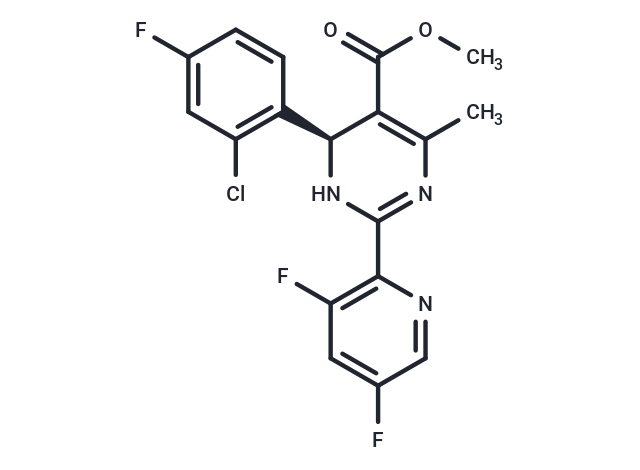
| Pack Size | Price | USA Stock | Global Stock | Quantity |
|---|---|---|---|---|
| 2 mg | $68 | - | In Stock | |
| 1 mL x 10 mM (in DMSO) | $29 | 6-8 weeks | 6-8 weeks |
| Description | BAY 41-4109 (Methyl (4R)-4-(2-chloro-4-fluorophenyl)-2-(3,5-difluoropyridin-2-yl)-6-methyl-1,4-dihydropyrimidine-5-carboxylate) is a potent inhibitor of human hepatitis B virus (HBV)(IC50 : 53 nM). |
| Targets & IC50 | HepG2.2.15 cells:7 μM (cc50), HBV:50 nM |
| In vitro | Method: In HepG2.2.15 cells, the inhibitory effects of BAY 41-4109 on HBV DNA release and cytoplasmic HBcAg levels were measured, and the half-maximal inhibitory concentrations (IC50) were calculated. The dose-response relationship for both parameters and the association between the anti-HBV mechanism and HBcAg inhibition were evaluated. Result: The IC50 values of BAY 41-4109 for inhibiting HBV DNA release and cytoplasmic HBcAg levels were 32.6 nM and 132 nM, respectively, indicating a stronger inhibitory effect on HBV DNA. Both HBV DNA and HBcAg were inhibited in a dose-dependent manner, suggesting that the anti-HBV mechanism is associated with and dependent on the rate of HBcAg inhibition [1]. Method: Human HepG2.2.15 cells were treated with BAY 41-4109 for 8 days. Inhibition of HBV DNA was detected using dot-blot hybridization and quantified by LumiImager, and cytotoxicity (CC50) was also determined. Result: The IC50 of BAY 41-4109 for inhibiting HBV replication was approximately 53 nM, and the CC50 in HepG2.2.15 cells was approximately 7 μM [3]. Method: HepAD38 cells were treated with BAY 41-4109 (2 μM) for 6 days. Supernatant HBV DNA was quantified by qPCR, and HBeAg and HBsAg levels were measured by ELISA. Result: Following BAY 41-4109 treatment, HBV DNA inhibition exceeded 95% (residual DNA was 4.9% ± 2.8% of the DMSO control), and HBeAg secretion was significantly reduced (to 31.8% ± 3.8% of the control), with an EC50 of 0.05 ± 0.003 μM [4]. |
| In vivo | Method: In a transgenic mouse model, the effect of BAY 41-4109 treatment on HBV replication was evaluated. Result: BAY 41-4109 inhibited HBV virion production at nanomolar concentrations in an animal model. Its mechanism of action involves targeting the viral capsid protein, leading to the formation of aberrant capsids and subsequently suppressing viral replication [2]. Method: HBV transgenic mice (Tg [HBV1.3 fsX-3'5']) were orally administered BAY 41-4109 (3-30 mg/kg) twice daily (b.i.d.) or three times daily (t.i.d.) for 28 days. Hepatic HBV DNA was detected by dot-blot hybridization, plasma HBV DNA was quantified by real-time qPCR, and HBcAg expression in liver tissues was examined by immunohistochemistry. Result: BAY 41-4109 reduced hepatic and plasma HBV DNA levels in a dose-dependent manner, with significant effects observed at doses of 30 mg/kg and 15 mg/kg (P < 0.05). Unlike 3TC, BAY 41-4109 markedly reduced HBcAg in the cytoplasm of hepatocytes, suggesting a mechanism of action distinct from that of nucleoside analogs. Pharmacokinetic analysis revealed an oral bioavailability of 30% in mice and a half-life of approximately 2 hours [3]. |
| Synonyms | Methyl (4R)-4-(2-chloro-4-fluorophenyl)-2-(3,5-difluoropyridin-2-yl)-6-methyl-1,4-dihydropyrimidine-5-carboxylate, BAY41-4109, (R)-Bay 41-4109 |
| Molecular Weight | 395.76 |
| Formula | C18H13ClF3N3O2 |
| Cas No. | 298708-81-3 |
| Smiles | C(OC)(=O)C=1[C@@H](NC(=NC1C)C2=C(F)C=C(F)C=N2)C3=C(Cl)C=C(F)C=C3 |
| Relative Density. | 1.46 g/cm3 (Predicted) |
| Storage | Powder: -20°C for 3 years | In solvent: -80°C for 1 year Shipping with blue ice/Shipping at ambient temperature. | |||||||||||||||||||||||||||||||||||
| Solubility Information | DMSO: 80 mg/mL (202.14 mM), Sonication is recommended. | |||||||||||||||||||||||||||||||||||
| In Vivo Formulation | 10% DMSO+40% PEG300+5% Tween-80+45% Saline: 3.3 mg/mL (8.34 mM), Sonication is recommended. Please add the solvents sequentially, clarifying the solution as much as possible before adding the next one. Dissolve by heating and/or sonication if necessary. Working solution is recommended to be prepared and used immediately. The formulation provided above is for reference purposes only. In vivo formulations may vary and should be modified based on specific experimental conditions. | |||||||||||||||||||||||||||||||||||
Solution Preparation Table | ||||||||||||||||||||||||||||||||||||
DMSO
Note : The dilution table applies only to solid products. For liquid products, please calculate the stock solution based on the stated concentration and/or density. | ||||||||||||||||||||||||||||||||||||
 For example, if the intended dosage is 10 mg/kg for animals weighing 20 g , with a dosing volume of 100 μL per animal, and a total of 10 animals are to be administered, using a formulation of
  10% DMSO+ 40% PEG300+ 5% Tween 80+ 45% Saline/PBS/ddH2O , the resulting working solution concentration would be 2 mg/mL.
Dissolve 2 mg of the compound in 100 μL DMSO to obtain a stock solution at a concentration of 20 mg/mL . If the required concentration exceeds the compound's known solubility, please contact us for technical support before proceeding.
1) Add 100 μL of the DMSO stock solution to 400 µL PEG300 and mix thoroughly until the solution becomes clear.
2) Add 50 µL Tween 80 and mix well until fully clarified.
3) Add 450 µL Saline,PBS or ddH2O and mix thoroughly until a homogeneous solution is obtained.
| Size | Quantity | Unit Price | Amount | Operation |
|---|
 Feedback
 Hello! How can I help you today?
Copyright © 2015-2026 TargetMol Chemicals Inc. All Rights Reserved.
