


Shopping Cart
Remove All Your shopping cart is currently empty

Synonyms:
| Pack Size | Price | USA Stock | Global Stock | Quantity |
|---|---|---|---|---|
| 1 mg | $178 | In Stock | In Stock | |
| 5 mg | $436 | In Stock | In Stock | |
| 10 mg | $592 | In Stock | In Stock | |
| 25 mg | $912 | In Stock | In Stock | |
| 50 mg | $1,180 | In Stock | In Stock | |
| 100 mg | $1,660 | - | In Stock | |
| 200 mg | $2,230 | - | In Stock |
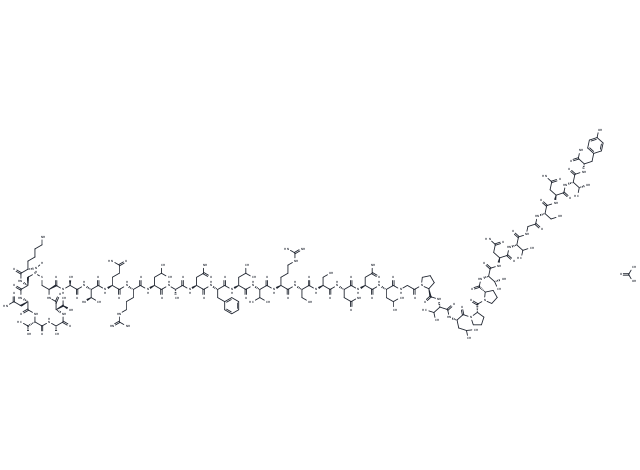
| Description | Amylin, amide, rat acetate is a potent and high affinity ligand of AMY1 and AMY3 receptors and variably of AMY2 receptors. |
| In vivo | Amylin is an important 37 amino acid glucoregulatory hormone with great potential to target metabolic diseases. Amylin is a member of the calcitonin (CT) family of peptides, which includes CT itself, the CGRPs comprising two variants (αCGRP and βCGRP), adrenomedullin (AM) and AM2 (intermedin). Amylin is a centrally acting, neuroendocrine hormone synthesized with insulin in the beta cells of pancreatic islets. Amylin regulates glucose homeostasis by inhibiting gastric emptying, inhibiting the release of the counter-regulatory hormone glucagon and inducing meal-ending satiety. Amylin functions as a glucoregulatory and satiety-inducing hormone, which is protective against postprandial spikes in blood glucose and overeating.[1] |
| Molecular Weight | 3980.45 |
| Formula | C169H276N52O55S2 |
| Smiles | [H]N[C@H](C(N[C@H]1CSSC[C@@H](C(N[C@H](C(N[C@H](C(N[C@H](C(N[C@H](C(N[C@H](C(N[C@H](C(N[C@H](C(N[C@H](C(N[C@H](C(N[C@H](C(N[C@H](C(N[C@H](C(N[C@H](C(N[C@H](C(N[C@H](C(N[C@H](C(NCC(N2CCC[C@H]2C(N[C@H](C(N[C@H](C(N3CCC[C@H]3C(N4CCC[C@H]4C(N[C@H](C(N[C@H](C(N[C@H](C(NCC(N[C@H](C(N[C@H](C(N[C@H](C(N[C@H](C(N)=O)CC5=CC=C(C=C5)O)=O)[C@H](O)C)=O)CC(N)=O)=O)CO)=O)=O)C(C)C)=O)CC(N)=O)=O)[C@H](O)C)=O)=O)=O)CC(C)C)=O)C(C)C)=O)=O)=O)CC(C)C)=O)CC(N)=O)=O)CC(N)=O)=O)CO)=O)CO)=O)CCCNC(N)=N)=O)C(C)C)=O)CC(C)C)=O)CC6=CC=CC=C6)=O)CC(N)=O)=O)C)=O)CC(C)C)=O)CCCNC(N)=N)=O)CCC(N)=O)=O)[C@H](O)C)=O)C)=O)NC([C@H]([C@H](O)C)NC([C@@H](NC([C@H]([C@H](O)C)NC([C@@H](NC1=O)CC(N)=O)=O)=O)C)=O)=O)=O)CCCCN.CC(O)=O |
| Relative Density. | no data available |
| Storage | Keep away from moisture Powder: -20°C for 3 years | In solvent: -80°C for 1 year Shipping with blue ice/Shipping at ambient temperature. |
 For example, if the intended dosage is 10 mg/kg for animals weighing 20 g , with a dosing volume of 100 μL per animal, and a total of 10 animals are to be administered, using a formulation of
  10% DMSO+ 40% PEG300+ 5% Tween 80+ 45% Saline/PBS/ddH2O , the resulting working solution concentration would be 2 mg/mL.
Dissolve 2 mg of the compound in 100 μL DMSO to obtain a stock solution at a concentration of 20 mg/mL . If the required concentration exceeds the compound's known solubility, please contact us for technical support before proceeding.
1) Add 100 μL of the DMSO stock solution to 400 µL PEG300 and mix thoroughly until the solution becomes clear.
2) Add 50 µL Tween 80 and mix well until fully clarified.
3) Add 450 µL Saline,PBS or ddH2O and mix thoroughly until a homogeneous solution is obtained.
| Size | Quantity | Unit Price | Amount | Operation |
|---|
 Feedback
 Hello! How can I help you today?
Copyright © 2015-2026 TargetMol Chemicals Inc. All Rights Reserved.
