


Shopping Cart
Remove All Your shopping cart is currently empty

Synonyms:
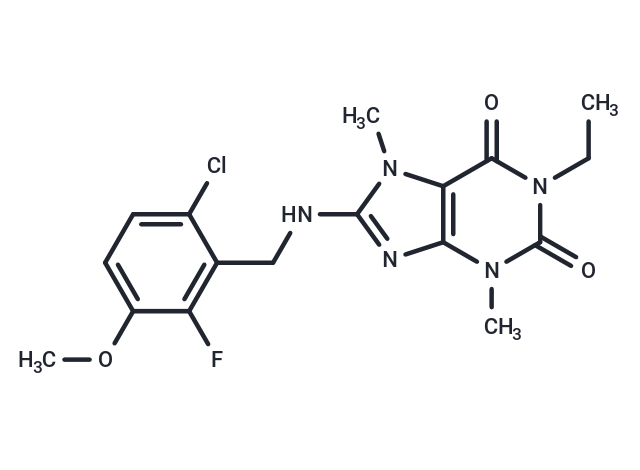
| Pack Size | Price | USA Stock | Global Stock | Quantity |
|---|---|---|---|---|
| 25 mg | $1,520 | 6-8 weeks | 6-8 weeks | |
| 50 mg | $1,980 | 6-8 weeks | 6-8 weeks | |
| 100 mg | $2,500 | 6-8 weeks | 6-8 weeks |
| Description | Adenosine receptor inhibitor 1 is a highly potent and selective antagonist of adenosine receptor (AR), exhibiting exceptional affinity for A1 AR, A2A AR, A2B AR, and A3 AR, with respective Ki values of >1000, 68.5, >1000, >1000 nM. This compound demonstrates notable antinociceptive, anti-inflammatory, and peripheral analgesic properties, holding great promise for investigating cancer and neurodegenerative diseases [1]. |
| Targets & IC50 | A3 receptor:>1000 nM (Ki), A2A receptor:68.5 nM (Ki), A2B (human):>1000 nM (Ki), A1AR:>1000 nM (Ki) |
| In vitro | Compound 12d, an adenosine receptor inhibitor, demonstrates metabolic stability with 96.56% and 97.97% of the parent compound remaining after a 120-minute incubation with mouse liver microsomes (MLMs) and rat liver microsomes (RLMs), respectively [1]. |
| In vivo | Adenosine receptor inhibitor 1 administered intraperitoneally (i.p.) at doses of 20, 30, 40 mg/kg demonstrated concentration-dependent antinociceptive effects, reducing the pain response in animal models. Specifically, at a 20 mg/kg dose, it exhibited an anti-inflammatory effect, reducing edema in a carrageenan-induced model, and at doses of 5, 10, 20 mg/kg, it showed significant analgesic effects in mice, reducing pain from peripheral sources. In an 18-26 g male albino Swiss mouse model with chronic pain induced by 5% formalin, doses of 20, 30, 40 mg/kg decreased the licking/biting time of the irritated paw. In 150-180 g male Wistar rats experiencing carrageenan-induced edema, a 20 mg/kg dose inhibited edema by 23.3%, 54.2%, and 66.0% over 1, 2, and 3 hours, respectively. Furthermore, in mice injected with irritants such as phenylbenzoquinone or acetic acid to induce pain, doses of 5, 10, 20 mg/kg led to a decrease in pain manifestations by 32.9%, 54.9%, and 82.0%, respectively. |
| Molecular Weight | 395.82 |
| Formula | C17H19ClFN5O3 |
| Cas No. | 2550400-52-5 |
| Smiles | CN1C2=C(N(C)C(NCC3=C(F)C(OC)=CC=C3Cl)=N2)C(=O)N(CC)C1=O |
| Storage | Powder: -20°C for 3 years | In solvent: -80°C for 1 year Shipping with blue ice/Shipping at ambient temperature. |
 For example, if the intended dosage is 10 mg/kg for animals weighing 20 g , with a dosing volume of 100 μL per animal, and a total of 10 animals are to be administered, using a formulation of
  10% DMSO+ 40% PEG300+ 5% Tween 80+ 45% Saline/PBS/ddH2O , the resulting working solution concentration would be 2 mg/mL.
Dissolve 2 mg of the compound in 100 μL DMSO to obtain a stock solution at a concentration of 20 mg/mL . If the required concentration exceeds the compound's known solubility, please contact us for technical support before proceeding.
1) Add 100 μL of the DMSO stock solution to 400 µL PEG300 and mix thoroughly until the solution becomes clear.
2) Add 50 µL Tween 80 and mix well until fully clarified.
3) Add 450 µL Saline,PBS or ddH2O and mix thoroughly until a homogeneous solution is obtained.
| Size | Quantity | Unit Price | Amount | Operation |
|---|
 Feedback
 Hello! How can I help you today?
Copyright © 2015-2026 TargetMol Chemicals Inc. All Rights Reserved.
