


Shopping Cart
Remove All Your shopping cart is currently empty

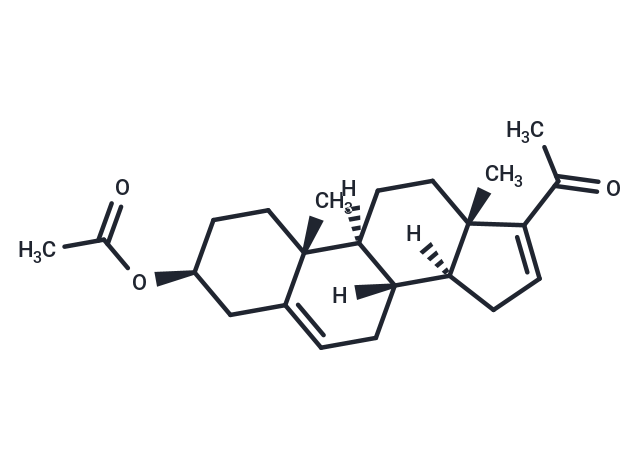
Synonyms: Dehydropregnenolone acetate, 16-DPA
| Pack Size | Price | USA Stock | Global Stock | Quantity |
|---|---|---|---|---|
| 100 mg | $30 | - | In Stock |
| Description | 16-Dehydropregnenolone acetate (16-DPA, Dehydropregnenolone acetate) is a sterol compound with oral activity that inhibits both 17α-hydroxylase and 5α-reductase. Additionally, 16-Dehydropregnenolone acetate acts as a potent antagonist of the bile acid receptor (BAR)/farnesoid X receptor (FXR). 16-DPA exhibits lipid-lowering and anticancer effects and is commonly used as an intermediate in drug synthesis for the preparation of dexamethasone and other related steroidal drug active carriers. |
| In vitro | Method: Human hepatocellular carcinoma HepG2 cells were treated with 16-Dehydropregnenolone (10, 25, 50, 100 μM) for 24 h, and the mRNA expression levels of PPARα and CYP7A1 were detected by RT-PCR. Result: Treatment of HepG2 cells with 16-Dehydropregnenolone significantly increased the mRNA expression levels of PPARα and CYP7A1. PPARα expression was increased approximately 1.5-fold at 50 μM, and CYP7A1 expression was increased approximately 2.2-fold at 25 μM [1]. Method: Human cervical carcinoma HeLa cells were treated with 16-Dehydropregnenolone (0-40 μM) for various time periods. Cell growth inhibition was assessed by MTT assay, cell cycle distribution was analyzed by flow cytometry, and the expression levels of ATM-Chk2-p53 pathway-related proteins were detected by Western blot. Result: 16-Dehydropregnenolone inhibited the growth of HeLa cells in a time- and dose-dependent manner, induced G1 phase arrest and mitochondrial apoptosis. The mechanism was associated with activation of the ATM-Chk2-p53 pathway [2]. |
| In vivo | Method: Hyperlipidemic male Syrian golden hamsters fed a high-fat diet were orally administered 16-Dehydropregnenolone (72 mg/kg) once daily for 7 consecutive days. Serum levels of total cholesterol, triglycerides, low-density lipoprotein cholesterol, high-density lipoprotein cholesterol, and fecal total bile acid levels were measured using biochemical assays. The mRNA expression of CYP7A1, LXRα, and PPARα in liver tissue was detected by RT-PCR. Result: Compared with the high-fat diet group, the 16-Dehydropregnenolone-treated group showed a 60.20% reduction in serum total cholesterol, a 54.12% reduction in triglycerides, and a 62.27% reduction in low-density lipoprotein cholesterol, along with an increased HDL-C/TC ratio and a decreased atherogenic index. Hepatic CYP7A1 mRNA expression was increased by 5.58-fold, LXRα by 1.93-fold, and PPARα by 1.89-fold. Fecal total bile acid excretion was further increased by 179.38% compared with the high-fat diet group [1]. Method: Female nude mice bearing human cervical carcinoma xenografts were intravenously injected with 16-Dehydropregnenolone liposomes (30 mg/kg). Plasma and tissues including heart, liver, spleen, lung, kidney, brain, tumor, uterus and ovary, intestine, stomach, and pancreas were collected at various time points (0.17, 2, 8, and 12 h). The distribution of 16-Dehydropregnenolone in each tissue was determined by HPLC-UV. Result: 16-Dehydropregnenolone was widely and rapidly distributed throughout the body, with major distribution in plasma (AUC 12.67 μg·h/mL, Te 11.4%), liver (AUC 12.10 μg·h/g, Te 10.9%), spleen (AUC 8.09 μg·h/g, Te 7.3%), and tumor (AUC 12.84 μg·h/g, Te 11.6%). The highest tumor drug distribution was observed at 8 h post-administration, and the distribution ratio in the uterus and ovaries was 10.2%, which is beneficial for antitumor efficacy [2]. |
| Synonyms | Dehydropregnenolone acetate, 16-DPA |
| Molecular Weight | 356.50 |
| Formula | C23H32O3 |
| Cas No. | 979-02-2 |
| Smiles | C[C@@]12[C@]([C@]3([C@](CC1)([C@]4(C)C(=CC3)C[C@@H](OC(C)=O)CC4)[H])[H])(CC=C2C(C)=O)[H] |
| Storage | Powder: -20°C for 3 years | In solvent: -80°C for 1 year Shipping with blue ice/Shipping at ambient temperature. |
 For example, if the intended dosage is 10 mg/kg for animals weighing 20 g , with a dosing volume of 100 μL per animal, and a total of 10 animals are to be administered, using a formulation of
  10% DMSO+ 40% PEG300+ 5% Tween 80+ 45% Saline/PBS/ddH2O , the resulting working solution concentration would be 2 mg/mL.
Dissolve 2 mg of the compound in 100 μL DMSO to obtain a stock solution at a concentration of 20 mg/mL . If the required concentration exceeds the compound's known solubility, please contact us for technical support before proceeding.
1) Add 100 μL of the DMSO stock solution to 400 µL PEG300 and mix thoroughly until the solution becomes clear.
2) Add 50 µL Tween 80 and mix well until fully clarified.
3) Add 450 µL Saline,PBS or ddH2O and mix thoroughly until a homogeneous solution is obtained.
| Size | Quantity | Unit Price | Amount | Operation |
|---|
 Feedback
 Hello! How can I help you today?
Copyright © 2015-2026 TargetMol Chemicals Inc. All Rights Reserved.
