


Shopping Cart
Remove All Your shopping cart is currently empty

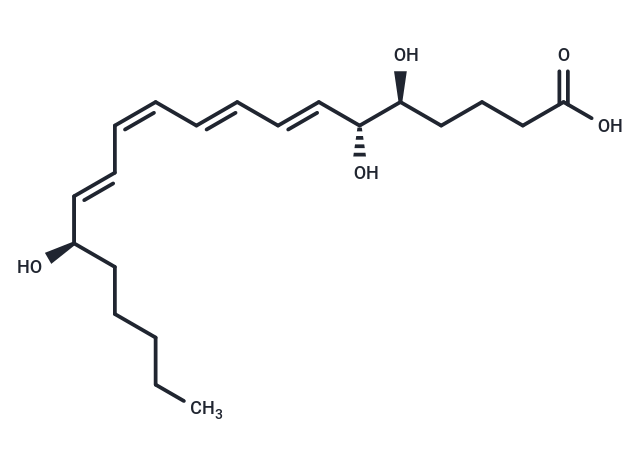
Synonyms: AT-Lipoxin A4, 15(R)-Lipoxin A4
| Pack Size | Price | USA Stock | Global Stock | Quantity |
|---|---|---|---|---|
| 25 µg | $713 | 35 days | 35 days | |
| 50 µg | $1,380 | 35 days | 35 days | |
| 100 µg | $2,580 | 35 days | 35 days | |
| 250 µg | $5,680 | 35 days | 35 days |
| Description | Lipid-derived lipoxins are produced at the site of vascular and mucosal inflammation where they down-regulate polymorphonuclear leukocyte recruitment and function. 15(R)-Lipoxin A4 (15(R)-LXA4) is derived from the aspirin-triggered formation of 15(R)-HETE from arachidonic acid. [1] [2] 15(R)-LXA4 inhibits LTB4-induced chemotaxis, adherence, and transmigration of neutrophils with twice the potency of LXA4 demonstrating activity in the nM range.[2] [3] The anti-inflammatory effects of aspirin may be ascribed in part to the ability of 15(R)-LXA4 to regulate leukocyte function.[4] 15(R)-LXA4 is reported to promote resolution of inflammation in LPS-treated stromal cells derived from intermediate-stage diseased supraspinatus tendons as evidenced by increased expression of the STAT-6 pathway target genes, ALOX15 and CD206.[5] |
| Synonyms | AT-Lipoxin A4, 15(R)-Lipoxin A4 |
| Molecular Weight | 352.47 |
| Formula | C20H32O5 |
| Cas No. | 171030-11-8 |
| Smiles | [C@H]([C@H](CCCC(O)=O)O)(/C=C/C=C/C=C\C=C\[C@@H](CCCCC)O)O |
| Storage | Powder: -20°C for 3 years | In solvent: -80°C for 1 year Shipping with blue ice/Shipping at ambient temperature. | ||||||||||||||||||||||||||||||||||||||||
| Solubility Information | DMF: 50 mg/mL (141.86 mM), Sonication is recommended. Ethanol: 50 mg/mL (141.86 mM), Sonication is recommended. PBS (pH 7.2): 1 mg/mL (2.84 mM), Sonication is recommended. | ||||||||||||||||||||||||||||||||||||||||
Solution Preparation Table | |||||||||||||||||||||||||||||||||||||||||
PBS (pH 7.2)/DMF/Ethanol
DMF/Ethanol
Note : The dilution table applies only to solid products. For liquid products, please calculate the stock solution based on the stated concentration and/or density. | |||||||||||||||||||||||||||||||||||||||||
 For example, if the intended dosage is 10 mg/kg for animals weighing 20 g , with a dosing volume of 100 μL per animal, and a total of 10 animals are to be administered, using a formulation of
  10% DMSO+ 40% PEG300+ 5% Tween 80+ 45% Saline/PBS/ddH2O , the resulting working solution concentration would be 2 mg/mL.
Dissolve 2 mg of the compound in 100 μL DMSO to obtain a stock solution at a concentration of 20 mg/mL . If the required concentration exceeds the compound's known solubility, please contact us for technical support before proceeding.
1) Add 100 μL of the DMSO stock solution to 400 µL PEG300 and mix thoroughly until the solution becomes clear.
2) Add 50 µL Tween 80 and mix well until fully clarified.
3) Add 450 µL Saline,PBS or ddH2O and mix thoroughly until a homogeneous solution is obtained.
| Size | Quantity | Unit Price | Amount | Operation |
|---|
 Feedback
 Hello! How can I help you today?
Copyright © 2015-2026 TargetMol Chemicals Inc. All Rights Reserved.
